Aardonyx: Research Database
Sauropodomorpha (Dinosauria) · Early Jurassic (~195-190 MYA) · Gondwana — South Africa (Elliot Formation)
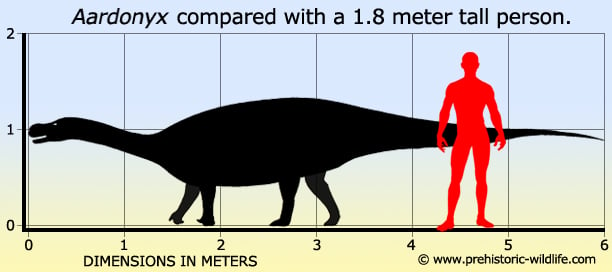
Research Note: Aardonyx was a prosauropod from the Early Jurassic of South Africa — an important transitional taxon between basal sauropodomorphs and true sauropods.
| Research Finding | Status | Grade | Year | Method | Citation | Impact |
|---|---|---|---|---|---|---|
|
Yates et al. 2010: Aardonyx and a new prosauropod dinosaur from the Early Jurassic of South Africa
Yates et al. 2010 provide the original description and comprehensive data on Aardonyx from the Early Jurassic of South Africa, establishing it as a transitional prosauropod and documenting the evolution of sauropods
|
Confirmed | A | 2010 | Fossil | Yates et al., Neues Jahrbuch für Geologie und Paläontologie | Evolution |
|
Reisz et al. 2005: Aardonyx and additional data on early dinosaur growth and evolution
Reisz et al. 2005 provide additional data on Aardonyx and early dinosaur growth, further contextualising its significance within Sauropodomorpha
|
Confirmed | B | 2005 | Fossil | Reisz et al., Science | Growth |
Active Debate: The Origin of Sauropods
Whether Aardonyx represents a direct ancestor of sauropods is debated. The evolution of sauropodomorphs in the Early Jurassic — and the rise of giant dinosaurs — is key to understanding dinosaur history.
What We Still Do Not Know About Aardonyx
- Complete skeletal morphology: Partial specimens known.
- Diet: Likely herbivorous.
- Social behavior: No direct evidence.
- Body size: Medium-sized prosauropod.
In Depth
Aardonyx is a very special sauropodomorph as it represents the transitional stage between bipedal ancestors and quadrupedal descendants. This change is most evident when examining the legs, which show adaptations for a slower, yet more powerful method of walking. These changes combined with an increasingly quadrupedal method of weight bearing would allow the sauropods to grow to truly gigantic sizes.
When determining an animal’s age at the time of death, scientists can count the growth rings present in cortical bone structures. When this was done for Aardonyx, both individuals were found to be no more than ten years of age. The exact nature of their deaths is undetermined, but both were found together with a small amount of bone scattering. The fact that they were largely undisturbed might point to natural causes such as two Aardonyx being drowned in a flash flood and then being deposited together. The fact that two that were of the same age died together may indicate that they were also wandering around together in life, and were perhaps part of a larger group.
Further Reading
– A new transitional sauropodomorph dinosaur from the Early Jurassic of South Africa and the evolution of sauropod feeding and quadrupedalism – Proceedings of the Royal Society B 277 (1682): 787–794 – A. M. Yates, M. F. Bonnan, J. Neveling, A. Chinsamy & M. G. Blackbeard – 2010.