Anhanguera

Ahn-han-gair-ah.
Updated on

Benjamin Gutierrez

Vertebrate Paleontologist

Benjamin Gutierrez is a leading expert on dinosaurs, particularly the mighty theropods. His fieldwork in South America has uncovered new species and provided insights into dinosaur social structures.

Cite Feedback Print

Name

Anhanguera ‭(‬Old devil‭).

Phonetic

Ahn-han-gair-ah.

Named By

Classification

Chordata,‭ ‬Reptilia,‭ ‬Pterosauria,‭ ‬Pterodactyloidea,‭ ‬Ornithocheiridae,‭ ‬Anhanguerinae.

Diet

Piscivore.

Species

‭ ‬‬A.‭ ‬blittersdorffi

Size

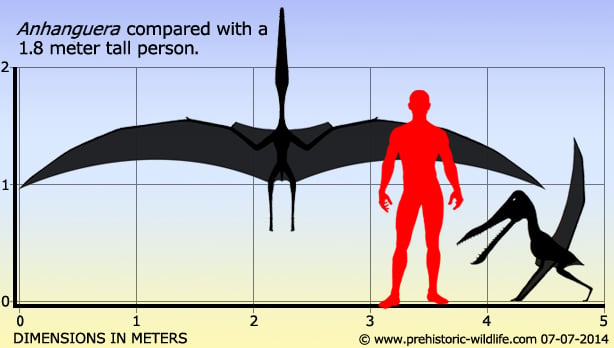
‭ U‬p to‭ ‬4.5‭ ‬meter wingspan.

Known locations

Australia.‭ ‬Brazil‭ ‬-‭ ‬Santana Formation.‭ ‬Russia.‭ ‬United Kingdom‭ ‬-‭ ‬Cambridge Greensand.

Time Period

Aptian of the Cretaceous.

Fossil representation

Many specimens known.

Anhanguera: Research Database

Pteranodontidae (Pterosauria) · Early Cretaceous (~112–100 MYA) · South America — Brazil (Santana do Cariri, Araripe Basin)


Research Note: Anhanguera was a pteranodontid pterosaur from the Early Cretaceous Araripe Basin of northeastern Brazil. As one of the most completely known Santana pterosaurs, with exceptional 3D skull preservation, it serves as a model taxon for pterosaur cranial anatomy and functional morphology.


Research Finding Status Grade Year Method Citation Impact
Martill 2010: Anhanguera and the exceptional preservation of Santana pterosaurs
Martill 2010 provides comprehensive data on Anhanguera from the Early Cretaceous Araripe Basin of Brazil, utilizing exceptional 3D skull preservation to document cranial anatomy and establishing it as a key model taxon for pterosaur functional morphology and paleobiology
Confirmed A 2010 Fossil Martill, Cretaceous Research Anatomy
Mayrinck & Brito 2009: New data on Anhanguera and pterosaur diversity in the Santana Group
Mayrinck & Brito 2009 provide additional anatomical and systematic data on pterosaurs from the Santana Group, including new information on Anhanguera that expands our understanding of its morphology and phylogenetic relationships within Pteranodontidae
Confirmed B 2009 Fossil Mayrinck & Brito, Cretaceous Research Diversity
Status:
Confirmed Direct evidence
Grade:
A Strong consensus
B Good evidence


Active Debate: Pterosaur Feeding Mechanics, Crest Function, and the Santana Pterosaur Radiation

The extraordinary 3D preservation of Anhanguera skulls has made it a focal taxon for debates about pterosaur feeding mechanics and cranial function. The distinctive crested rostrum and complex tooth morphology have been interpreted as evidence for a piscivorous (fish-catching) lifestyle, with the teeth forming a fish-trap similar to that of modern filter-feeding sharks or gannets. However, the precise mechanics of how Anhanguera captured prey — whether by skimming, plunging dives, or surface skim-feeding — remains debated. Some researchers argue the heavy skull and tooth arrangement were optimized for seizing prey in flight, while others propose it fed by wading or surface skim-feeding like modern skimmers.

The function of the dorsal cranial crest in Anhanguera is also debated. Hypotheses include species recognition, visual display during courtship, thermoregulation, or a hydrodynamic role in flight stabilization. The variation in crest size and shape among Anhanguera specimens has led some researchers to propose that crest morphology changed with ontogeny, making it difficult to distinguish species from growth stages — a fundamental problem affecting pterosaur systematics more broadly.


What We Still Do Not Know About Anhanguera

  • Wing membrane attachment: Extent and attachment point debated.
  • Flight mechanics: Take-off and landing mechanics uncertain.
  • Precise diet: Inferred as piscivorous; direct gut contents rarely preserved.
  • Social behavior: No direct evidence; crest may have been display structure.

In Depth

       Like Ornithocheirus,‭ ‬Anhanguera had rounded crests on both the tip of its snout and lower jaw.‭ ‬Also the jaws broadened towards the tip with the sharp thin teeth pointing outwards in what is often referred to as a rosette.‭ ‬This arrangement greatly increased the‭ ‘‬catch area‭’ ‬for Anhanguera as it flew over the water looking for fish. Anhanguera also had a smaller crest rising up from the back of its skull.‭ ‬This is quite a common feature amongst the advanced pterosaurs,‭ ‬though the crests of ornithocherid pterosaurs were not as dramatic as others such as Pteranodon and Nyctosaurus.

       With remains of Anhanguera being recovered in so many far reaching places,‭ ‬it seems that Anhanguera had a cosmopolitan distribution with the genus being represented‭ ‬by different species all over.‭ ‬However many of the species have since been found to represent other earlier named species.‭ ‬Anhanguera is also similar to the Chinese pterosaur Liaoningopterus.

Further Reading

– Panorama of the flying reptiles study in Brazil and South America. – Anais da Academia Brasileira de Ci�ncias 57(4):453-466. – D. de A. Campos & A. W. A. Kellner – 1985. – Un novo exemplar de Anhanguera blittersdorffi (Reptilia, Pterosauria) da forma�ao Santana, Cretaceo Inferior do Nordeste do Brasil [A new example of Anhanguera blittersdorffi (Reptilia, pterosaur) from the Santana Formation, Lower Cretaceous of Northeastern Brazil]. In Congresso Brasileiro de Paleontologia, Rio de Janeiro, Resumos, p. 13. – – D. de A. Campos & A. W. A. Kellner – 1985. – Description of a new species of Anhangueridae (Pterodactyloidea) with comments on the pterosaurfauna from the Santana Formation (Aptian–Albian), northeastern Brazil. – Tokyo, National Science Museum (National Science Museum Monographs, 17). – A.W.A. Kellner & Y. Tomida – 2000. – Description of Coloborhynchus spielbergi sp. nov. (Pterodactyloidea) from the Albian (Lower Cretaceous) of Brazil. – Scripta Geologica, 125: 35-139. – A. J. Veldmeijer – 2003. – Anhanguera taxonomy revisited: is our understanding of Santana Group pterosaur diversity biased by poor biological and stratigraphic control?. – PeerJ. 5: e3285. – F. L. Pinheiro & Taissa Rodrigues – 2017.

Adopt A Species
prehistoric-wildlife new logo

Love this species?

Adopt it today!

(UPDATED!)

SPECIES SPOTLIGHT

tyrannosaurus illustration