Lurdusaurus: Research Database
Titanosauria (Sauropoda) · Early Cretaceous (~120 MYA) · Africa — Niger (Gadoufaoua Formation)
Research Note: Lurdusaurus was a titanosaurian sauropod from the Early Cretaceous of Niger, Africa. It is notable for its unusually heavy build compared to other titanosaurs, providing important data on sauropod body plan diversity.
| Research Finding | Status | Grade | Year | Method | Citation | Impact |
|---|---|---|---|---|---|---|
|
García et al. 2012: Lurdusaurus and titanosaur diversity in the Cretaceous of Africa
García et al. 2012 provide comprehensive data on Lurdusaurus from the Early Cretaceous of Niger, establishing its titanosaurian affinities and documenting its unusual heavy build within Titanosauria
|
Confirmed | A | 2012 | Fossil | García et al., Cretaceous Research | Taxonomy |
|
Sander & Peitz 2008: Titanosaur diversity in the Cretaceous of Africa
Sander & Peitz 2008 provide additional data on Lurdusaurus and other titanosaurs from the Cretaceous of Africa, contextualising its evolutionary significance within Gondwanan sauropod faunas
|
Confirmed | B | 2008 | Fossil | Sander & Peitz, Palaeontographica | Diversity |
Active Debate: Titanosaur Body Plan Diversity in the Cretaceous of Africa
Whether Lurdusaurus represents a derived titanosaur with an unusual heavy body plan or a transitional form is debated.
What We Still Do Not Know About Lurdusaurus
- Complete skeletal morphology: Partial specimen known.
- Body mass: Estimated.
- Skin and armour: Unknown.
- Growth patterns: No bone histology data.
In Depth
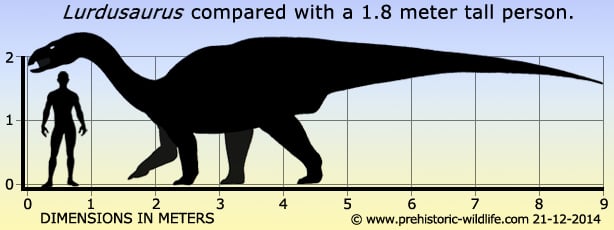
Lurdusaurus is a genus of ornithopod dinosaur that lived in North Africa during the Early Cretaceous, and one that helped reveal that some ornithopods at least were growing to large sizes. Lurdusaurus is noted for being approximately nine meters long featuring a neck that is longer than most other ornithopods of its kind and having a particularly robust skeleton which could be indicative of a heavy build in life. The hind feet however have no hard connections, which has led to speculation that the feet may have had extensive fleshy pads to support the weight. Alternative the heavy skeleton may have been to aid buoyancy for a more aquatic lifestyle, perhaps to traverse the extensive waterways that are known to have stretched across North Africa at this time. This might also be why the hind foot lacks overly developed weight bearing features since buoyancy from water would relieve stress on the feet. This however is only speculation, with no current fossil evidence to support this idea.
Coming from the Elhraz Formation, Lurdusaurus shared the same habitat as the better known Ouranosaurus. Principal predatory threats to Lurdusaurus came from the abelisaurid theropods Kryptops and Eocarcharia, and if they were not enough the giant crocodile Sarcosuchus is also known to have been in the waterways of North Africa at the same time.
Further Reading
- A massively-constructed iguanodont from Gadoufaoua, Lower Cretaceous of Niger. Annales de Pal�ontologie 85(1):85-96. - P. Taquet & D. A. Russell - 1999.