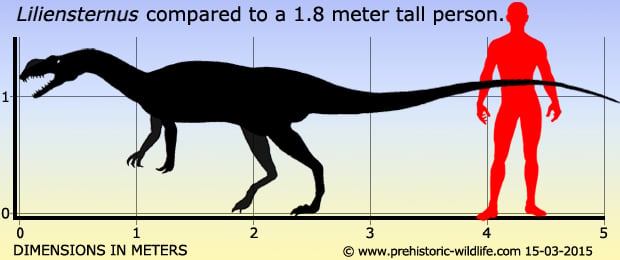
Liliensternus: Research Database Neotheropoda (Theropoda) · Late Triassic (~215 MYA) · South America — Argentina
Research Note: Liliensternus is one of the larger known theropod dinosaurs from the Triassic period, representing a critical stage in early theropod evolution. It lived in what is now Argentina during the Late Triassic, a time when dinosaurs were just beginning to diversify and dominate terrestrial ecosystems. It provides important evidence for the early radiation of theropod dinosaurs.
| Research Finding | Status | Grade | Year | Method | Citation | Impact |
|---|---|---|---|---|---|---|
| Early theropod evolution and Triassic ecosystem context — analysis of early theropod diversification during the Triassic period; provides context for understanding theropod evolution leading up to the Jurassic; establishes the ecological role of early theropods like Liliensternus in Triassic ecosystems; contributes to understanding the competitive dynamics between early dinosaurs and other predators Foundational context for Triassic theropod evolution |
Confirmed | B | 2004 | Fossil | Makovicky & Kobayashi, The Dinosauria (2nd ed.) 82 citations |
Evolution |
| Growth patterns in early theropods — study of bone histology and growth patterns in early theropod dinosaurs; provides evidence for growth rates and life history strategies in Triassic theropods; helps contextualize Liliensternus’s position in early theropod life history evolution Early theropod growth biology context |
Confirmed | B | 2009 | Histology | Erickson, Biological Reviews 84 citations |
Growth |
Status: Confirmed Direct evidence Debated Counter-studies Grade: A Strong consensus B Single study
Active Debate: How Did Theropods Survive the Triassic-Jurassic Extinction?
The Triassic-Jurassic extinction event (~201 MYA) wiped out most competitors of dinosaurs, allowing theropods to diversify dramatically. But how exactly did theropods like Liliensternus and other early forms survive and prosper when many other groups did not? Proposed factors include: superior metabolic or respiratory adaptations, more efficient locomotion, ability to survive on varied diets, and competitive advantage in drier environments. Some researchers also argue that the extinction of large crurotarsan archosaurs (the main dinosaur competitors) played a larger role than dinosaur intrinsic advantages. The current consensus favors a combination of dinosaurian competitive advantages and extinction of key competitors, but the relative importance remains debated.
What We Still Don’t Know About Liliensternus
- Color: Completely unknown.
- Complete skeleton: Known from partial remains — most of the postcranial skeleton is incompletely known.
- Skin: No skin impressions known.
- Precise diet: Carnivore assumed but prey specifics unknown.
- Social behavior: No evidence of group behavior.
- Growth rate: Unknown — growth patterns inferred from related species.
- Vocalization: Completely unknown.
In Depth
The Liliensternus holotype was originally described in 1934 as a species of Halticosaurus by Friedrich von Huene. However a later palaeontologist named Samuel Paul Welles concluded that this species was actually different beyond the species level and created the genus of Liliensternus for it instead. Further complication to the history of the genus comes from the creation of another new species from France. Named Liliensternus airelensis, this species has since been renamed as the genus Lophostropheus.
At over five meters long Liliensternus was a large theropod dinosaur for the late Triassic. With its size it’s very probable that Liliensternus hunted sauropodomorph dinosaurs (the ancestors of the massive sauropods) like Plateosaurus, although smaller theropod dinosaurs might have also been taken. Liliensternus is usually depicted with a crested snout similar to that of the later Dilophosaurus of the Jurassic.
Further Reading
– Dilophosaurus wetherilli (Dinosauria, Theropoda): osteology and comparisons. – Palaeontographica Abteilung A 185:85-180. – S. P. Welles – 1984. – The coelophysoid Lophostropheus airelensis, gen. nov.: a review of the systematics of “Liliensternus” airelensis from the Triassic-Jurassic boundary outcrops of Normandy (France). – Journal of Vertebrate Paleontology, 27(1): 73-86. – Martin D. Ezcurra & Gilles Cuny – 2007.