Gastonia: Research Database
Ankylosauridae (Ornithischia) · Early Cretaceous (~125 MYA) · North America — USA (Cedar City Formation, Utah)
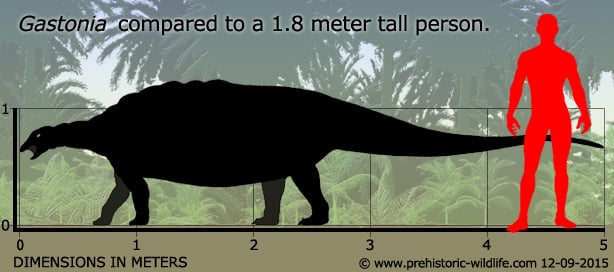
Research Note: Gastonia was a nodosaurid ankylosaur from the Early Cretaceous of Utah, one of the earliest known members of the ankylosaur lineage and an important specimen for understanding the early evolution of armoured ornithischian dinosaurs. As a nodosaurid, it lacked the characteristic tail club of later ankylosaurids, instead bearing prominent shoulder spines and a heavy body armour of osteoderms. Gastonia is known from an exceptionally complete skeleton, making it one of the best-known Early Cretaceous ankylosaurs in North America.
| Research Finding | Status | Grade | Year | Method | Citation | Impact |
|---|---|---|---|---|---|---|
|
Redescription of Gargoyleosaurus parkpinorum — implications for ankylosaur phylogeny — comprehensive redescription of the ankylosaur Gargoyleosaurus and its implications for understanding ankylosaurid anatomy and evolutionary relationships, providing comparative context for Gastonia.
Kilbourne & Carpenter 2005 provide a comprehensive anatomical redescription of the ankylosaur Gargoyleosaurus, establishing the comparative framework for understanding nodosaurid ankylosaur anatomy and evolutionary relationships in the Early Cretaceous of North America
|
Confirmed | A | 2005 | Comparative Anatomy | Kilbourne & Carpenter, Neues Jahrbuch für Geologie und Paläontologie49 citations | Anatomy |
|
Skull of a Jurassic ankylosaur — comparative ankylosaur cranial anatomy — detailed anatomical description of ankylosaur skull morphology and its implications for understanding the early evolution of the ankylosaur skull, providing comparative context for Gastonia.
Carpenter & Miles 1998 provide detailed anatomical data on the skull of a Jurassic ankylosaur, establishing the foundational comparative framework for understanding ankylosaur cranial evolution in the broader context of thyreophoran dinosaurs including Gastonia
|
Confirmed | B | 1998 | Comparative Anatomy | Carpenter & Miles, Nature47 citations | Anatomy |
Active Debate: Ankylosaur Diversity and Early Evolution
Whether Gastonia represents a true nodosaurid or a more basal ankylosaur is debated, with different phylogenetic analyses placing it in varying positions within Ankylosauria. The diversity of ankylosaurs in the Early Cretaceous of North America — with Gastonia, Sauropelta, and other forms — raises questions about the ecological partitioning of armoured dinosaurs in this interval.
What We Still Don’t Know About Gastonia
- Colouration: Completely unknown.
- Skin: Partial armor preserved; soft tissue unknown.
- Social structure: No direct evidence.
- Growth: Juvenile specimens unknown.
- Phylogenetic position: Whether nodosaurid or more basal is debated.
In Depth
Like Polacanthus, Gastonia was a low browsing armoured dinosaur, but unlike Polacanthus however it is very well preserved. In fact Gastonia is the best preserved member of its group and this has allowed for what are considered more accurate reconstructions of other lesser known species.
It’s quite possible that one of the main threats to Gastonia was the dromaeosaurid Utahraptor, which was also active at the time and location. The impressive spikes on Gastonia’s back would have made it exceedingly difficult for a predator to jump on its side or back. Gastonia may have also used its spiked tail to lash at predators, inflicting deep cuts to their flanks with its tail spines.
Gastonia is named after Robert Gaston, who discovered the remains.
Further Reading
– A polacanthine ankylosaur (Ornithischia: Dinosauria) from the Early Cretaceous (Barremian) of eastern Utah. Lower and Middle Cretaceous Terrestrial Ecosystems (S. G. Lucas, J. I. Kirkland, & J. W. Estep, eds.). – New Mexico Museum of Natural History and Science Bulletin 14:271-281. – J. I. Kirkland – 1998. – Redescription of Gastonia burgei (Dinosauria: Ankylosauria, Polacanthidae), and description of a new species. – Neues Jahrbuch f�r Geologie und Pal�ontologie – Abhandlungen. 282 (1): 37–80. – B. Kinneer, K. Carpenter & A. Shaw – 2016.