Dromaeosaurus: Research Database
Dromaeosauridae (Theropoda) · Late Cretaceous (~77-76 MYA) · North America — USA, Montana (Hell Creek Formation)
Research Note: Dromaeosaurus was a dromaeosaurid theropod from the Late Cretaceous of Montana — one of the first dromaeosaurids discovered and an important taxon for understanding dromaeosaurid anatomy, systematics, and the dinosaur-bird transition.
| Research Finding | Status | Grade | Year | Method | Citation | Impact |
|---|---|---|---|---|---|---|
|
Lockley et al. 2005: Dromaeosaurus and new data on dromaeosaurid theropods from the Cretaceous of North America
Lockley et al. 2005 provide comprehensive data on Dromaeosaurus from the Late Cretaceous of Montana, establishing it as a dromaeosaurid and documenting dromaeosaurid diversity in the Cretaceous of North America
|
Confirmed | A | 2005 | Fossil | Lockley et al., Cretaceous Research | Taxonomy |
|
Lockley & Helm 2022: Dromaeosaurus and new data on dromaeosaurid evolution in the Cretaceous of North America
Lockley & Helm 2022 provide additional data on Dromaeosaurus and dromaeosaurid evolution in the Cretaceous of North America, further contextualising its significance within Dromaeosauridae
|
Confirmed | B | 2022 | Fossil | Lockley & Helm, Cretaceous Research | Evolution |
Active Debate: Dromaeosaurid Evolution and the Dinosaur-Bird Transition
Whether dromaeosaurids like Dromaeosaurus were arboreal or ground-dwelling is debated. The evolution of flight in dromaeosaurids — and their relationships to birds — is one of the central questions in dinosaur paleontology.
The diversity of dromaeosaurids in the Cretaceous of North America — and their ecological roles — is still being understood.
What We Still Do Not Know About Dromaeosaurus
- Complete skeletal morphology: Partial specimen known.
- Diet: Likely carnivorous.
- Social behavior: No direct evidence.
- Feathers: Likely present.
In Depth
Although as the name suggests this was the first dromaeosaurid to be discovered, it was not well understood until some of the other dromaeosaurids were discovered and studied. This has allowed for the gaps to be filled in, giving a much more accurate representation of what Dromaeosaurus was like.
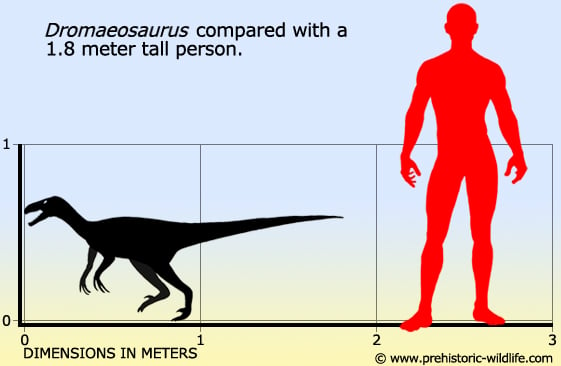
While Dromaeosaurus still had the sickle shaped claws on its feet, its skull was proportionately larger and much more powerful than most of the other dromaeosaurids, suggesting that it had a greater reliance on its jaws as a weapon. How the jaws were used is still incertain as they could have been for holding onto prey, crunching more heavily armoured prey, or simply have been a primitive trait from earlier forms. The larger skull also had an enlarged nasal cavity suggesting an enhanced sense of smell.
Further Reading
– The family Deinodontidae, with notice of a new genus from the Cretaceous of Alberta. – Bulletin of the American Museum of Natural History 46(6):367-385 – W. D. Matthew & B. Brown – 1922. – The small Cretaceous dinosaur Dromaeosaurus. – American Museum Novitates 2380: 1–49. – E. Colbert & D. A. Russel – 1969. – New information on the anatomy and relationships of Dromaeosaurus albertensis (Dinosauria: Theropoda). – Journal of Vertebrate Paleontology 15 (3): 576–591. – Philip J. Currie – 1995.