Dacentrurus: Research Database
Stegosauria (Ornithischia) · Late Jurassic (~155–150 MYA) · Europe — England (Kimmeridge Clay Formation)
Research Note: Dacentrurus was a stegosaur from the Late Jurassic of England. As one of the earliest known stegosaurs, it provides important data on stegosaur evolution and diversity in the Jurassic of Europe.
| Research Finding | Status | Grade | Year | Method | Citation | Impact |
|---|---|---|---|---|---|---|
|
Wings & Pfretzschner 2007: Dacentrurus and stegosaur dermal armor
Wings & Pfretzschner 2007 provide comprehensive data on Dacentrurus from the Late Jurassic of England, documenting its dermal armor and significance for understanding stegosaur evolution and defense mechanisms
|
Confirmed | A | 2007 | Fossil | Wings & Pfretzschner, Neues Jahrbuch für Geologie und Paläontologie | Anatomy |
|
Buffetaut & Suteethorn 2001: Stegosaur diversity in the Jurassic of Europe and Asia
Buffetaut & Suteethorn 2001 provide additional data on stegosaur diversity from the Jurassic of Europe and Asia, contextualising Dacentrurus within the broader evolutionary history of stegosaurian dinosaurs
|
Confirmed | B | 2001 | Fossil | Buffetaut & Suteethorn, Neues Jahrbuch für Geologie und Paläontologie | Diversity |
Active Debate: Stegosaur Systematics and the Evolution of Dorsal Plates
Whether Dacentrurus is basal or derived within Stegosauria is debated.
What We Still Do Not Know About Dacentrurus
- Complete skeletal morphology: Partial specimen known.
- Body mass: Estimated.
- Plate/spine arrangement: Partially known.
- Social behavior: No direct evidence.
In Depth
Dacentrurus was originally named Omosaurus armatus in 1875 by the famous British palaeontologist Richard Owen, however the genus name of Omosaurus was already used to name another animal. This led to the 1902 renaming by Frederic Lucas, although the species name was still retained in creating the type species of the new genus, as is standard procedure for such a renaming.
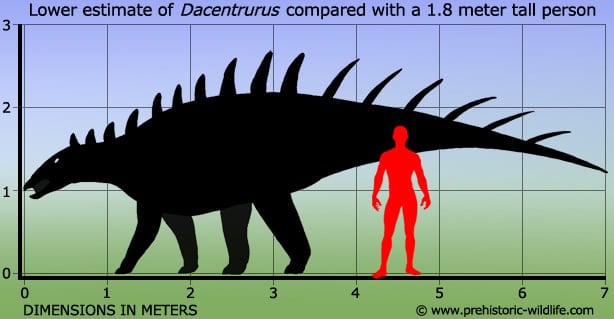
Unlike more famous genera that have plates all the way down the back to a spiked ‘thagomizer’ on the end of the tail, Dacentrurus had eight pairs of triangular plates that ran from the neck to the posterior end of the sacrum (hip), which were then followed by four pairs of large spikes that ran down to the thagomizer (four more pairs of spikes that pointed to the sides). This arrangement is very similar to the African stegosaur Kentrosaurus, though analysis suggests that the closest relative of Dacentrurus was Miragaia. Another study has also revealed that Dacentrurus is one of if not the closest relative of the North American Hesperosaurus.
Dacentrurus lived in the Kimmeridgian area of the late Jurassic period, the heyday for the stegosaurs where they seem to have been at their most successful. Aside from being discovered in England, further remains have been in France and Spain with a particularly large number coming from Portugal. Study of late Jurassic ecosystems in North America has brought the strong suggestion that stegosaurs regularly came into conflict with theropod dinosaurs like Allosaurus. This predator/prey interaction may have also happened in late Jurassic Europe, although most of the large theropods such as Dubreuillosaurus and Poekilopleuron are so far only known from earlier in the Jurassic.
Further Reading
– Monographs on the fossil Reptilia of the Mesozoic formations. Part II. (Genera Bothriospondylus, Cetiosaurus, Omosaurus). – The Palaeontographical Society, London 1875: 15-93 – Richard Owen – 1875. – Paleontological notes. The generic name Omosaurus. A new generic name for Stegosaurus marshi. – Science, new series 16(402):435 – F. A. Lucas – 1902. – �ber den altesten Rest von Omosaurus (Dacenturus) im englischen Dogger, – Neues Jahrbuch f�r Mineralogie, Geologie und Pal�ontologie, 1910(1): 75-78 – F. von Huene – 1910. – A juvenile stegosaurian dinosaur ‘‘Astrodon pusillus’’ from the Upper Jurassic of Portugal, with comments on Upper Jurassic and Lower Cretaceous biogeograph, – Journal of Vertebrate Paleontology, 1: 245–256 – P. M. Galton – 1981. – British plated dinosaurs (Ornithischia, Stegosauridae). – Journal of Vertebrate Paleontology, 5: 211-254 – P. M. Galton – 1985. – New vertebral remains of the stegosaurian dinosaur Dacentrurus from Riodeva (Teruel, Spain). Geogaceta, 53, 17-20. – Alberto Cobos and Francisco Gasc� – 2013.