Tianchisaurus

In Depth        Tianchisaurus was originally dubbed‭ (‬but never officially named‭) ‬Jurassosaurus because in the same year that it was named,‭ ‬the very first Jurassic park film was released.‭ ‬Incidentally,‭ ‬the name Jurassosaurus was suggested by Steven Spielberg who produced and directed the film.‭ ‬Dong rejected the name Jurassosaurus in favour of Tianchisaurus,‭ ‬but kept the … Read more

Qantassaurus

In Depth        Like so many other Australian dinosaurs Qantassaurus is known only from frustratingly incomplete remains.‭ ‬At the time of writing the only parts of this dinosaur that are known are partial jaws,‭ ‬but they are still distinct enough to recognise as a new type of dinosaur.‭ ‬Qantassaurus has been classified as a hypsilophodontid dinosaur,‭ … Read more

Mandschurosaurus

In Depth        Mandschurosaurus is registered as a genus of hadrosaur that lived in what is now China during the late Cretaceous.‭ ‬Unfortunately the first individual ever found for this genus is so poorly preserved that most palaeontologists today regard the genus as a nomen dubium due to the difficulty of assigning further remains to the … Read more

Kritosaurus

In Depth        Kritosaurus was first described in‭ ‬1910‭ ‬upon a description of a partial skull that was not only incomplete but partially eroded.‭ ‬To fill in the gaps,‭ ‬Brown used a second skull that would later be referred to Anatotitan to complete the reconstruction.‭ ‬Not all the fragments were used,‭ ‬and the final reconstruction was … Read more

Matheronodon

In Depth        Although only described from a single upper jaw bone,‭ ‬Matheronodon is noteworthy among ornithopod dinosaurs for having teeth that are larger,‭ ‬but fewer in‭ ‬number to most other known ornithopods.‭ ‬The describers speculated that Matheronodon used a scissoring action to eat plants. Further Reading -‭ ‬Extreme tooth enlargement in a new Late Cretaceous … Read more

Lexovisaurus

In Depth        Like with many dinosaurs named from English fossils in the nineteenth century,‭ ‬Lexovisaurus has a complex taxonomic history,‭ ‬but it can be broken down like this.‭ ‬Current fossils of Lexovisaurus were originally described in‭ ‬1887as Omosaurus a genus that had different species.‭ ‬However it was later realised that the name Omosaurus was preoccupied,‭ … Read more

Spinops

In Depth        The holotype specimen of Spinops was first discovered in‭ ‬1916‭ ‬by Charles H.‭ ‬and Levi Sternberg.‭ ‬However when the material was sent to the London Natural History Museum‭ (‬the institution that financed the dig‭) ‬the keeper of Geology,‭ ‬one Arthur Smith Woodward‭ (‬today best remembered for declaring the‭ ‘‬Piltdown Man‭’ ‬as a genuine … Read more

Breviceratops

In Depth        Originally named as a species of Protoceratops,‭ ‬P.‭ ‬kozlowskii,‭ ‬Breviceratops was established as a distinct genus of ceratopsian dinosaur in‭ ‬1990.‭ ‬There has been much speculation that Breviceratops may actually be synonymous with the genus Bagaceratops,‭ ‬though some researchers have pointed out notable differences between the holotype of Breviceratops and the known specimens … Read more

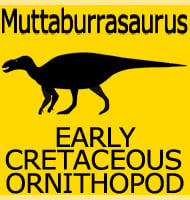
Muttaburrasaurus

muttaburrasaurus

In Depth        Muttaburrasaurus is one of the best known dinosaurs to come from Australia,‭ ‬though it was the inclusion of Muttaburrasaurus in an episode of the TV series Walking with Dinosaurs that brought it to‭ ‬the attention of a worldwide audience.‭ ‬Muttaburrasaurus is named after the town Muttaburra situated in Queensland,‭ ‬Australia where the holotype … Read more

Owenodon

In Depth        Back in‭ ‬1860‭ ‬a partial lower jaw of a dinosaur was collected by A.‭ ‬J.‭ ‬Hogg,‭ ‬which later in‭ ‬1874‭ ‬was named as a species of Iguanodon,‭ ‬I.‭ ‬hoggi by Richard Owen.‭ ‬More than a hundred years later the jaw was thought to represent a European specimen of Camptosaurus,‭ ‬but later still in‭ … Read more