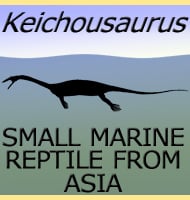
Keichousaurus

keichousaurus

In Depth        Keichousaurus looks like a miniature plesiosaur,‭ ‬and indeed many have looked into the possibility that it may either be a direct ancestor,‭ ‬or representative of an ancestral form that led to the evolution of the giant plesiosaurs.        As well as resembling the later plesiosaurs,‭ ‬Keichousaurus may have moved like them too,‭ ‬using their … Read more

Lonchodectes

In Depth        The problem with Lonchodectes is that the genus continues to be treated somewhat like a wastebasket with the most fragmentary remains being attributed to it, which explains the broad temporal range of Lonchodectes in the fossil record. The reason for this is mostly down to is taxonomic history with the first sets of … Read more

Ianthodon

In Depth        Ianthodon is a genus of pelycosaur that lived in North America during the Carboniferous.‭ ‬Care should be taken not to confuse Ianthodon with the similarly named Ianthasaurus. Further Reading -‭ ‬Synapsid fauna of the Upper Pennsylvanian Rock Lake Shale near Garnett,‭ ‬Kansas and the diversity pattern of early amniotes.‭ ‬Recent Advances in the … Read more

Andalgalornis

In Depth        Andalgalornis has a more gracile build than many other South American‭ ‘‬terror birds‭’‬ and this lightweight build is also reflected in the skull and beak.‭ ‬In depth analysis suggests that the beak was strongest when subjected to stresses from below rather than the sides.‭ ‬This meant that gripping and holding large prey was … Read more

Hyrachyus

In Depth        The type genus of the Hyrachyidae,‭ ‬Hyrachyus usually considered to be an ancient relative of the tapirs.‭ ‬Hyrachyus would have been an average sized herbivore for its time,‭ ‬and may have been hunted by other types of mammals such as mesonychids. Further Reading -‭ ‬Oldest West Indian Land Mammal:‭ ‬Rhinocerotoid Ungulate from the … Read more

Aletopelta

In Depth        Once considered a possible nodosaurid,‭ ‬Aletopelta was confirmed as an ankylosaurid when it was formally described in‭ ‬2001.‭ ‬This interpretation came about mainly from study of the osteoderm armour which is more like the armour of known ankylosaurs and less like that of nodosaurs.‭ ‬By extension Aletopelta would be assumed to have had … Read more

Alnashetri

In Depth        Although only named from the description of hind legs,‭ ‬Alnashetri has been identified as an alvaresauroid.‭ ‬These small theropods are noted for having short stubby arms with single‭ ‬claws pointing out,‭ ‬which may helped them to feed upon certain types of prey like insects.‭ ‬This remains unknown for certain with Alnashetri since at … Read more

Branisella

In Depth        At first glance the lack of fossils might make Branisella not seem an important primate,‭ ‬but here you need to appreciate two things‭; ‬where the fossils have been found and how old they are.‭ ‬Dating to the Chattian stage of the Oligocene period about twenty-six million years ago,‭ ‬Branisella was and at the … Read more

Fasolasuchus

In Depth        Fasolasuchus was not only one of the last but it was possibly the largest of the rauisuchians.‭ ‬Unfortunately however incomplete remains mean that only a range estimate‭ ‬of between eight and ten meters‭ ‬is possible.‭ ‬The next largest rauisuchian is Saurosuchus which is also from Argentina‭ ‬and‭ ‬is estimated at seven meters long,‭ … Read more

Astrodon

In Depth        Astrodon‭ ‬has been a troublesome genus of sauropod dinosaur,‭ ‬partly because of the lack of complete remains for the genus which was initially primarily named from the teeth.‭ ‬Astrodon also has an uncertain relationship with the genus Pleurocoelus,‭ ‬with some authors considering the two to be synonymous,‭ ‬to just some species of Pleurocoelus … Read more