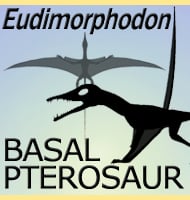
Eudimorphodon

eudimorphodon

In Depth        Eudimorphodon represents one of the earliest known pterosaurs, and already features that include a possibly vaned tail like that seen in Rhamphorhynchus can be clearly seen to be established. However the tail seems to lack stiffening tendons that can be seen in the rhamphorhynchoid group, and may have been of little use in … Read more

Regnosaurus

In Depth        The holotype fossil of a partial jaw of Regnosaurus was recovered by Gideon Mantell who considered it to belong to an unknown large prehistoric animal.‭ ‬Mantell would later name his animal Igaunodon,‭ ‬though it was still referred to as a big lizard since the word dinosaur had still not been invented.‭ ‬Mantell realised … Read more

Paludititan

In Depth        Discovered in the increasingly famous Hațeg basin of Romania,‭ ‬Paludititan was a genus of titanosaurian dinosaur that lived in Eastern Europe towards the end of the Cretaceous period.‭ ‬Paludititan is not the first titanosaur to be named from this part of the world,‭ ‬the‭ ‬dwarf titanosaur Magyarosaurus‭ ‬was named earlier and‭ ‬seems to … Read more

Rhopalodon

In Depth        There has been a lot of uncertainty as to exactly what Rhopalodon was,‭ ‬but a‭ ‬2005‭ ‬study by Tverdokhlebov et al considered the genus to represent a mid-sized dinocephalian therapsid. Further Reading -‭ ‬Upper Permian vertebrates and their sedimentological context in the South Urals,‭ ‬Russia,‭ ‬-‭ ‬Earth-Science Reviews‭ ‬69‭ ‬27-77‭ ‬55‭ ‬-‭ ‬Valentin … Read more

Nanokogia

In Depth        Nanokogia seems to have been much like modern day pygmy sperm whales of the Kogia genus.‭ ‬This is‭ ‬reflected in the genus name which basically means‭ ‘‬Small Kogia‭’‬.‭ ‬One difference however is that Nanokogia seems to have lacked teeth in the upper jaw,‭ ‬which may be a reflection of a specific prey specialisation.‭ … Read more

Paleoparadoxia

In Depth        The first description of Paleoparadoxia remains was published in‭ ‬1939‭ ‬by Tokunaga as Cornwallius tabatai.‭ ‬The genus Paleoparadoxia was not named until‭ ‬1959‭ ‬when R.‭ ‬H.‭ ‬Reinhart published a review of the Sirenia and Desmostylia.‭ ‬Paleoparadoxia was a large quadrupedal mammal that has been identified as a member of the Desmostylia‭ (‬type genus … Read more

Eotriceratops

In Depth        Named in reference to the more famous Triceratops,‭ ‬Eotriceratops was a large ceratopsian dinosaur of the late Cretaceous.‭ ‬At three meters long from the snout to the tip of the neck frill,‭ ‬the skull of Eotriceratops is also immense.‭ ‬The skull at the base of the left brow horn has bite marks which … Read more

Ischyodus

In Depth        Nine times out of ten Ischyodus in simply referred to as a prehistoric Chimaera.‭ ‬In this instance it is meant as being similar to Chimaera monstrosa,‭ ‬also known as the rat fish and the rabbit fish,‭ ‬due to its physical similarity.‭ ‬Both Ischyodus‭ ‬and Chimaera monstrosa are members of the Chondrichthyes,‭ ‬which means … Read more

Platycraniellus

In Depth        Platycraniellus is a genus of therapsid that lived in South Africa‭ ‬during the early Triassic. Further Reading -‭ ‬Redescription of Platycraniellus elegans‭ (‬Therapsida,‭ ‬Cynodontia‭) ‬from the lower Triassic of South Africa,‭ ‬and the cladistic relationships of eutheriodonts.‭ ‬-‭ ‬Palaeontology col‭ ‬50,‭ ‬issue‭ ‬3‭ ‬pp‭ ‬591-618.‭ ‬-‭ ‬Fernando Abdala‭ ‬-‭ ‬2007.

Chiayusaurus

In Depth        Chiayusaurus is a highly dubious genus of sauropod dinosaur because the type species is based upon the description of a tooth crown.‭ ‬The problem with such tooth taxons is that unless in exceptionally rare cases‭ (‬like with Troodon‭)‬,‭ ‬it is next to impossible to assign further remains.‭ ‬Even a second species named C.‭ … Read more