In Depth
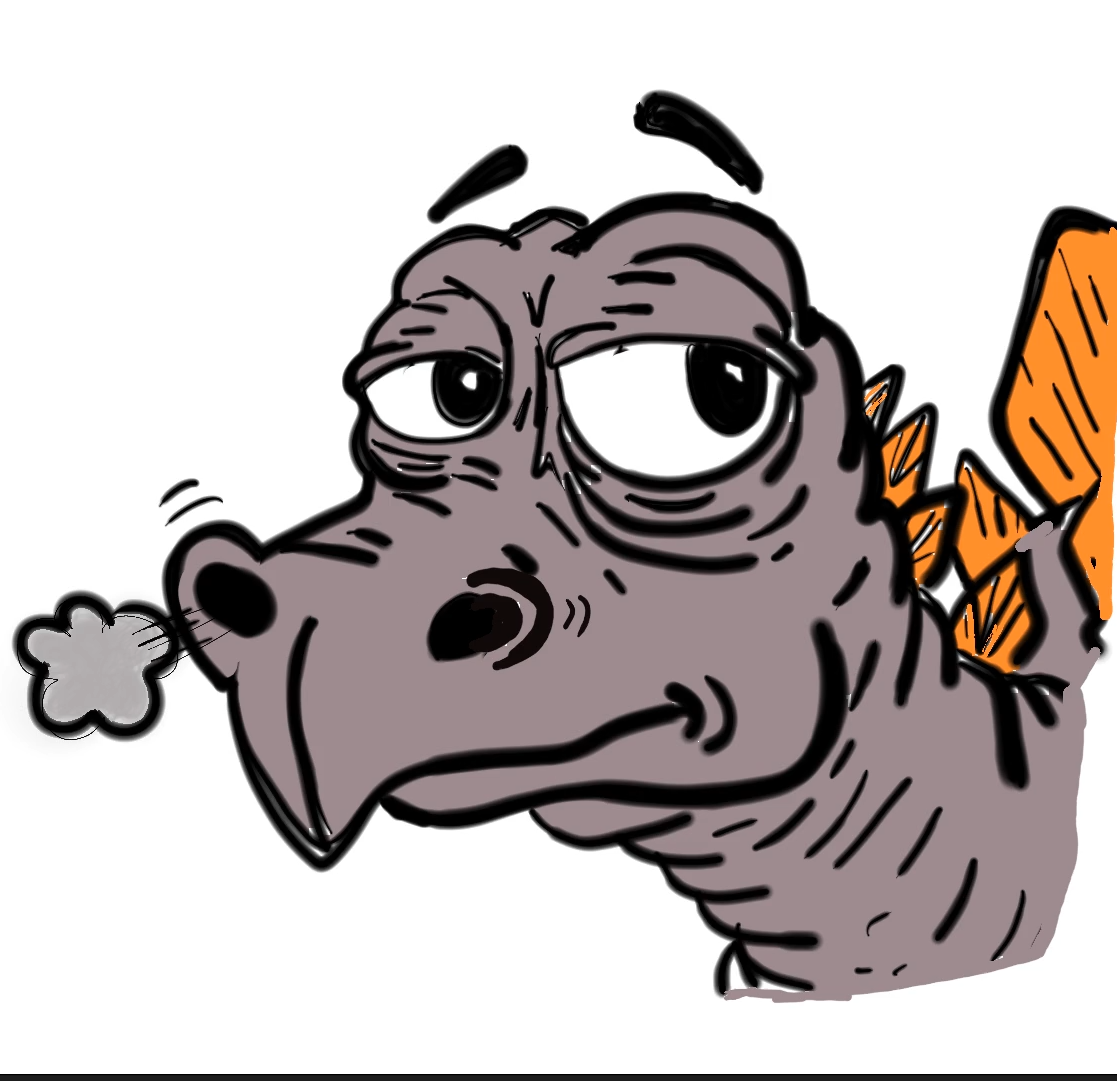
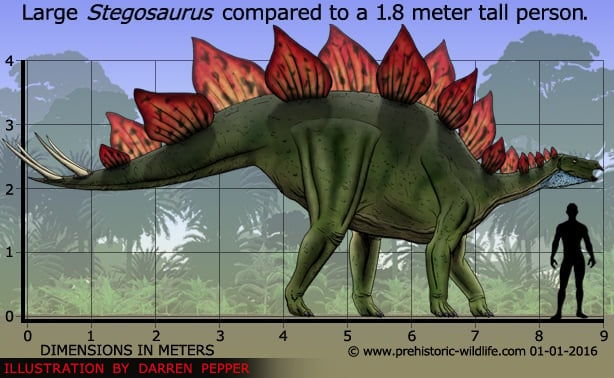
With its distinctive back plates, Stegosaurus is one of the best represented dinosaurs in popular culture today.
Initially thought to just live in the USA, a partial skeleton discovered in 2006 places Stegosaurus in Portugal. This has significantly increased the known range of this animal and further reinforced the theory that North America and Europe would have been connected during this time.
Living the life of a low browser in the Jurassic, Stegosaurus seems to have concentrated upon eating soft and leafy vegetation that did not require much effort to chew. Studies have shown that Stegosaurus probably did not have much bite force, but the shape of its teeth would do most of the work for it.
Fossilised teeth show extra wear on the sides where they would have been sharpest, meaning all Stegosaurus would have to do is bite onto the plant and pull its head back and its teeth would cut through the soft vegetation. Because of the aforementioned method of eating, Stegosaurus probably relied upon its gut to do the main work in breaking down the plant material for nutrients, and may have swallowed stones for use as gastroliths to aid this process.
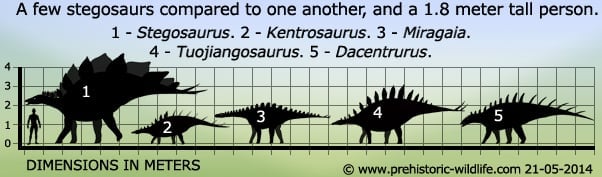
Stegosaurus had a body type similar to many other stegosaurids in that the hind legs were much longer than the fore legs, carrying the hips high above the rest of the body. When first discovered it was thought that Stegosaurus could have been bipedal, and this continued until examination of the forelegs combined with the estimated bulk and weight of the animal had Stegosaurus re-cast as a quadruped.
Although now known to be quadrupedal, most of the weight seems to be balanced towards the hips and carried by the hind legs, giving Stegosaurus a reasonably tight turning arc that could have been very useful in defending itself. Another advantage of the high hips is that the head is always held closer to the ground and nearer its food sources, while the tail and thagomizer (arrangement of spikes) would be always carried at a height that would allow for a body strike on an attacking predator.
It goes without saying that Stegosaurus is most famous for the plates that run along its back, in fact its name meaning ‘roof lizard’ is in reference to them. The plates themselves are specially developed osteoderms that have no fixed join with the skeleton.
When named, the plates were mistakenly placed flat across its back like the tiles on a roof, hence the name ‘roof lizard’. Discovery of more complete fossils later revealed that they were placed vertical as opposed to horizontal. However they were then placed in a single row which in itself caused problems as the plates would overlap.
The third arrangement was of the more familiar double row configuration, with the plates being arranged in pairs to one another. There was still a problem with this in that each plate was different in size meaning there could be no true pairs as they were all different. This has led to the fourth arrangement which has been generally accepted since the second half of the twentieth century.
This arrangement is two rows of plates in an alternating configuration, meaning that when viewed from the side there would be no gaps of daylight between the plates. Some have called this configuration into question on the basis that there is no other precedent for the arrangement, but that does not mean that the current accepted arrangement is wrong.
The world of natural history is full of ‘freaks’ that don’t seem to make sense, yet continue to thrive regardless of how much sense their adaptations make to us.
If the placement of the plates was not confusing enough the function of them has been even more demanding of understanding.
One theory that can be discounted is the one of defence. While large and impressive, the plates were actually very fragile and would not have been able to withstand much punishment.
The second theory is that of thermoregulation, and the evidence to support this comes from grooves in the plates that would have allowed blood vessels to run through them. The blood would then be carried close to the skin where temperature adjustment could take place.
The third theory, one that has rapidly gained more credence amongst the paleontological community is that they were used for display, particularly for intimidating rivals and attracting mates.
This may have involved the flushing of blood into the plates to provide a vivid colour display necessitating the need for blood vessels in the plates.
One argument against both thermoregulation and colour change is that the plates would have been covered with keratin, which does not allow for efficient heat exchange or rapid visual colour change.
Another body part that has had to be revised is the thagomizer. Early representations had the spikes arranged in upward angles, but with further study they are now accepted to have stuck out to the sides.
It’s likely that it was the thagomizer that was the primary form of defence.
Although the plates that ran down the tail would be of a hindrance to its flexibility, Stegosaurus would likely been able to pivot on its hind legs easily keeping its tail presented to an attacking predator.
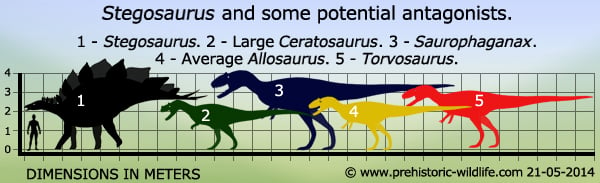
In fact, remains of an Allosaurus have been found that show a serious injury to the tail vertebrae that upon examination appears to have been caused by a thagomizer spike from a Stegosaurus.
The final area of contention is the cavity in the spinal cord of the hip region.
This was once conceived as a nerve cluster which was then in turn misinterpreted as a second brain, perhaps in compensation for its actual brain which has famously been described as the size of a walnut. In reality the second brain theory is impossible in the realms of known science.
Thankfully however this cavity is not exclusive to Stegosaurus, it also seems to appear in other dinosaurs and more importantly modern birds.
Study of this body has given rise to the notion that it is a glycogen body. This body allows for the storage of excess glycogen, a molecule that is used for energy storage in animals and fungi.
While the precise method of use is uncertain this may have acted in a way similar to an adrenaline burst in the flight or fight reflex.
With the release of glycogen, the muscles would get a sudden burst of energy allowing for more active movement, perhaps for the swinging of the thagomizer at an attacking Allosaurus.
Further Reading
- A new order of extinct Reptilia (Stegosauria) from the Jurassic of the Rocky Mountains. – American Journal of Science 3 (14): 513–514. – Othniel Charles Marsh – 1877.
- Restoration of Stegosaurus. – American Journal of Science 3 (42): 179–81. – Othniel Charles Marsh – 1891.
- Osteology of the armored Dinosauria in the United States National Museum, with special reference to the genus Stegosaurus. – Series: Smithsonian Institution. United States National Museum. Bulletin 89. – C. W. Gilmore – 1914.
- Plates of the dinosaur Stegosaurus:Forced convection heat loss fins? – Science 192 (4244): 1123–25 – J. O. Farlow, C. V. Thompson & D. E. Rosner – 1976.
- Taphonomy and paleoecology of the dinosaur beds of the Jurassic Morrison Formation. – Paleobiology 6 (2): 208–232. – Peter Dodson, A.K. Behrensmeyer, Robert T. Bakker & John S. McIntosh – 1980.
- Juveniles of the stegosaurian dinosaur Stegosaurus from the Upper Jurassic of North America. – Journal of Vertebrate Paleontology 2 (1): 47–62. – P. M. Galton – 1982.
- Growth and Function of Stegosaurus Plates. – Paleobiology 12: 459–73.- Buffrénil – 1986.
- Armor of Stegosaurus stenops, and the taphonomic history of a new specimen from Garden Park Colorado”. The Upper Jurassic Morrison Formation: An Interdisciplinary Study. Part 1. Modern Geol. 22. pp. 127–44. – K. Carpenter – 1998.
- Comparative histology, growth and evolution of archosaurian osteoderms: why did Stegosaurus have such large dorsal plates?. Journal of Vertebrate Paleontology 56A (20). – R. P. Main, K. Padian & J. Horner – 2000.
-New Evidence of Shared Dinosaur Across Upper Jurassic Proto-North Atlantic: Stegosaurus From Portugal. – Naturwissenschaften 94 (5): 367–74. – F. Escaso, F. Ortega, P. Dantas, E. Malafaia, N. L. Pimentel, X. Pereda-Suberbiola J. L. Sanz, J. C. Kullberg, M. C. Kullberg, F. Barriga – 2007. - Species of plated dinosaur Stegosaurus (Morrison Formation, Late Jurassic) of western USA: new type species designation needed. – Swiss Journal of Geosciences 103 (2): 187–198. – P. M. Galton – 2010.
- A model for the bite mechanics in the herbivorous dinosaur Stegosaurus (Ornithischia, Stegosauridae). _ Swiss Journal of Geosciences 103 (2): 235. – Reichel Miriam – 2010.
- Stegosauria: a historical review of the body fossil record and phylogenetic relationships, – Swiss Journal of Geosciences 103(2): 199-210 – S. C. R. Maidment – 2010.
- Internal vascularity of the dermal plates of Stegosaurus (Ornithischia, Thyreophora). – Swiss J Geoscia 103 (2): 173–85. – James O. Farlow, Shoji Hayashi & Glenn J. Tattersall – 2010.
- The plated dinosaur Stegosaurus longispinus Gilmore, 1914 (Dinosauria: Ornithischia; Upper Jurassic, western USA), type species of Alcovasaurus n. gen. - Neues Jahrbuch für Geologie und Paläontologie - Abhandlungen 279(2): 185-208. - Peter M. Galton & Kenneth Carpenter - 2016