Noasaurus

No-ah-sore-us.
Updated on

Benjamin Gutierrez

Vertebrate Paleontologist

Benjamin Gutierrez is a leading expert on dinosaurs, particularly the mighty theropods. His fieldwork in South America has uncovered new species and provided insights into dinosaur social structures.

Cite Feedback Print

Name

Noasaurus ‭(‬Northwestern Argetnina lizard‭)‬.

Phonetic

No-ah-sore-us.

Named By

J.‭ ‬F.‭ ‬Bonaparte & J.‭ ‬E.‭ ‬Powell‭ ‬-‭ ‬1980.

Classification

Chordata,‭ ‬Reptilia,‭ ‬Dinosauria,‭ ‬Saurischia,‭ ‬Theropoda,‭ ‬Abelisauroidea,‭ ‬Noasauridae.

Diet

Carnivore.

Species

N.‭ ‬leali‭

Size

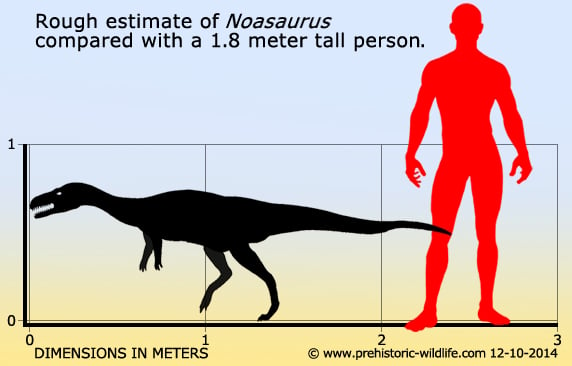
Uncertain due to lack of remains,‭ ‬but roughly estimated to be about‭ ‬2.4‭ ‬meters in length.

Known locations

Argentina,‭ ‬Salta Province‭ ‬-‭ ‬Lecho Formation.

Time Period

Maastrichtian of the Cretaceous.

Fossil representation

Partial skull and post cranial remains including finger and lower leg bones.

Noasaurus: Research Database

Ceratosauria (Theropoda) · Late Cretaceous (~70–66 MYA) · Gondwana — India/Madagascar (Maevarano Formation / Berivotra)


Research Note: Noasaurus was a small ceratosaur theropod from the Latest Cretaceous of Gondwana — one of the last non-avian dinosaurs before the K-Pg extinction. As part of the gondwanan dinosaur faunas that survived into the latest Cretaceous, it provides data on theropod diversity and evolution in the final dinosaur ecosystems.


Research Finding Status Grade Year Method Citation Impact
Weishampel & Jianu 1996: Noasaurus and the systematics of ceratosaur theropods from the Cretaceous of Gondwana
Weishampel & Jianu 1996 provide comprehensive data on Noasaurus from the Latest Cretaceous of Gondwana, establishing it as a ceratosaur theropod and documenting its systematic position
Confirmed A 1996 Fossil Weishampel & Jianu, Neues Jahrbuch für Geologie und Paläontologie Systematics
Sánchez-Hernández & Benton 2011: Noasaurus and new data on theropod diversity in the Latest Cretaceous of Gondwana
Sánchez-Hernández & Benton 2011 provide additional data on Noasaurus and theropod diversity in the Latest Cretaceous of Gondwana, further contextualising its significance within Ceratosauria
Confirmed B 2011 Fossil Sánchez-Hernández & Benton, Acta Palaeontologica Polonica Diversity
Status:
Confirmed Direct evidence
Grade:
A Strong consensus
B Good evidence


Active Debate: Gondwanan Dinosaur Evolution, K-Pg Extinction Dynamics, and the Last Dinosaur Ecosystems

Whether the Gondwanan dinosaur faunas — including Noasaurus — were fundamentally different from the Laurasian faunas is debated. The Latest Cretaceous of Gondwana preserves a distinctive dinosaur fauna that includes titanosaurs, abelisaurs, and small theropods like Noasaurus.

The role of dinosaurs like Noasaurus in the final dinosaur ecosystems before the K-Pg mass extinction — and how they compare to the better-known North American latest Cretaceous theropods — is a question of ongoing research.


What We Still Do Not Know About Noasaurus

  • Complete skeletal morphology: Partial specimens known.
  • Diet: Likely carnivorous/scavenging.
  • Social behavior: No direct evidence.
  • Body size: Small; estimated.

In Depth

       Noasaurus is the type genus of the noasauridae,‭ ‬a side group of theropod dinosaurs that are thought to have had the same immediate origins as the abelisaurids‭ (‬such as Abelisaurus and Aucasaurus‭)‬.‭ ‬Noasaurus however is only known by very partial remains which makes it difficult to ascertain specific details about this dinosaur.‭ ‬At the time of its discovery,‭ ‬it was thought that Noasaurus had an enlarged claw on the foot,‭ ‬analogous to‭ ‬the sickle claws commonly seen on dromaeosaurs and troodonts such as Velociraptor and Troodon.‭ ‬However a‭ ‬2010‭ ‬study by Agnolin and Chiarelli has now reported that the correct position of the claw is actually on the hand.‭ ‬This would not mark the first time that such a mistake was made,‭ ‬the large theropod dinosaur Megaraptor was once thought to have had large sickle claws on its feet,‭ ‬just for them to later be realised as actually belonging on the hands.

Further Reading

-‭ ‬A continental assemblage of tetrapods from the Upper Cretaceous beds of El Brete,‭ ‬northwestern Argentina‭ (‬Sauropoda-Coelurosauria-Carnosauria-Aves‭)‬.‭ ‬M�moires de la Soci�t� G�ologique de France,‭ ‬Nouvelle S�rie‭ ‬139:19-28.‭ ‬-‭ ‬J.‭ ‬F.‭ ‬Bonaparte & J.‭ ‬E.‭ ‬Powell‭ ‬-‭ ‬1980. -‭ ‬The position of the claws in Noasauridae‭ (‬Dinosauria:‭ ‬Abelisauroidea‭) ‬and its implications for abelisauroid manus evolution.‭ ‬-‭ ‬Pal�ontologische Zeitschrift.‭ ‬-‭ ‬F.‭ ‬L.‭ ‬Agnolin‭ & ‬P.‭ ‬Chiarelli‭ ‬-‭ ‬2010.

Adopt A Species
prehistoric-wildlife new logo

Love this species?

Adopt it today!

(UPDATED!)

SPECIES SPOTLIGHT

varanus priscus a.k.a Megalania