In Depth
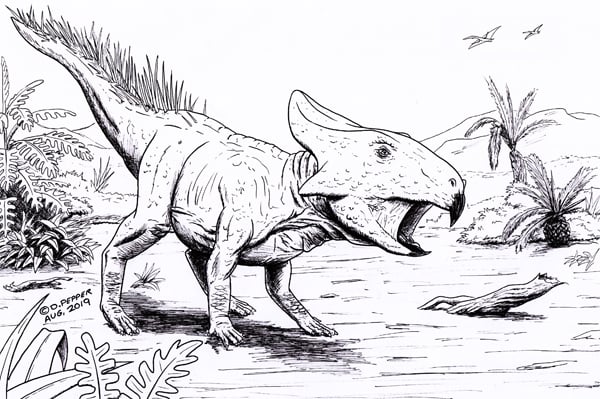
Leptoceratops is similar in form to the earlier ceratopsian dinosaurs that would evolve into the larger members of the group such as Chasmosaurus and Anchiceratops. However Leptoceratops lived much later than these ancestral forms as indicated by its entry into the fossil record at a time which would have seen Leptoceratops living in the same locations as the much larger Triceratops. This would suggest that while the ceratopsians descended into large quadrupedal herbivores, there was still an ecological niche where the more primitive ceratopsian body plan could still thrive.
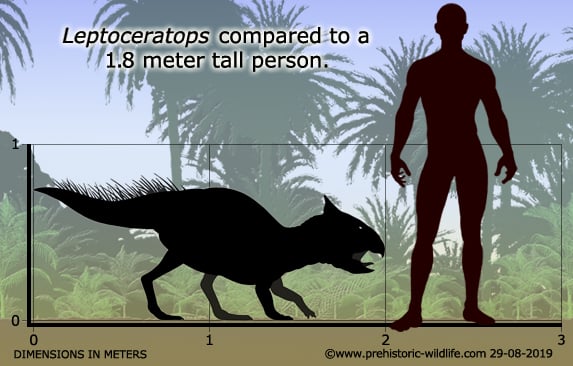
While Leptoceratops was probably quadrupedal like its larger cousins, the rear legs were much longer than the front legs. This had led to the suggestion that Leptoceratops may have occasionally been bipedal, either for the purpose of reaching up for food sources, or running at speed, similar in fashion to how hadrosaur movement is interpreted. As with other ceratopsians Leptoceratops probably used its hard beak to crop the leafy fronds of vegetation from cycads and ferns.
Leptoceratops used to have a second species named L. cerorhynchos which was based upon partial remains. However when further material was discovered it was found to be so different that it was placed into a new genus named Montanoceratops.
Further Reading
– Leptoceratops, a new genus of Ceratopsia from the Edmonton Cretaceous of Alberta – Bulletin of the American Museum of Natural History 33(36):567-580 – Barnum Brown – 1914. – The skeleton of Leptoceratops with the description of a new species – American Museum Novitates 1169:1-15 – B. Brown & E. M. Schlaikjer – 1942. – Complete skeleton of Leptoceratops gracilis Brown from the Upper Edmonton Member on Red Deer River, Alberta – National Museum of Canada Bulletin 123:225-255 – C. M. Sternberg – 1951. – Local stratigraphic and tectonic significance of Leptoceratops, a Cretaceous dinosaur in the Pinyon Conglomerate, northwestern Wyoming – United States Geological Survey Professional Paper 700(D) – M. C. McKenna & J. D. Love – 1970. – A skeletal reconstruction of Leptoceratops gracilis from the upper Edmonton Formation (Cretaceous) of Alberta – Canadian Journal of Earth Sciences 7:181-184 – D. A. Russell – 1970. – Cranial anatomy and biogeography of the first Leptoceratops gracilis (Dinosauria: Ornithischia) specimens from the Hell Creek Formation, southeast Montana – C. J. Ott – 2007 – In Horns and Beaks: Ceratopsian and Ornithopod Dinosaurs. Indiana University Press, Bloomington 213-233 – K. Carpenter (ed.). – Dental microwear reveals mammal-like chewing in the neoceratopsian dinosaur Leptoceratops gracilis. – PeerJ. 4: e2132. – Frank Varriale – 2016.