
In Depth
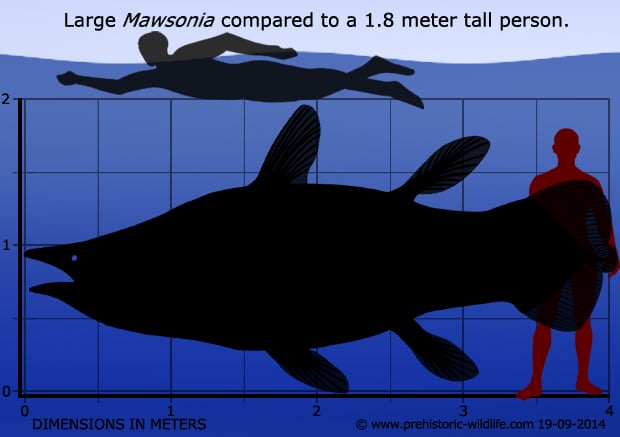
Coelacanths are one of the few creatures that typify animal life in the Mesozoic that are still alive today. Modern coelacanths are represented by the genus Latimeria that live in the deep waters of the Indian Ocean, the largest examples of which are known to easily attain lengths of two meters. Back in the early Cretaceous however these fish would have been small fry, with impressively large coelacanths of the Mawsonia genus reaching lengths of up to four meters, double that of the largest observed Latimeria. Because of their large size, Mawsonia are rarely preserved complete, and specimens which are preserved, are usually of smaller individuals under three meters. Skull bones are usually the most common specimens of Mawsonia due to the greater bone density increasing the likelihood of those parts surviving long enough to fossilize.
Mawsonia like other coelacanths were probably predatory fish that would cruise over the sea floor snatching up fish and larger invertebrates that were sheltering in crevices amongst rocks and coral. We do not know for certain however if Mawsonia were nocturnal like the Latimeria coelacanths that we know today. Interestingly, Mawsonia may have been more inclined to stray into shallower waters than what Latimeria are known to. This is because most of the fossil bearing formations that Mawsonia are known from were estuarine and mangrove habitats back in the early Cretaceous.
When fully grown to such a large size, Mawsonia may have had few predators, though larger sharks, pliosaurs and perhaps even spinosaurid dinosaurs, may have still been potential dangers for Mawsonia.
Further Reading
- On the Cretaceous formation of Bahia (Brazil), and on vertebrate fossils collected therein. Quarterly Journal of the Geological Society of London 63:128-139 - J. Mawson & A. S. Woodward - 1907. - Un nouveau Coelacanthid� du Cr�tac� inf�rieur du Niger, remarques sur la fusion des os dermiques [A new coelacanth from the Lower Cretaceous of Niger, remarks on fusion of the dermal bones]. - Colloques Internationaux du Centre National de la Recherche Scientifique, Paris, 1973. Probl�mes actuels de Pal�ontologie (�volution des Vert�br�s). Centre National de la Recherche Scientifique 218:175-190. - S. Wenz - 1975. - Coelacanths from the Lower Cretaceous of Brazil. American Museum novitates ; no. 2866. - John G. Maisey - 1986. - A new coelacanth from the Early Cretaceous of Brazil (Sarcopterygii, Actinistia). - Paleontological Research 6: 343-350. - Yoshitaka Yabumoto -2002. - New mawsoniid coelacanth (Sarcopterygii: Actinistia) remains from the Cretaceous of the Kem Kem beds, Southern Morocco - In Mesozoic Fishes 3 – Systematics, Paleoenvironments and Biodiversity, G. Arratia & A. Tintori (eds.): pp. 493-506, 7 figs. - Lionel Cavin & Peter L. Forey - 2004. - New materials of a Cretaceous coelacanth, Mawsonia lavocati Tabaste from Morocco. - Bulletin National Science Museum Tokyo C 01/2005; 31:39-49. - Yoshitaka Yabumoto & Teryua Uyeno - 2005. - New occurrence of Mawsonia (Sarcopterygii: Actinistia) from the Early Cretaceous of the Sanfranciscana Basin, Minas Gerais, southeastern Brazil. - Geological Society, London, Special Publications 01/2008; 295(1):109-144. DOI: 10.1144/SP295.8. - Marise S. S. de Carvalho & John G. Maisley - 2008.