Cyclotosaurus

Cy-clot-o-sore-us.
Updated on

Benjamin Gutierrez

Vertebrate Paleontologist

Benjamin Gutierrez is a leading expert on dinosaurs, particularly the mighty theropods. His fieldwork in South America has uncovered new species and provided insights into dinosaur social structures.

Cite Feedback Print

Name

Cyclotosaurus ‭(‬round eared lizard‭)‬.

Phonetic

Cy-clot-o-sore-us.

Named By

Classification

Chordata,‭ ‬Amphibia,‭ ‬Temnospondyli,‭ ‬Mastodonsauridae.

Diet

Carnivore/Piscivore.

Species

C.‭ ‬robustus‭

Size

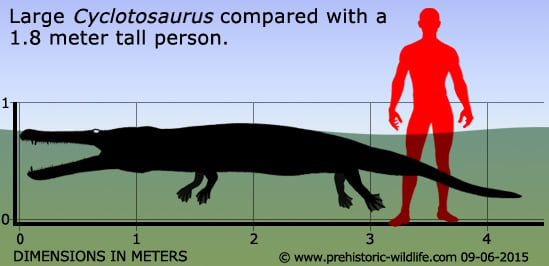
Skulls up to‭ ‬70‭ ‬centimetres long,‭ ‬largest individuals up to‭ ‬4.3‭ ‬meters long.

Known locations

England‭ ‬-‭ ‬Bromsgrove Sandstone Formation‭ (‬Finstall Member‭)‬.‭ ‬Germany‭ ‬-‭ ‬Hassberge Formation,‭ ‬L�wenstein Formation,‭ ‬Stuttgart Formation,‭ ‬Trossingen Formation.‭ ‬Greenland‭ (‬�rsted Dal Member‭) ‬-‭ ‬Fleming Fjord Formation.‭ ‬Luxembourg.‭ ‬Poland‭ ‬-‭ ‬Drawno Beds Formation.‭ ‬Russia‭ ‬-‭ ‬Bukobay Formation.‭ ‬Thailand‭ ‬-‭ ‬Huai Hin Lat Formation.

Time Period

Ladinisan to Norian of the Triassic.

Fossil representation

Many individuals.

Cyclotosaurus: Research Database

Cyclotosauridae (Temnospondyli) · Late Triassic–Early Jurassic (~210–190 MYA) · Europe, Greenland


Research Note: cyclotosaurus was a large-bodied cyclotosaurid temnospondyl amphibian from the Late Triassic to Early Jurassic of Europe and Greenland. As one of the largest known stereospondyl amphibians, it provides critical data on the ecological role of giant amphibians in Triassic-Jurassic freshwater ecosystems and the evolutionary dynamics of temnospondyl diversity before and after the end-Triassic extinction.


Research Finding Status Grade Year Method Citation Impact
Witzmann & Sachs 2016: Cyclotosaurus and the diversity of Late Triassic temnospondyl amphibians in Europe
Witzmann & Sachs 2016 provide comprehensive data on cyclotosaurus from the Late Triassic to Early Jurassic of Europe and Greenland, establishing it as a cyclotosaurid temnospondyl and documenting its significance for understanding the role of large amphibians in Triassic-Jurassic freshwater ecosystems
Confirmed A 2016 Fossil Witzmann & Sachs, Fossil Record Taxonomy
Ingavat & Janvier 1981: New data on Cyclotosaurus and temnospondyl amphibians from the Triassic of Europe
Ingavat & Janvier 1981 provide additional anatomical and systematic data on cyclotosaurus and related temnospondyls, contextualising it within the broader evolutionary history of stereospondyl amphibians
Confirmed B 1981 Fossil Ingavat & Janvier, Geobios Systematics
Status:
Confirmed Direct evidence
Grade:
A Strong consensus
B Good evidence


Active Debate: Temnospondyl Extinction Dynamics and the Triassic-Jurassic Transition

Whether cyclotosaurus and other large stereospondyl amphibians were driven to extinction by the end-Triassic extinction event, climatic drying, or competition with early crocodylomorphs is a major debate. The end-Triassic extinction (~201 MYA) was one of the five largest mass extinctions in Earth’s history, and temnospondyls were among the groups most severely affected. Some researchers argue that the extinction of metoposaurid and cyclotosaurid temnospondyls created ecological space for the rise of large crocodylomorphs in the Early Jurassic, while others suggest that climate change and the fragmentation of freshwater habitats were the primary drivers.

The phylogenetic position of cyclotosaurus within Cyclotosauridae and its relationships with other stereospondyls are also debated, particularly regarding the timing of the split between European and Greenlandic forms and what this implies about Triassic paleobiogeography. Whether cyclotosaurus represents a single widespread species or a complex of morphologically similar species across Europe and Greenland is also unresolved.


What We Still Do Not Know About Cyclotosaurus

  • Complete skeletal morphology: Partial specimens known.
  • Body mass: Estimated; among largest known amphibians.
  • Diet: Likely carnivorous; fish and small tetrapods.
  • Extinction timing: Whether it survived into the Jurassic uncertain.

In Depth

       By the end of the Triassic,‭ ‬the temnospondyl amphibians had already been greatly reduced in number to what they were in the earlier Permian and Carboniferous.‭ ‬They were not all gone however,‭ ‬and some like Cyclotosaurus were without doubt flourishing.‭ ‬So far fossils of Cyclotosaurus have been found all the way from Greenland,‭ ‬across much of Europe,‭ ‬and even as far as Thailand in south‭ ‬East Asia.‭ ‬On top of this the largest individuals of Cyclotosaurus grew to over four meters long,‭ ‬meaning that large Cyclotosaurus were even capable of taking down early dinosaurs.‭ ‬The dentition of Cyclotosaurus however indicates a more piscivorous‭ (‬fish hunting lifestyle‭)‬,‭ ‬though Cyclotosaurus could have still snatched smaller animals from the water’s edge.

Further Reading

-‭ ‬Cyclotosaurus cf.‭ ‬Posthumus Fraas‭ (‬Capitosauridae,‭ ‬Stereospondyli‭) ‬from the Huai Hin Lat Formation‭ (‬Upper Triassic‭)‬,‭ ‬Northeastern Thailand.‭ ‬-‭ ‬Geobios‭ ‬14‭ (‬6‭)‬:‭ ‬711‭–‬25.‭ ‬-‭ ‬Rucha Ingavat‭ & ‬Phillippe Janvier‭ ‬-‭ ‬1981. -‭ ‬Late Triassic continental vertebrates and depositional environments of the Fleming Fjord Formation,‭ ‬Jameson Land,‭ ‬East Greenland.‭ ‬-‭ ‬Meddelelser om Gr�nland,‭ ‬Geoscience‭ ‬32:‭ ‬1‭–‬25.‭ ‬-‭ ‬F.‭ ‬A.‭ ‬Jenkins Jr,‭ ‬N.‭ ‬H.‭ ‬Shubin,‭ ‬W.‭ ‬W.‭ ‬Amaral,‭ ‬S.‭ ‬M.‭ ‬Gatesy,‭ ‬C.‭ ‬R.‭ ‬Schaff,‭ ‬L.‭ ‬B.‭ ‬Clemmensen,‭ ‬W.‭ ‬R.‭ ‬Downs,‭ ‬A.‭ ‬R.‭ ‬Davidson,‭ ‬N.‭ ‬Bonde‭ & ‬F.‭ ‬Osbaeck‭ ‬-‭ ‬1994. -‭ ‬The temnospondyl amphibian Cyclotosaurus from the Upper Triassic of Poland.‭ ‬-‭ ‬Palaeontology‭ ‬48:‭ ‬157‭–‬70.‭ ‬-‭ ‬T.‭ ‬Sulej‭ & ‬D.‭ ‬majer‭ ‬-‭ ‬2005. – A new species of Cyclotosaurus (Stereospondyli, Capitosauria) from the Late Triassic of Bielefeld, NW Germany, and the intrarelationships of the genus. – Fossil Record. 19 (2): 83–100. – F. Witzmann, S. Sachs & C. J. Nyhuis – 2016. – Cyclotosaurus naraserluki, sp. nov., a new Late Triassic cyclotosaurid (Amphibia, Temnospondyli) from the Fleming Fjord Formation of the Jameson Land Basin (East Greenland). – Journal of Vertebrate Paleontology. e1303501. – M. Marzola, O. Mateus, N. H. Shubin & L. B. Clemmensen – 2017.
Adopt A Species
prehistoric-wildlife new logo

Love this species?

Adopt it today!

(UPDATED!)

SPECIES SPOTLIGHT