In Depth
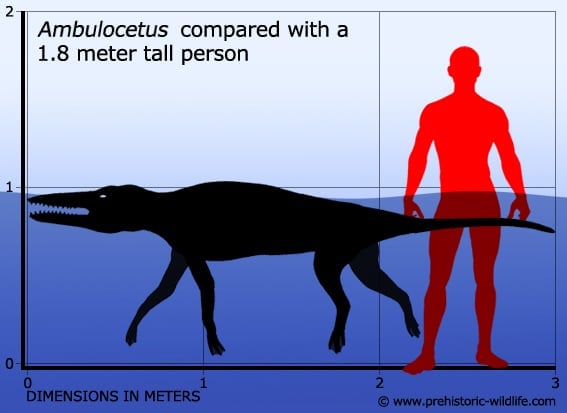
Ambulocetus is a very important transitional fossil as it displays the link between terrestrial mammals and the early whales. Ambulocetus acquired its name from the idea that it could both swim by undulating its back as well as leave the water and walk on land. However a 2016 study by Ando & Fujiwara suggests that Ambulocetus was more aquatic than terrestrial, perhaps even exclusively aquatic.
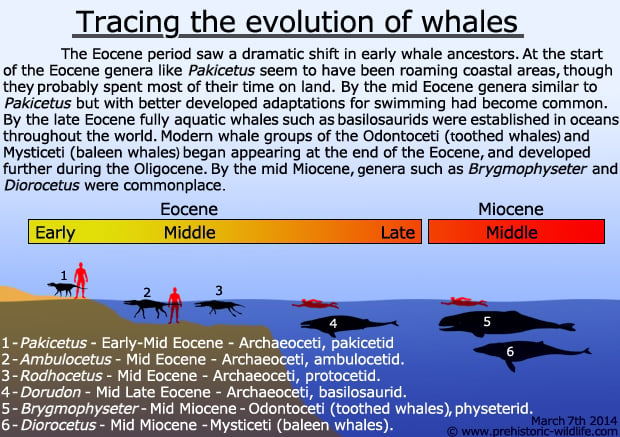
The ear structure of Ambulocetus is very interesting as it appears to have only worked while it was underwater.The skull of Ambulocetus is arranged in such a way that it could swallow food while underwater. This was achieved by the arrangement of air passages in the snout. The teeth were also very similar to other early cetaceans and a chemical analysis of these teeth has shown them to have been exposed to both fresh and salt water. This implies that Ambulocetus was active in river estuaries where fresh meets salt water, but can also suggest that Ambulocetus was a go anywhere predator. Other primitive whales important to the study of whale evolution include Pakicetus and Rodhocetus.
Further Reading
– Fossil evidence for the origin of aquatic locomotion in archaeocete whales – Science 263 (5144): 210–212. – J. G. M. Thewissen, S. T. Hussain & M. Arif – 1994. – Ambulocetus natans, an Eocene cetacean (Mammalia) from Pakistan. – Courier Forschungsinstitut Senckenberg 191. pp. 1–86 – J. G. M. Thewissen, S. I. Madar & S. T. Hussain – 1996. – Farewell to life on land – thoracic strength as a new indicator to determine paleoecology in secondary aquatic mammals. – Journal of Anatomy. 229 (6): 768–777. – K. Ando & S.-I. Fujiwara – 2016.