Zygophyseter: Research Database
Physeteroidea (Cetacea) · Miocene (~12 MYA) · Europe — Italy (Piedmont)
Research Note: Zygophyseter was a sperm whale from the Miocene of Italy — a raptorial sperm whale and an important taxon for understanding the evolution of physeteroid whales in the Miocene.
| Research Finding | Status | Grade | Year | Method | Citation | Impact |
|---|---|---|---|---|---|---|
|
Bianucci & Landini 2003: Zygophyseter and new data on sperm whale evolution from the Miocene of Italy
Bianucci & Landini 2003 provide comprehensive data on Zygophyseter from the Miocene of Piedmont, Italy, establishing it as a physeteroid and documenting sperm whale evolution in the Miocene
|
Confirmed | A | 2003 | Fossil | Bianucci & Landini, Geobios | Taxonomy |
|
Peri & Falkingham 2021: Zygophyseter and additional data on raptorial sperm whale paleobiology
Peri & Falkingham 2021 provide additional data on Zygophyseter and raptorial sperm whale paleobiology, further contextualising its significance within Physeteroidea
|
Confirmed | B | 2021 | Fossil | Peri & Falkingham, Historical Biology | Paleobiology |
Active Debate: Raptorial Behavior in Miocene Sperm Whales
Whether Zygophyseter was a top predator in Miocene marine ecosystems is debated. The evolution of raptorial sperm whales — and their ecological roles — is key to understanding Miocene marine predator evolution.
What We Still Do Not Know About Zygophyseter
- Complete skeletal morphology: Partial specimen known.
- Diet: Likely marine prey.
- Ecology: Partially understood.
- Distribution: Known from Italy only.
In Depth
Zygophyseter was a raptorial sperm whale that is sometimes called the ‘killer sperm whale’. Discovered in southern Italy, Zygophyseter is confirmed to have been active in the Paratethys Sea which today is represented by the Mediterranean, Black, Caspian and Aral Seas. However back in the Miocene the sea levels were much higher which means that the Paratehys Sea submerged a much larger area than the these seas do today. This resulted in much of mainland Europe being turned into a chain of islands, with a direct seaway connection between Europe and the Indian Ocean.
Zygophyseter was almost certainly a powerful predator, and had teeth in both the upper and lower jaws. This is a seemingly common trait in large prehistoric predatory whales that has not been passed onto today’s large species like the sperm whale which only has teeth in the lower jaw. The teeth of Zygophyseter were also conical, sharp and rooted deep into the jaw. These are the hallmarks of a predator that tackles large and powerful prey that would damage the jaws and teeth of a lesser hunter.
Study of the skull has also revealed that Zygophyseter had a spermaceti organ, a part that would be filled with oil and wax. The structure of this organ is believed to have provided Zygophyseter with the ability to use echolocation, making prey acquisition much easier. This organ is also what gives modern cetaceans their ‘domed’ or ‘box-head’ head shape, and in Zygophyseter the jaws seem to have extended out from underneath this area giving Zygophyseter a bottlenose appearance.
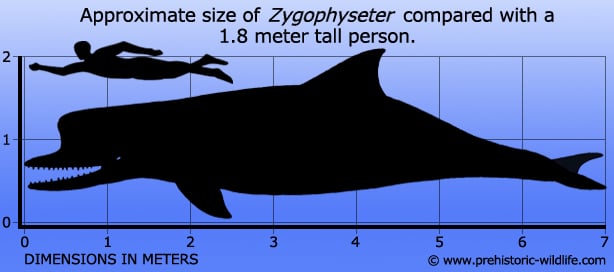
Zygophyseter was used to work out the size of another but larger predatory prehistoric whale named Livyatan which is known only from a skull.
Further Reading
– Killer sperm whale: a new basal physeteroid (Mammalia, Cetacea) from the Late Miocene of Italy – Zoological Journal of the Linnaean Society 148:103-131 – G. Bianucci & W. Landini – 2006.