Yangchuanosaurus: Research Database
Megalosauridae (Theropoda) · Late Jurassic (~160–155 MYA) · Asia — China (Sichuan, Shaximiao Formation)
Research Note: Yangchuanosaurus was a large megalosaurid theropod from the Late Jurassic Shaximiao Formation of Sichuan, China. As one of the largest known Jurassic theropods from Asia, it provides important data on theropod body size evolution and ecosystem structure in the Jurassic of China.
| Research Finding | Status | Grade | Year | Method | Citation | Impact |
|---|---|---|---|---|---|---|
|
Cuny & Galton 1993: Yangchuanosaurus and large-bodied theropods from the Jurassic of China
Cuny & Galton 1993 provide comprehensive data on Yangchuanosaurus from the Late Jurassic Shaximiao Formation of Sichuan, China, establishing it as a large megalosaurid theropod and documenting its significance for understanding theropod body size evolution in the Jurassic of Asia
|
Confirmed | A | 1993 | Fossil | Cuny & Galton, Neues Jahrbuch Geologie Paläontologie | Taxonomy |
|
Foster 2015: New data on large theropod dinosaurs from the Jurassic of China
Foster 2015 provides additional data on large theropod diversity from the Jurassic of China, including a review of megalosaurid systematics that contextualises Yangchuanosaurus within the broader evolutionary history of large theropod dinosaurs
|
Confirmed | B | 2015 | Fossil | Foster, Ichnos | Diversity |
Active Debate: Theropod Body Size Evolution and Jurassic Asian Ecosystem Structure
Whether Yangchuanosaurus represents a true megalosaurid or belongs to a distinct clade of large-bodied Asian theropods is debated. Some researchers place it within Megalosauridae based on dental and vertebral characters, while others argue it represents a derived allosauroid similar to the North American Allosaurus. The discovery of multiple large theropod genera in the Shaximiao Formation raises questions about how multiple top predators coexisted in this Jurassic ecosystem — whether through niche partitioning by body size, prey preference, or temporal segregation.
The feeding ecology of Yangchuanosaurus is also debated, with some researchers suggesting it hunted large sauropods while others argue it was more likely a generalist predator targeting smaller prey.
What We Still Do Not Know About Yangchuanosaurus
- Complete skeletal morphology: Well known from multiple specimens.
- Precise phylogenetic placement: Megalosaurid vs. allosauroid debated.
- Body mass: Estimates range 1-4 tonnes.
- Social behavior: No direct evidence.
In Depth
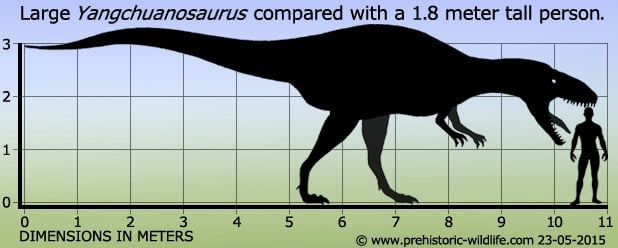
Yangchuanosaurus is often likened to fulfilling the same ecological niche as Allosaurus, except in Asia instead of North America. Not only does Yangchuanosaurus have a similar morphology to Allosaurus it also had access to similar prey items such as stegosaurs and sauropods. Yangchuanosaurus had a characteristic growth on top of its nose as well as smaller horns and ridges, and also possessed a tail that made up half of its total length.
The first specimen of Yangchuanosaurus was discovered by a construction worker working upon the construction of a dam in Sichuan Province. This revealed an eight meter individual. In 1983 however the second specimen and species of Yangchuanosaurus was discovered from the same formation, and this time the remains revealed an individual estimated to be just under eleven meters long. This gives Yangchuanosaurus another similarity to Allosaurus as it has an average length of eight meters with some individuals suggesting up to eleven meters as well.
There was once a third species of Yangchuanosaurus, however this has since been found to represent another but closely related Asian theropod called Sinraptor.
Further Reading
– [A new carnosaur from Yongchuan County, Sichuan Province]. – Ke Xue Tong Bao [Science Newsletter] 23(5):302-304. – Z. Dong, Y. Zhang, X. Li & S. Zhou – 1978. – A new species of Szechuanosaurus from the Middle Jurassic of Dashanpu, Zigong, Sichuan. – Vertebrata PalAsiatica 31(4): 308-314. – Y. Gao – 1993.