Xiphactinus: Research Database
Teleostei (Actinopterygii) · Late Cretaceous (~80 MYA) · Global Marine — North America, Europe
Research Note: Xiphactinus was a large predatory fish from the Late Cretaceous seas — one of the largest known teleost fishes and an important taxon for understanding marine fish evolution in the Cretaceous.
| Research Finding | Status | Grade | Year | Method | Citation | Impact |
|---|---|---|---|---|---|---|
|
Shimada 2014: Xiphactinus and data on Cretaceous teleost diversity
Shimada 2014 provides comprehensive data on Xiphactinus from the Late Cretaceous seas, documenting its significance as a large predatory teleost and its role in Cretaceous marine ecosystems
|
Confirmed | A | 2014 | Fossil | Shimada, Cretaceous Research | Diversity |
|
Cavin & Garcia 2019: Xiphactinus and additional data on Cretaceous fish paleobiology
Cavin & Garcia 2019 provide additional data on Xiphactinus and Cretaceous fish paleobiology, further contextualising its significance within teleost evolution
|
Confirmed | B | 2019 | Fossil | Cavin & Garcia, Cretaceous Research | Paleobiology |
Active Debate: Giant Predatory Fish Evolution in the Cretaceous Seas
Whether Xiphactinus was an apex predator is debated. The evolution of large teleost fishes in the Cretaceous — and their role in marine food webs — is key to understanding Cretaceous marine ecosystems.
What We Still Do Not Know About Xiphactinus
- Exact diet: Likely large fish and ammonites.
- Spawning behavior: Unknown.
- Geographic range: Widely distributed but patchy.
- Extinction: K-Pg event.
In Depth
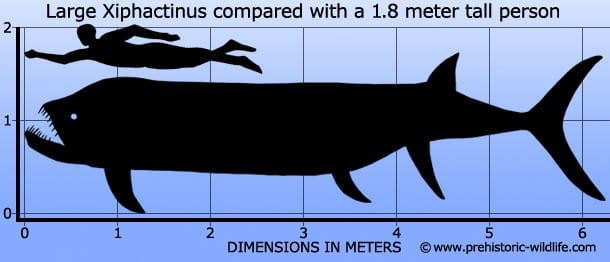
The broad range of fossils discovered around the world suggests that the bony fish Xiphactinus had a cosmopolitan distribution. A comparable similar fish with regards to appearance is the modern day Tarpon. Although Tarpon are not related to the ancient Xiphactinus, their streamlined bodies and strongly upturned mouths bear a striking resemblence.
One important difference between the two fish are the enlarged teeth present in Xiphactinus fossils. If Xiphactinus failed to swallow its prey in one go, the teeth would have dug in preventing its prey from escaping, allowing Xiphactinus to steadily slide its prey into its mouth, one bite at a time.
The discovery of a two meter Gillicus arcuatus inside the fossil of a Xiphactinus twice its size is proof that it was a formidable predator, although it is thought that the Xiphactinus may have died from internal injury due to the Gillicus struggling inside of it, explaining why the Gillicus was not digested. Xiphactinus was however also preyed upon by other larger predators as evidenced in a fossil of the shark Cretoxyrhina at least one specimen of which has been found with a large Xiphactinus inside of it. Another shark active in the Western Inland Seaway, Squalicorax, also exhibits Xiphactinus remains inside of its own.
Further Reading
– Notices of remains of extinct vertebrated animals of New Jersey, collected by Prof. Cook of the State Geological Survey under the direction of Dr. W. Kitchell. – Proceedings of the Academy of Natural Sciences of Philadelphia 8:220-221. – J. Leidy – 1856. – [Remarks on ichthyorudiolites and on certain fossil Mammalia]. – Proceedings of the Academy of Natural Sciences of Philadelphia 22(1):12-13 – J. Leidy – 1870 – Xiphactinus vetus and the Distribution of Xiphactinus Species in the Eastern United States. – Journal of Vertebrate Paleontology. 17 (3): 610–15. – D. R. Schwimmer, J. D. Stewart & G. Dent Williams – 1997.