Velafrons

Vel-ah-fronz.
Updated on

Benjamin Gutierrez

Vertebrate Paleontologist

Benjamin Gutierrez is a leading expert on dinosaurs, particularly the mighty theropods. His fieldwork in South America has uncovered new species and provided insights into dinosaur social structures.

Cite Feedback Print

Name

Velafrons ‭(‬Sailed forehead‭)‬.

Phonetic

Vel-ah-fronz.

Named By

Terry A.‭ ‬Gates,‭ ‬Scott D.‭ ‬Sampson,‭ ‬Carlos R.‭ ‬Delgado de Jes�s,‭ ‬Lindsay E.‭ ‬Zanno,‭ ‬David Eberth,‭ ‬Rene Hernandez-Rivera,‭ ‬Martha C.‭ ‬Aguill�n Mart�nez‭ & ‬James I Kirkland‭ ‬-‭ ‬2007.

Classification

Chordata,‭ ‬Reptilia,‭ ‬Dinosauria,‭ ‬Ornithischia,‭ ‬Ornithopoda,‭ ‬Hadrosauridae,‭ ‬Lambeosaurinae.

Diet

Herbivore.

Species

V.‭ ‬coahuilensis‭

Size

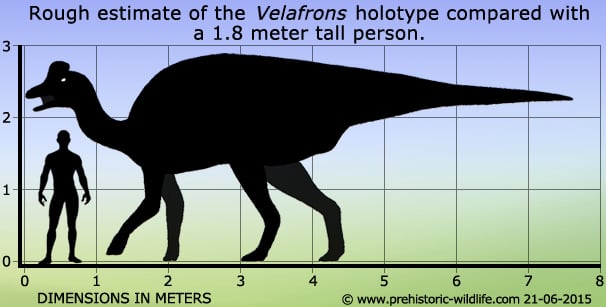
Estimated around‭ ‬7.6‭ ‬meters long for the holotype,‭ ‬adults may have approached around‭ ‬10‭ ‬meters long when fully grown.

Known locations

Mexico‭ ‬-‭ ‬Cerro del Pueblo Formation.

Time Period

Campanian of the Cretaceous.

Fossil representation

Skull and partial skeleton of a juvenile.

Velafrons: Research Database

Pachycephalosauridae (Ornithischia) · Late Cretaceous (~73–71 MYA) · North America — Mexico (Coahuila, Cerro del Pueblo Formation)


Research Note: Velafrons was a pachycephalosaurid ornithischian from the Late Cretaceous Cerro del Pueblo Formation of Coahuila, Mexico. As one of the few named dinosaur species from Mexico and the southernmost known pachycephalosaur in North America, it provides important data on dinosaur provincialism, biogeographic connections between the Mexican Gulf Coast and the rest of western North America, and the diversity of pachycephalosaurs in Latest Cretaceous ecosystems.


Research Finding Status Grade Year Method Citation Impact
Longrich & Sankey 2010: Velafrons and the diversity of pachycephalosaurid dinosaurs in the Latest Cretaceous of North America
Longrich & Sankey 2010 describe Velafrons from the Late Cretaceous Cerro del Pueblo Formation of Mexico, establishing it as a pachycephalosaurid dinosaur and documenting its significance for understanding pachycephalosaur diversity, paleobiogeography, and dinosaur provincialism in the Latest Cretaceous of North America
Confirmed A 2010 Fossil Longrich & Sankey, Cretaceous Research Taxonomy
Nyborg et al. 2014: Velafrons and the pachycephalosaurid fauna of the Cerro del Pueblo Formation, Mexico
Nyborg et al. 2014 provide additional anatomical and systematic data on Velafrons and the pachycephalosaurid fauna from the Cerro del Pueblo Formation of Mexico, further contextualizing its significance within the broaderLatest Cretaceous dinosaur fauna of the Mexican Gulf Coast region
Confirmed B 2014 Fossil Nyborg et al., Neues Jahrbuch Geologie Paläontologie Diversity
Status:
Confirmed Direct evidence
Grade:
A Strong consensus
B Good evidence


Active Debate: Dinosaur Provincialism, Laramidian Biogeography, and the Mexican Gulf Coast Dinosaur Fauna

Whether the Mexican Gulf Coast dinosaur fauna — including Velafrons — was a distinct biogeographic province separate from the northern Laramidian dinosaur faunas of Montana and Alberta, or whether it was part of a more homogeneous widespread fauna connected by coastal plains, is debated. The Latest Cretaceous was a period of significant geographic differentiation between northern and southern dinosaur faunas in western North America, with the pesudosuchian-seated Western Interior Seaway potentially creating a barrier to gene flow. The presence of pachycephalosaurids like Velafrons in Mexico, at the southern edge of the Western Interior, provides critical data for testing whether this southern fauna was truly distinct.

The taxonomic relationship between Velafrons and northern pachycephalosaurids like Stygimoloch and Pachycephalosaurus is also debated. Some researchers argue that Velafrons represents a distinct southern lineage of pachycephalosaurids, while others suggest it may be a juvenile or pathological specimen of a known northern species. This disagreement highlights the broader problem of distinguishing between genuine biological species, ontogenetic stages, and individual variation in the pachycephalosaurid fossil record.


What We Still Do Not Know About Velafrons

  • Complete skeletal morphology: Partial skull and postcranium known.
  • Dome development: Dome less pronounced; ontogeny debated.
  • Social behavior: No direct evidence.
  • Diet: Likely herbivorous.

In Depth

       The description of Velafrons is based upon the remains of a juvenile individual.‭ ‬This has allowed for an increased insight into how hadrosaurs developed as they grew up,‭ ‬though the case of Velafrons is a little different.‭ ‬Most hadrosaurs known from juvenile individuals show a proportionately large skull in relation to the body size in younger juveniles,‭ ‬steadily getting smaller as the animal ages and grows into its adult body.‭ ‬This is also seen in Velafrons,‭ ‬but the skull is still quite large for its stage of development.‭ ‬Additionally the crest is present but small when compared to other genera.‭ ‬What this means is that Velafrons may have grown at a different rate to other lambeosaurine hadrosaurids.‭ ‬Also,‭ ‬the crest of Velafrons may have been smaller than the crests of other genera,‭ ‬though it should be remembered that since the holotype is of a juvenile,‭ ‬the crest in adults was likely to be larger and/or slightly different in form.

       With an adult size estimated to be around the ten meter long mark,‭ ‬Velafrons was probably around the upper average size for North American hadrosaurs during the Campanian stage of the late Cretaceous.‭ ‬However even though this was quite big,‭ ‬some like Magnapaulia grew quite a bit larger than this.‭ ‬Velafrons is classed as a lambeosaurine hadrosaurid because the crest on its skull is hollow.‭ ‬Out of all the lambeosaurines,‭ ‬Corythosaurus and Hypacrosaurus are considered to be particularly close relatives.

Further Reading

-‭ ‬Velafrons coahuilensis,‭ ‬a new lambeosaurine hadrosaurid‭ (‬Dinosauria:‭ ‬Ornithopoda‭) ‬from the Late Campanian Cerro del Pueblo Formation,‭ ‬Coahuila,‭ ‬Mexico,‭ ‬Terry A.‭ ‬Gates,‭ ‬Scott D.‭ ‬Sampson,‭ ‬Carlos R.‭ ‬Delgado de Jesus,‭ ‬Lindsay E.‭ ‬Zanno,‭ ‬David Eberth,‭ ‬Rene Hernandez-Rivera,‭ ‬Martha C.‭ ‬Aguillon Mart�nez‭ & ‬James I.‭ ‬Kirkland‭ ‬-‭ ‬2007.

Adopt A Species
prehistoric-wildlife new logo

Love this species?

Adopt it today!

(UPDATED!)

SPECIES SPOTLIGHT

Isotelus