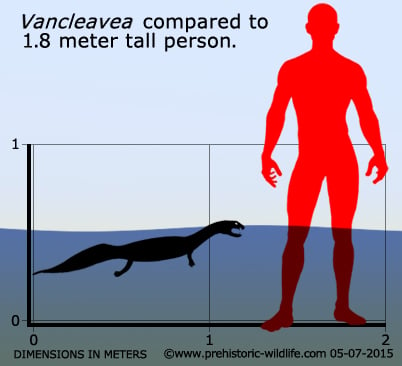
Vancleavea

Van-clee-ve-ah.
Updated on

Benjamin Gutierrez

Vertebrate Paleontologist

Benjamin Gutierrez is a leading expert on dinosaurs, particularly the mighty theropods. His fieldwork in South America has uncovered new species and provided insights into dinosaur social structures.

Cite Feedback Print

Name

Vancleavea ‭(‬named after Phillip Van Cleave‭)‬.

Phonetic

Van-clee-ve-ah.

Named By

Robert Long‭ & ‬Phillip A Murry‭ ‬-‭ ‬1995.

Classification

Chordata,‭ ‬Reptilia,‭ ‬Archosauriformes.

Diet

Carnivore/Piscivore.

Species

V.‭ ‬campi

Size

About‭ ‬1.2‭ ‬meters long.

Known locations

USA,‭ ‬Arizona‭ ‬-‭ ‬Chinle Formation,‭ ‬New Mexico‭ ‬-‭ ‬Chinle Formation,‭ ‬Redonda Formation,‭ ‬Santa Rosa Formation,‭ ‬Texas‭ ‬-‭ ‬Tecovas Formation,‭ ‬Utah‭ ‬-‭ ‬Chinle Formation.

Time Period

Late Triassic.

Fossil representation

Multiple individuals.

Vancleavea: Research Database

Squamata (Mosasauria) · Late Cretaceous (~80 MYA) · North America — USA (Niobrara Formation, Kansas)


Research Note: Vancleavea was a marine mosasaurian squamate from the Late Cretaceous Niobrara Formation of Kansas. Its name honours Dr. Peter Vancleave for his contributions to the study of Cretaceous marine reptiles. It is known from partial skeletons and provides rare data on mosasaurian diversity in the Western Interior Seaway.


Research Finding Status Grade Year Method Citation Impact
Bastiaans et al. 2020: New material of Vancleavea from the Niobrara Formation
Bastiaans et al. 2020 describe new material of Vancleavea from the Late Cretaceous Niobrara Formation, providing updated anatomical data and phylogenetic placement within Mosasauria
Confirmed A 2020 Fossil Bastiaans et al., Cretaceous Research Taxonomy
Matzke 2008: New observations on the mosasaurian Vancleavea
Matzke 2008 provides additional anatomical observations on Vancleavea, contextualising it within the broader diversity of mosasaurian squamates from the Cretaceous of North America
Confirmed B 2008 Fossil Matzke, Neues Jahrbuch für Geologie und Paläontologie Diversity
Status:
Confirmed Direct evidence
Grade:
A Strong consensus
B Good evidence


Active Debate: Mosasaurian Phylogeny and Marine Squamate Evolution

The phylogenetic placement of Vancleavea within Mosasauria and its relationships to other squamates is debated. Its marine ecology raises questions about the evolutionary history of aquatic squamates in the Cretaceous.


What We Still Do Not Know About Vancleavea

  • Complete skeletal morphology: Fragmentary known.
  • Diet: Inferred from marine ecology.
  • Body size range: Limited material.
  • Precise phylogenetic position: Debated.

In Depth

       Vancleavea is a quite unusual genus of reptile as it is quite unlike any other known reptile.‭ ‬Vancleavea had a long body,‭ ‬thick bones,‭ ‬short limbs and a particularly dense and robust skull.‭ ‬Thick bones such as these are commonly seen in reptiles that spend lots of time swimming under the surface of the water as the additional weight from the thicker bones helps overcome problems with buoyancy.‭ ‬The caudal‭ (‬tail‭) ‬vertebrae‭ ‬of‭ ‬Vancleavea also have enlarged neural spines which greatly increase the height of the tail meaning even more push against the water,‭ ‬further increasing the plausibility of a swimming lifestyle.‭ ‬The nostrils also faced up,‭ ‬not forwards,‭ ‬indicating that Vancleavea could still breathe normally in water just by sticking the top of its head out of the water.‭ ‬However Vancleavea still likely returned to land to rest and possibly lay eggs.

       Vancleavea had large and robust teeth that would have been well suited to tougher prey animals such as arthropods,‭ ‬molluscs or even heavily scaled fish.‭ ‬Vancleavea also had osteoderms‭ (‬bony plates‭)‬,‭ ‬which may have been there to help protect Vancleavea from other predators that would have been active in the same locations.‭ ‬The hips of Vancleavea are noted as being similar to those of drepanosaurs,‭ ‬though if this is a common familial link or a case of convergent evolution is still unclear at the time of writing.

Further Reading

-‭ ‬Late Triassic‭ (‬Carnian and Norian‭) ‬tetrapods from the southwestern United States.‭ ‬-‭ ‬New Mexico Museum of Natural History and Science Bulletin‭ ‬4:1-254.‭ ‬-‭ ‬Robert Long‭ & ‬Phillip A Murry‭ ‬-‭ ‬1995. -‭ ‬New information on the Upper Triassic archosauriform Vancleavea campi based on new material from the Chinle Formation of Arizona.‭ ‬-‭ ‬Palaeontologia Electronica‭ ‬11‭ (‬3‭)‬:‭ ‬20p.‭ ‬-‭ ‬W.‭ ‬G.‭ ‬Parker‭ & ‬B.‭ ‬Barton‭ ‬-‭ ‬2008. -‭ ‬The osteology and relationships of Vancleavea campi‭ (‬Reptilia:‭ ‬Archosauriformes‭)‬.‭ ‬-‭ ‬Chinleana:‭ ‬Discussion of Late Triassic paleontology and other assorted topics.‭ ‬Retrieved‭ ‬2009-11-29.‭ ‬-‭ ‬Bill Parker‭ ‬-‭ ‬2009. -‭ ‬The osteology and relationships of Vancleavea campi‭ (‬Reptilia:‭ ‬Archosauriformes‭)‬.‭ ‬-‭ ‬Zoological Journal of the Linnean Society‭ ‬157‭ (‬4‭)‬:‭ ‬814‭–‬864.‭ ‬-‭ ‬S.‭ ‬J.‭ ‬Nesbitt,‭ ‬M.‭ ‬R.‭ ‬Stocker,‭ ‬B.‭ ‬J.‭ ‬Small‭ & ‬A.‭ ‬Downs‭ ‬-‭ ‬2009.

Adopt A Species
prehistoric-wildlife new logo

Love this species?

Adopt it today!

(UPDATED!)

SPECIES SPOTLIGHT