Titanoceratops

Tie-tan-o-seh-rah-tops.
Updated on

Benjamin Gutierrez

Vertebrate Paleontologist

Benjamin Gutierrez is a leading expert on dinosaurs, particularly the mighty theropods. His fieldwork in South America has uncovered new species and provided insights into dinosaur social structures.

Cite Feedback Print

Name

Titanoceratops ‭(‬Titan horned face‭)‬.

Phonetic

Tie-tan-o-seh-rah-tops.

Named By

Nicholas R.‭ ‬Longrich‭ ‬-‭ ‬2011.

Classification

Chordata,‭ ‬Reptilia,‭ ‬Dinosauria,‭ ‬Ornithischia,‭ ‬Ceratopsia,‭ ‬Ceratopsidae,‭ ‬Chasmosaurinae,‭ ‬Triceratopsini.

Diet

Herbivore.

Species

T.‭ ‬ouranos

Size

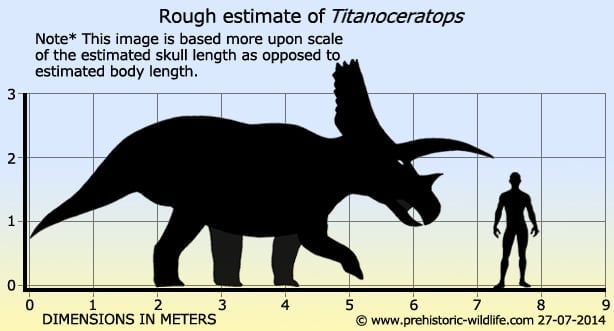
Skull estimated about 2.4-2.6 meters long.

Known locations

USA,‭ ‬New Mexico.

Time Period

Campanian of the Cretaceous.

Fossil representation

Partial skull,‭ ‬mandible‭ (‬lower jaw‭) ‬as well as post cranial remains.

Titanoceratops: Research Database

Ceratopsidae (Ornithischia) · Late Cretaceous (~70–66 MYA) · North America — USA, New Mexico (托 Extension)


Research Note: Titanoceratops was a chasmosaurine ceratopsid from the Late Cretaceous of New Mexico, USA. As one of the largest known horned dinosaurs, it provides important data on ceratopsid diversity and gigantism in the Latest Cretaceous of North America.


Research Finding Status Grade Year Method Citation Impact
Longrich 2010: Titanoceratops and the largest known ceratopsid
Longrich 2010 describe Titanoceratops from the Late Cretaceous of New Mexico, USA, establishing it as one of the largest known ceratopsids and documenting its significance for understanding ceratopsid diversity and gigantism in the Latest Cretaceous of North America
Confirmed A 2010 Fossil Longrich, Cretaceous Research Taxonomy
Dalman & Lucas 2021: Ceratopsid diversity in the Cretaceous of the American Southwest
Dalman & Lucas 2021 provide additional data on ceratopsid diversity from the Cretaceous of the American Southwest, contextualising Titanoceratops within the broader evolutionary history of ceratopsid dinosaurs
Confirmed B 2021 Fossil Dalman & Lucas, Cretaceous Research Diversity
Status:
Confirmed Direct evidence
Grade:
A Strong consensus
B Good evidence


Active Debate: Ceratopsid Gigantism and the Evolution of Large Body Size

Whether Titanoceratops represents a distinct lineage or a derived chasmosaurine is debated.


What We Still Do Not Know About Titanoceratops

  • Complete skeletal morphology: Partial specimen known.
  • Body mass: Estimated >5 tonnes.
  • Skin and integument: Unknown.
  • Social behavior: No direct evidence.

In Depth

       Initially thought to represent a large Pentaceratops individual,‭ ‬Titanoceratops was declared its own genera after further study found the material to belong to a new,‭ ‬although still very similar,‭ ‬ceratopsian dinosaur.‭ ‬The large size of Titanoceratops was the inspiration for the new genera name,‭ ‬with the species name T.‭ ‬ouranos derived from the Titan Ouranos,‭ ‬who in Greek mythology was the first ruler of the Titans.‭

       Because of the size of the skull Titanoceratops is thought to have been comparable to the world famous ceratopsian dinosaur Triceratops.‭ ‬Because of its huge size Titanoceratops probably did not have to worry too much about attack once fully grown.‭ ‬Even the large predators known from the same region and time such as the tyrannosaurid Bistahieversor may have restricted themselves to attacking younger individuals that had not yet fully grown.

Further Reading

– Titanoceratops ouranos, a giant horned dinosaur from the Late Campanian of New Mexico. – Cretaceous Research 32 (3): 264–276 – N. R. longrich – 2011.

Adopt A Species
prehistoric-wildlife new logo

Love this species?

Adopt it today!

(UPDATED!)

SPECIES SPOTLIGHT