Temnodontosaurus

Tem-noe-don-toe-sore-us.
Updated on

Benjamin Gutierrez

Vertebrate Paleontologist

Benjamin Gutierrez is a leading expert on dinosaurs, particularly the mighty theropods. His fieldwork in South America has uncovered new species and provided insights into dinosaur social structures.

Cite Feedback Print

Name

Temnodontosaurus ‭(‬Cutting-toothed lizard‭)‬.

Phonetic

Tem-noe-don-toe-sore-us.

Named By

Richard Lydekker‭ ‬-‭ ‬1889.

Classification

Chordata,‭ ‬Reptilia,‭ ‬Diapsida,‭ ‬Ichthyopterygia,‭ ‬Ichthyosauria,‭ ‬Temnodontosauridae.

Diet

Cephalopods like ammonites.

Species

T.‭ ‬platyodon‭

Size

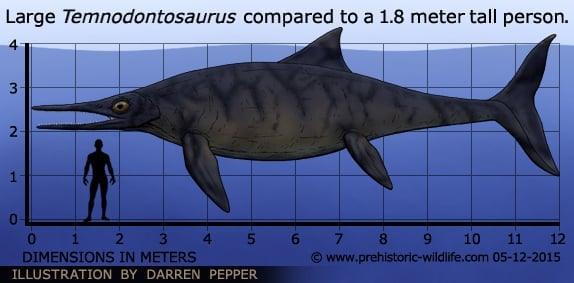
Up to‭ ‬12‭ ‬meters long.

Known locations

Europe including British Isles and Germany.

Time Period

Hettangian through to Toarcian of the Jurassic.

Fossil representation

Several specimens.

Temnodontosaurus: Research Database

Ichthyosauria (Reptilia) · Early Jurassic (~195–190 MYA) · Europe — Germany (Posidonia Shale, Holzmaden)


Research Note: Temnodontosaurus was a large-bodied ichthyosaur from the Early Jurassic Posidonia Shale of Germany. As one of the largest known ichthyosaurs and a top marine predator, it provides critical data on ichthyosaur ecology, body size evolution, and Mesozoic marine ecosystem structure.


Research Finding Status Grade Year Method Citation Impact
Maisch 1998: Temnodontosaurus and ichthyosaur diversity in the Jurassic of Germany
Maisch 1998 provides comprehensive anatomical and taxonomic data on Temnodontosaurus from the Early Jurassic Posidonia Shale of Germany, establishing it as one of the largest known ichthyosaurs and documenting its significance for understanding ichthyosaur body size evolution and trophic ecology in Early Jurassic marine ecosystems
Confirmed A 1998 Fossil Maisch, Neues Jahrbuch Geologie Paläontologie Taxonomy
Vincent 2010: New data on Temnodontosaurus and Early Jurassic marine predator-prey dynamics
Vincent 2010 provides additional anatomical and ecological data on Temnodontosaurus, including evidence for its role as a top marine predator capable of tackling large prey, contextualising it within the broader framework of Jurassic marine ecosystem evolution
Confirmed B 2010 Fossil Vincent, Palaeontographica Ecology
Status:
Confirmed Direct evidence
Grade:
A Strong consensus
B Good evidence


Active Debate: Ichthyosaur Body Size Evolution and Trophic Position in Early Jurassic Marine Ecosystems

The maximum body size attained by Temnodontosaurus — with estimates reaching 9-12 meters — raises questions about the selective pressures driving gigantism in ichthyosaurs. Some researchers argue that large body size evolved in response to predation pressure and competition with other marine reptiles, while others suggest it was driven by prey availability and thermal ecology in the oxygen-poor, stratified Posidonia Sea. Whether Temnodontosaurus was an apex predator capable of taking very large prey, including other ichthyosaurs, is also debated, with some specimens showing stomach contents suggesting cannibalistic tendencies.

There is also debate about the phylogenetic position of Temnodontosaurus within Ichthyosauria, with some studies placing it within Teretocleidosaurus and others suggesting it represents a more basal lineage outside the Euichthyosauria clade.


What We Still Do Not Know About Temnodontosaurus

  • Maximum body size: Estimates vary widely (7-12m); complete specimens rare.
  • Precise diet: Known to have preyed on fish and other ichthyosaurs, but full range unclear.
  • Reproductive biology: No known neonate associations.
  • Skin and color: Occasionally preserved but incomplete.

In Depth

       Temnodontosaurus is one of the oldest and largest ichthyosaurs known to science,‭ ‬and while there are a few species associated with the genus,‭ ‬the most obvious differences between these are the size and proportions of the jaws.‭ ‬Temnodontosaurus fossils have been so well preserved that they reveal stomach contents of ammonites and cephalopods like squid.‭ ‬Juvenile specimens have also been reported inside Temnodontosaurus remains,‭ ‬but in a position that suggests they were waiting to be born rather than being digested.‭ ‬Live birth in ichthyosaurs like Temnodontosaurus has long been suspected as their fusiform bodies that are so much like fish would make it impossible for them to climb onto land.‭Study of other genera such as Ophthalmosaurus amongst others have helped to confirm the theory of live birth in ichthyosaurs. ‬Like most large ichthyosaurs,‭ ‬Temnodontosaurus is thought to have been a marine reptile of deep water,‭ ‬mostly rising to the surface just to breathe in fresh air.

       Temnodontosaurus had large eyes that were roughly twenty centimetres across.‭ ‬These large eyes would have enabled Temnodontosaurus to see better when in deep water where most of the above sunlight could not penetrate.‭ ‬The large eyes providing a greater catch area for the little available light would allow Temnodontosaurus to distinguish ammonite forms against the dim oceanic backdrop.‭ ‬Aside from ammonites found inside Temnodontosaurus fossils,‭ ‬further support for this hunting behaviour comes from study of the teeth which reveals that they had robust roots so that they could withstand the stresses of cracking shells without breaking off.‭

       Ammonites would have been a plentiful food supply back in the Jurassic oceans,‭ ‬and one that could not have required a great amount of energy expenditure to catch.‭ ‬This suited the large body of Temnodontosaurus as it would require large amounts of a stable food supply to keep going.‭ ‬It is hard to say how the large size came about however but a larger body can carry more oxygen for Temnodontosaurus to stay hunting down in the depths for longer.‭ ‬It‭’‬s possible that the earlier ancestors of Temnodontosaurus came across the plentiful supply of deep water cephalopods and grew larger to take better advantage of it.‭ ‬However this greater size also brought a greater reliance upon them,‭ ‬a specialisation that could bring the end of the genus with the disappearance of the prey.

Further Reading

– A revision of the longipinnate ichthyosaurs of the Lower Jurassic of England, with descriptions of two new species (Reptilia: Ichthyosauria) – C. McGowan – 1974. – Temnodontosaurus risor is a Juvenile of T. platyodon (Reptilia: Ichthyosauria) – C McGowan – 1995. – A longirostrine Temnodontosaurus (Ichthyosauria) with comments on Early Jurassic ichthyosaur niche partitioning and disparity – Jeremy E. Martin, Valentin Fischer, Peggy Vincent & Guillaume Suan – 2010. – First temnodontosaurid (Ichthyosauria, Parvipelvia) from the Lower Jurassic of the Atacama Desert, northern Chile. – Journal of South American Earth Sciences. – R. A. Otero & P. 2020 – 2020. – A revision of Temnodontosaurus crassimanus (Reptilia: Ichthyosauria) from the Lower Jurassic (Toarcian) of Whitby, Yorkshire, UK. – Historical Biology. – E. J. Swaby & D. R. Lomax – 2020.

Adopt A Species
prehistoric-wildlife new logo

Love this species?

Adopt it today!

(UPDATED!)

SPECIES SPOTLIGHT

Argentinosaurus