In Depth
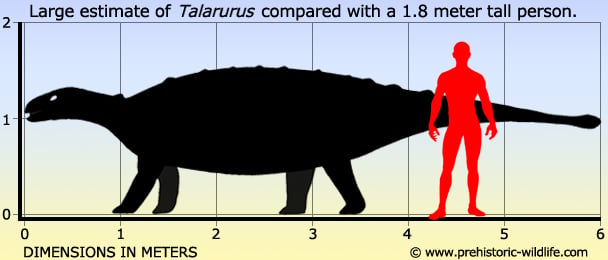
With the currently clear exception of Pinacosaurus, Talarurus is one of the best represented ankylosaurs from Asia. Talarurus was given its name because the tendons wove around the caudal (tail) vertebrae like a wicker basket. In life these would have strengthened and stiffened the tail so that the club on the end could be brought to bear with even more force. Analysis of the Bayan Shireh Formation concludes that Talarurus lived in a wetland environment. This is a stark contrast to many other ankylosaur genera which have been found in what were arid environments during the Cretaceous. Like other ankylosaurs however, Talarurus would have been a quadrupedal browser of low growing vegetation.
Talarurus was named, by the famous Russian palaeontologist Evgeny Maleev, who during his career also named other notable dinosaur genera, including Tarbosaurus and Therizinosaurus. Maleev had a genus of ankylosaur, Maleevus, named after him in 1987, and on a more trivial note, this ankylosaur has been found in the same fossil formation as Talarurus, however speculation has been raised that Maleevus may actually be based upon further remains of Talarurus.
Further Reading
- Noviy ankilosavr is verchnego mela Mongolii [A new ankylosaur from the Upper Cretaceous of Mongolia], Evgeny Maleev - 1952. – Neuroanatomy of the ankylosaurid dinosaurs Tarchia teresae and Talarurus plicatospineus from the Upper Cretaceous of Mongolia, with comments on endocranial variability among ankylosaurs. – Palaeogeography, Palaeoclimatology, Palaeoecology. 494. – A. Paulina-Carabajal, Y. N. Lee, Y. Kobayashi, H. J. Lee & P. J. Currie – 2017. – Additional skulls of Talarurus plicatospineus (Dinosauria: Ankylosauridae) and implications for paleobiogeography and paleoecology of armored dinosaurs. – Cretaceous Research. – Jin-Young Park, Yuong-Nam Lee, Philip J.Currie, Yoshitsugu Kobayashi, Eva Koppelhus, Rinchen Barsbold, Oct�vio Mateus, Sungjin Lee, Su-Hwan Kim – 2019.