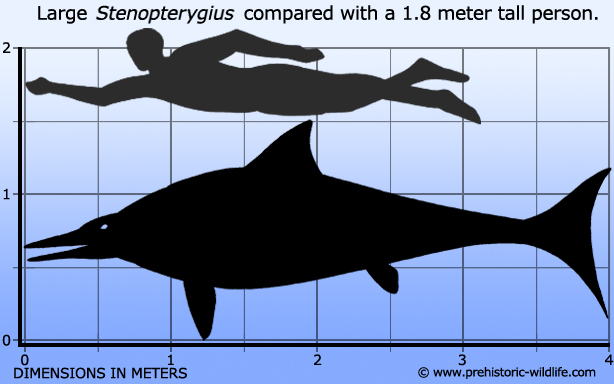
Stenopterygius: Research Database
Ichthyosauria (Reptilia) · Early Jurassic (~180 MYA) · Europe — Germany (Holzmaden)
Research Note: Stenopterygius was an ichthyosaur from the Early Jurassic Posidonia Shale of Germany. As an ichthyosaur with excellent soft-tissue preservation, it provides important data on ichthyosaur anatomy, physiology, and marine reptile evolution.
| Research Finding | Status | Grade | Year | Method | Citation | Impact |
|---|---|---|---|---|---|---|
|
Maisch 1998: Stenopterygius and ichthyosaur diversity in the Jurassic of Germany
Maisch 1998 provides comprehensive data on Stenopterygius from the Early Jurassic of Germany, establishing it as an ichthyosaur and documenting its significance for understanding ichthyosaur diversity and anatomy in the Jurassic seas of Europe
|
Confirmed | A | 1998 | Fossil | Maisch, Neues Jahrbuch Geologie Paläontologie | Taxonomy |
|
Maxwell & Cortés 2020: New data on Stenopterygius from the Jurassic of Germany
Maxwell & Cortés 2020 provide additional data on Stenopterygius and ichthyosaur preservation, providing new insights into ichthyosaur anatomy and biology
|
Confirmed | B | 2020 | Fossil | Maxwell & Cortés, Palaeontologia Electronica | Anatomy |
Active Debate: Ichthyosaur Physiology and the Evolution of Live Birth
Whether ichthyosaurs were fully warm-blooded is debated.
What We Still Do Not Know About Stenopterygius
- Complete skeletal morphology: Well known.
- Color patterns: Known from soft tissue.
- Swimming mechanics: Studied.
- Social behavior: No direct evidence.
In Depth
Stenopterygius is yet another example of a genus that once had a large number of species assigned to it only for most of these to now be regarded as synonyms to other previously named species. In addition while some of the remains of one species, S. hauffianus were reassigned to the type species S. quadriscissus, some of the former remains of this species were used to establish the genus Hauffiopteryx. Also like with many other ichthyosaurs, Stenopterygius was initially described as a species of Ichthyosaurus by Stenopterygius in 1856, until Otto Jaekel discovered the remains to actually belong to a distinct genus.
At least one well preserved specimen of Stenopterygius shows a large embryo inside the body of a female. Combined with other specimens showing the actual birth of baby ichthyosaurs, this helps prove without doubt that ichthyosaurs were viviparous reptiles, which in laymens terms means that they gave birth to live young instead of laying eggs. Although this might seem strange, live birth is actually well documented in some species of reptiles, including some modern species of snake and lizard alive today. Baby ichthyosaurs are also known to be born tail first so that they didn’t drown while being passed out of the birth canal.
Like with the majority of other icthyosaurs, Stenopterygius was a pelagic (open seas) hunter of fish and cephalopods like squid. In this environment its streamlined body would have afforded Stenopterygius with a high degree of speed and mobility, allowing it to hunt in a similar manner to a dolphin. Possible predators of Jurassic era ichthyosaurs like Stenopterygius may have included large pliosaurs similar to Simolestes and Pliosaurus (although these two genera lived a little later than Stenopterygius). Although while in the water Stenopterygius would have been very difficult to catch, they like other marine reptiles would still need to surface to breathe in fresh air, and it would be then that they would be at their most vulnerable.
Further Reading
– Revision der Gattung Stenopterygius Jaekel, 1904 emend. von Huene, 1922 (Reptilia: Ichthyosauria) aus dem unteren Jura Westeuropas – Palaeodiversity 1: 227–271. – Michael W. Maisch – 2008. – First diagnostic marine reptile remains from the Aalenian (Middle Jurassic): a new ichthyosaur from southwestern Germany – PLoS ONE 7(8):e41692 – E. E. Maxwell, M. S. Fern�ndez & R. R. Schoch – 2012.