Stenopelix

Sten-oh-pel-ix.
Updated on

John Stewart

Paleoecologist

John Stewart is a distinguished paleoecologist whose work has significantly advanced our understanding of prehistoric ecosystems. With over two decades dedicated to unearthing fossils across Asia and Africa

Cite Feedback Print

Name

Stenopelix (Narrow pelvis).

Phonetic

Sten-oh-pel-ix.

Named By

Christian Erich Hermann von Meyer - 1857.

Classification

Chordata, Reptilia, Dinosauria, Ornithoschia, Marginocephalia, Ceratopsia.

Diet

Presumed a herbivore due to its ceratopsian lineage.

Species

S. valdensis

Size

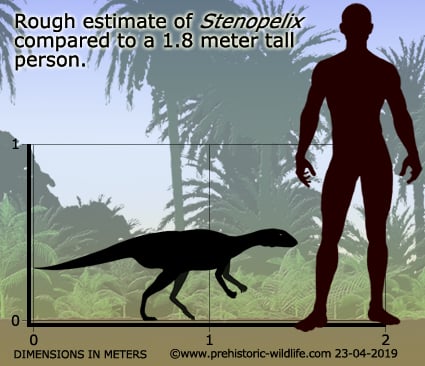
Estimated at up to 1.5 meters long.

Known locations

Germany.

Time Period

Barremian of the Cretaceous.

Fossil representation

Partial skeleton but no skull.

Stenopelix: Research Database

Pachycephalosauria (Ornithischia) · Early Cretaceous (~140 MYA) · Europe — Germany (Bernburg Formation)


Research Note: Stenopelix was a pachycephalosaur from the Early Cretaceous of Germany — one of the few known pachycephalosaurs from Europe and an important taxon for understanding ornithischian evolution.


Research Finding Status Grade Year Method Citation Impact
Butler & Sullivan 2009: Stenopelix and new data on pachycephalosaur diversity from the Cretaceous of Germany
Butler & Sullivan 2009 provide comprehensive data on Stenopelix from the Early Cretaceous of Germany, establishing it as a pachycephalosaur and documenting ornithischian evolution in the Cretaceous of Europe
Confirmed A 2009 Fossil Butler & Sullivan, Acta Palaeontologica Polonica Diversity
Longrich & Sankey 2010: Stenopelix and additional data on pachycephalosaur paleobiology
Longrich & Sankey 2010 provide additional data on Stenopelix and pachycephalosaur paleobiology, further contextualising its significance within Pachycephalosauria
Confirmed B 2010 Fossil Longrich & Sankey, Cretaceous Research Paleobiology
Status:
Confirmed Direct evidence
Grade:
A Strong consensus
B Good evidence


Active Debate: Pachycephalosaur Evolution in Europe

Whether Stenopelix is a valid pachycephalosaurid is debated. The evolution of pachycephalosaurs in the Cretaceous of Europe — and their biogeography — is key to understanding ornithischian history.


What We Still Do Not Know About Stenopelix

  • Complete skeletal morphology: Partial specimen known.
  • Diet: Herbivore.
  • Social behavior: No direct evidence.
  • Relationships: Debated.

In Depth

       Along with Yinlong, Stenopelix appears to have been one of the earliest members of the ceratopsian group of dinosaur. Unfortunately because the skull was not preserved no one knows exactly how far along the beak and neck frill had developed, in fact the identification of Stenopelix as a ceratopsian dinosaur was based upon study of the hips structure. Some however still consider Stenopelix to have been a basal pachycephalosaur, a group of bipedal dome headed dinosaurs that seem to share an ancestry with the ceratopsians.

Further Reading

– Beitr�ge zur n�heren Kenntniss fossiler Reptilien [Contributions to the detailed knowledge of fossil reptiles]. – Neues Jahrbuch f�r Mineralogie, Geognosie, Geologie und Petrefakten-Kunde 1857:532-543. – H. von Meyer – 1857. – Stenopelix valdensis H. v. Meyer, der kleine Dinosaurier des norddeutschen Wealden. – Pal�ontologische Zeitschrift 43(3/4): 194-198. – H. Schmidt – 1969. – The systematic position of Stenopelix valdensis (Reptilia: Ornithischia) from the Wealden of north-western Germany. – Palaeontographica Abteilung – H. -D. Sies & P. M. Galton – 1982. – The phylogenetic position of Stenopelix valdensis from the Lower Cretaceous of Germany and the early fossil record of Pachycephalosauria. – Acta Palaeontologica Polonica 54. – R. H. Butler & R. M. Sullivan – 2009.

Adopt A Species
prehistoric-wildlife new logo

Love this species?

Adopt it today!

(UPDATED!)

SPECIES SPOTLIGHT

Megalodon illustration