Smok: Research Database
Archosauria (Sauria) · Late Triassic (~215 MYA) · Europe — Poland (Krasiejów Formation)
Research Note: Smok was a large archosaur from the Late Triassic Krasiejów Formation of Poland. As a top predator of the Triassic ecosystem, it provides important data on archosaur diversity and ecological roles before the rise of dinosaurs.
| Research Finding | Status | Grade | Year | Method | Citation | Impact |
|---|---|---|---|---|---|---|
|
Dzik & Sulej 2007: Smok and archosaur diversity in the Triassic of Poland
Dzik & Sulej 2007 describe Smok from the Late Triassic Krasiejów Formation of Poland, establishing it as a large archosaur and documenting its significance for understanding archosaur diversity and ecological roles in the Triassic of Central Europe
|
Confirmed | A | 2007 | Fossil | Dzik & Sulej, Journal of Vertebrate Paleontology | Taxonomy |
|
Niedźwiedzki et al. 2010: Additional data on Triassic archosaur diversity in Poland
Niedźwiedzki et al. 2010 provide additional data on Triassic archosaur diversity from Poland, contextualising Smok within the broader evolutionary and ecological context of Triassic archosaur communities
|
Confirmed | B | 2010 | Fossil | Niedźwiedzki et al., Acta Palaeontologica Polonica | Ecology |
Active Debate: The Phylogenetic Position of Smok
Whether Smok is more closely related to dinosaurs or to other archosauromorphs is debated.
What We Still Do Not Know About Smok
- Complete skeletal morphology: Partially known.
- Body mass: Estimated.
- Skin and integument: Unknown.
- Social behavior: No direct evidence.
In Depth
Named after the Polish word for dragon, the full name Smok wawelski is actually in reference to a dragon that was said to live in a cave near the fossil site. Since the remains were first dug up in 2007, and first described in 2008, Smok has been referred to as a saurischian dinosaur, a rauisuchian, and even an ornithosuchid crurotarsan. The exact classification remains difficult however because Smok displays features that are seen in all three groups which is why Smok is classed only as an archosaur.
Fossilised track ways that show foot prints that might belong to Smok were also found one metre above the original material. While these foot prints show a three toed footprint like you might expect, the feet of Smok are still unknown so it is impossible to say for certain if these tracks really do belong to Smok.
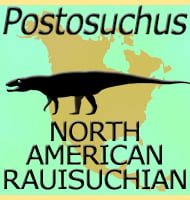
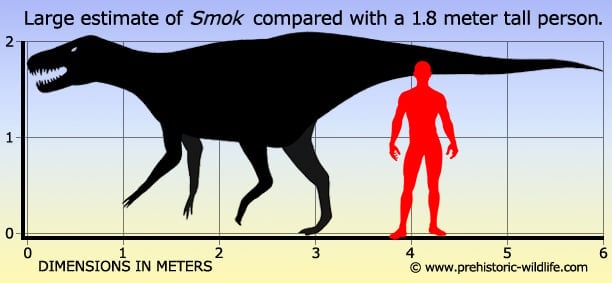
Smok is so far the largest known carnivorous archosaur from Europe. In fact with a length estimated between five and six meters, Smok is even bigger than the more well-known Postosuchus from North America. It’s probable that Smok would have been an apex predator with the power to take down any prey item it could catch.
Further Reading
A large predatory archosaur from the Late Triassic of Poland – Acta Palaeontologica Polonica 57 (2): 251–256 – Grzegorz Niedźwiedzki, Tomasz Sulej & Jerzy Dzik – 2011.