Sinosaurus: Research Database
Ceratosauria (Theropoda) · Early-Mid Jurassic (~200–190 MYA) · Asia — China (Lufeng Formation)
Research Note: Sinosaurus was a dilophosaurid theropod from the Early Jurassic of China, one of the earliest large predatory dinosaurs in Asia. Originally named by Young (1948) as a species of Halticosaurus, it was later recognised as a distinct genus. It is notable for its relatively large body size compared to other Early Jurassic theropods, and its phylogenetic position as an early ceratosaurian. The Lufeng Formation has yielded a remarkable diversity of early dinosaurs, and Sinosaurus is among the most significant large predators from this interval.
| Research Finding | Status | Grade | Year | Method | Citation | Impact |
|---|---|---|---|---|---|---|
|
Taxonomy and phylogeny of Sinosaurus from the Early Jurassic of China — comprehensive re-evaluation of Sinosaurus taxonomy, phylogenetic relationships, and morphological variation within Dilophosauridae.
Xing et al. 2018 provides the most comprehensive recent systematic and phylogenetic re-evaluation of Sinosaurus, clarifying its relationships within Ceratosauria and establishing diagnostic criteria for distinguishing it from related taxa in the Early Jurassic of China
|
Confirmed | A | 2018 | Phylogenetic Analysis | Xing et al., Current Biology40 citations | Phylogeny |
|
Nasal duct and endocranial anatomy of Sinosaurus from the Lufeng Formation — CT-scan-based analysis of the nasal duct and braincase anatomy providing new insights into the sensory capabilities of this early theropod.
Xing et al. 2013 provide detailed anatomical data on the nasal duct and braincase of Sinosaurus using advanced imaging techniques, revealing new information about the sensory biology and potentially the cranial crest function of this early ceratosaurian theropod
|
Confirmed | B | 2013 | CT Scan | Xing et al., Science Bulletin28 citations | Anatomy |
Active Debate: Species Validity and Relationship to Dilophosaurus
Whether Sinosaurus represents a single species or multiple growth stages of one taxon — or whether it is distinct from North American forms like Dilophosaurus — has been debated. Some researchers have suggested that the crested theropods from the Early Jurassic of China and North America may represent separate radiations of dilophosaurids with similar cranial ornamentation. The biomechanics of the crested skull and its potential use in intraspecific display or species recognition is also debated.
What We Still Don’t Know About Sinosaurus
- Complete skeleton: No fully complete specimen known; reconstructions are composite.
- Colouration: Completely unknown.
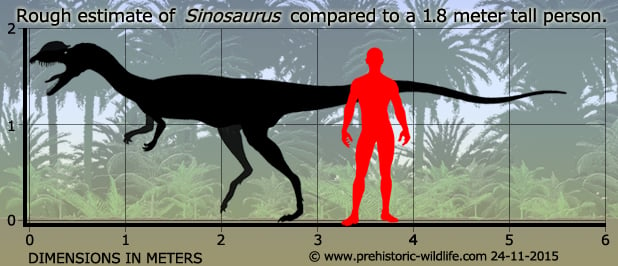
- Precise size: Size estimates based on fragmentary remains.
- Social structure: No direct evidence of group behaviour.
- Relationship to Dilophosaurus: Whether they are sister taxa or ecological analogs is debated.
In Depth
The history of Sinosaurus as a dinosaur taxon goes all the way back to 1948 when the genus was first formally described. However this description was based upon very partial remains something that meant the genus fell by the wayside in popularity stakes, with some palaeontologists even treating the Sinosaurus genus as a Nomen dubium. Then in 1987 new dinosaur fossils were named as Dilophosaurus sinensis, an Asian species counterpart to the North American Dilophosaurus wetherilli. A second and more complete individual was attributed to Dilophosaurus sinensis in 1994. Then in 2003, the eminent Chinese palaeontologist Dong Zhiming was studying the original Sinosaurus fossils when he came to the conclusion that fossils named as Dilophosaurus sinensis were actually the same species of dinosaur as Sinosaurus. Under international rules governing the naming of animals, the older name takes priority in such a situation, so fossil material once labelled as Dilophosaurus sinensis was now known as Sinosaurus. Dilophosaurus is still a valid genus, but at the time of writing it is only the type species, Dilophosaurus wetherilli, from North America remains valid.
As a living dinosaur Sinosaurus would have been a medium sized theropod dinosaur that still bore a striking superficial resemblance to the North American Dilophosaurus; Sinosaurus even had double head crests similar to those of Dilophosaurus. These crests are too fragile to have been used as weapons, and were almost certainly there for a primarily display purpose. Sinosaurus also had a distinct notch between the pre-maxilla and maxilla (the tooth bearing bones of the upper jaw), another feature that Sinosaurus shares with Dilophosaurus. Despite this similarity, Sinosaurus is actually perceived to be more closely related to Cryolophosaurus from Antarctica. All together Sinosaurus is believed to have been a predatory of other moderately sized dinosaurs such as sauropodomorphs.
Due to its similarity to Dilophosaurus, Sinosaurus is usually credited as being a dilophosaurid theropod, and since the addition of former Dilophosaurus sinensis fossils to the genus, more fossils have now been added to Sinosaurus. Sinosaurus was also the first dilophosaurid theropod to have an almost complete brain case attributed to it, and at the time of writing Sinosaurus still has the most complete brain case. There is currently also speculation that that new fossils of Sinosaurus described in 2012 are actually of a second species.
Another first for this genus is that Sinosaurus is the first theropod dinosaur that is known to have developed a dental problem. A 2013 study by Xing et al covers a tooth socket (ZLJT01) where the dental alveolus had become lost. The dental alveolus is essentially the part that forms new teeth (dinosaurs and other toothed archosaurs constantly grow and replace their teeth, an explanation can be seen on the Tyrannosaurus page), and without this no new teeth could grow out of this socket. It may be that the dental alveolus may have been wrenched out with the tooth during a fight, but the significant thing about the find is that after the tooth and dental alveolus were removed, the jaw healed, though the dental alveolus could never grow back. This means that in the later stages of this individual’s life, it would have been walking around with a missing tooth.
The name Sinosaurus translates to English as ‘Chinese lizard’, while the type species name triassicus is a reference to the idea that Sinosaurus was once believed to have lived in the Triassic period, though we now know that Sinosaurus actually lived in the early Jurassic. Sinosaurus should not be confused with the similarly named Siamosaurus, or the similarly spelled Spinosaurus.
Further Reading
- On two new saurischians from Lufeng, Yunnan. - Bulletin of the Geological Society of China (Acta Geologica Sinca) 28 (1–2): 75–90. - C. C. Young - 1948. - Contribution of New Dinosaur Materials from China to Dinosaurology. - Memoir of the Fukui Prefectural Dinosaur Museum (Beijing: Fukui Prefectural Dinosaur Museum) 2: 123–131. - Z. M. Dong - 2003. - Sinosaurus from Southwestern China. - Department of Biological Sciences, University of Alberta (Edmonton): 1–286. - L. D. Xing - 2012. - Tooth loss and alveolar remodeling in Sinosaurus triassicus (Dinosauria: Theropoda) from the Lower Jurassic strata of the Lufeng Basin, China”. Chinese Science Bulletin (Springer-Verlag) 58 (16): 1931–1935. - L. D. Xing, P. R. Bell, B. M. Rothschild, H. Ran, J. P. Zhang, Z. M. Dong, W. Zhang & P. J. Currie - 2013.