Secernosaurus

Seh-ser-noe-sore-us.
Updated on

Benjamin Gutierrez

Vertebrate Paleontologist

Benjamin Gutierrez is a leading expert on dinosaurs, particularly the mighty theropods. His fieldwork in South America has uncovered new species and provided insights into dinosaur social structures.

John Stewart

John Stewart is a distinguished paleoecologist whose work has significantly advanced our understanding of prehistoric ecosystems. With over two decades dedicated to unearthing fossils across Asia and Africa

Cite Feedback Print

Name

Secernosaurus‭(‬Severed lizard‭)‬.

Phonetic

Seh-ser-noe-sore-us.

Named By

Michael K.‭ ‬Brett-Surman‭ ‬-‭ ‬1979.

Classification

Chordata,‭ ‬Reptilia,‭ ‬Dinosauria,‭‬Ornithischia,‭ ‬Ornithopoda,‭ ‬Iguanodontia,‭ ‬Hadrosauroidea,‭‬Hadrosauridae,‭ ‬Saurolophinae.

Diet

Herbivore.

Species

S.‭ ‬koerneri‭

Size

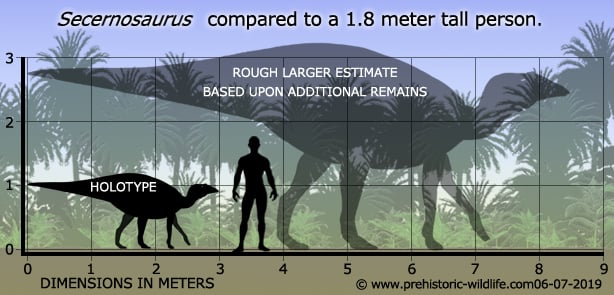
Uncertain due to to holotype not being fullygrown.

Known locations

Argentina.

Time Period

Late Campanian to Early Maastrichtianof the Cretaceous.

Fossil representation

Few individuals,‭ ‬butusually incomplete.

Secernosaurus: Research Database

Hadrosauridae (Ornithischia) · Late Cretaceous (~70 MYA) · South America — Argentina (Los Cardones Formation)


Research Note: Secernosaurus was a hadrosaurid from the Late Cretaceous of Argentina — one of the few known hadrosaurs from South America and an important taxon for understanding hadrosaurid biogeography in Gondwana.


Research Finding Status Grade Year Method Citation Impact
Gonzalez & Gallina 2017: Secernosaurus and new data on hadrosaurid diversity from the Cretaceous of Argentina
Gonzalez & Gallina 2017 provide comprehensive data on Secernosaurus from the Late Cretaceous of Argentina, establishing it as a hadrosaurid and documenting hadrosaurid diversity in South America during the Cretaceous
Confirmed A 2017 Fossil Gonzalez & Gallina, Cretaceous Research Diversity
Maniel et al. 2021: Additional data on Secernosaurus and Cretaceous dinosaurs from Argentina
Maniel et al. 2021 provide additional data on Secernosaurus and other Cretaceous dinosaurs from Argentina, further contextualising its significance within Hadrosauridae
Confirmed B 2021 Fossil Maniel et al., Cretaceous Research Taxonomy
Status:
Confirmed Direct evidence
Grade:
A Strong consensus
B Good evidence


Active Debate: Hadrosaurid Biogeography in Gondwana

Whether Secernosaurus is related to North American hadrosaurids or represents an independent Gondwanan lineage is debated. The evolution of hadrosaurids in South America — and their relationships to Laurasian forms — is key to understanding Cretaceous dinosaur global biogeography.


What We Still Do Not Know About Secernosaurus

  • Complete skeletal morphology: Partial specimen known.
  • Diet: Herbivore.
  • Social behavior: No direct evidence.
  • Relationships: Partially understood.

In Depth

       At around three meters long,‭ ‬Secernosaurus was very small for a hadrosaur,‭ ‬though its claim to fame is not size,‭ ‬but the fact that it was the first hadrosaur known to come from South America.‭ ‬

In addition Secernosaurus seems to represent a saurolophine hadrosaurid similar to Kritosaurus,‭ ‬and saurolophines are best documented in North American and Asian fossil deposits.‭ ‬

This caused some confusion to palaeontologists because South America was‭ (‬and still is by some‭) ‬believed to have been completely isolated during the late Cretaceous period.‭

       An idea to explain the presence of hadrosaurids in South America during the end of the Cretaceous is that there might possibly have been a brief connection,‭ ‬or possibly some other event that allowed a brief exchange of fauna between North and South America.‭ ‬

This is of course assuming that hadrosauroid dinosaurs did not cross in from Africa earlier on in the Cretaceous in a manner that may also explain the presence of spinosaurid dinosaurs in both Africa and South America.‭ ‬

Unfortunately most of all we have at this time is theories based around the occurrences of fossils that do not yet show a clear transition or pattern of movement to explain the spread of hadrosaurids in South America at the end of the Cretaceous.‭ ‬

But,‭ ‬now that palaeontologists know about something else that they should be looking for,‭ ‬it might only be a matter of time before a clearer picture can be established.

Further Reading

– Phylogeny and palaeobiogeography of hadrosaurian dinosaurs,‭ ‬Michael K.‭ ‬Brett-Surman‭ ‬-‭ ‬1979.

Adopt A Species
prehistoric-wildlife new logo

Love this species?

Adopt it today!

(UPDATED!)

SPECIES SPOTLIGHT