In Depth
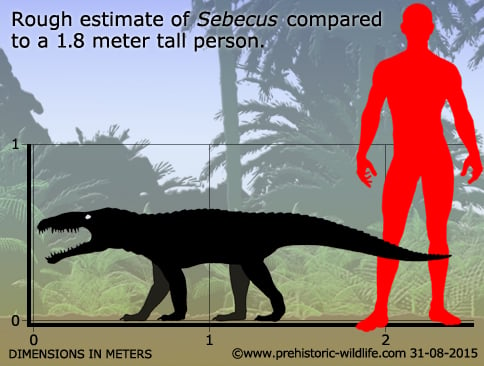
Sebecus is a genus of notosuchian crocodylomorph that is known to have lived in South America during the earliest part of the Eocene. Sebecus would have been predators of other similarly sized animals, but unlike crocodiles that we know today, Sebecus would have been more terrestrial and hunting on the land. Details of the anatomy such as longer legs and eyes that are on the sides of the head rather than orientated to look up all support this conclusion. The snout of Sebecus was deep, indicating longer jaw closing muscles that in turn suggest that had a particularly strong bite. The teeth of Sebecus have also been noted to be similar to the teeth of the earlier tyrannosaurid dinosaurs. These teeth had fairly blunt tips but were strongly serrated, with the serrations adapted for tearing up the preys muscle fibres. Combined with the extra strong jaw closing muscles and Sebecus may have hunted animals that had notably tough hides, possibly even crunching through bones.
At the time of writing only the type species of Sebecus, S. icaeorhinus, is considered valid The Sebecus genus once had two additional species assigned to it, S. huilensis and S. querejazus. S. huilensis has now been classified as its own genus Langstonia, while S. querejazus is also its own genus named Zulmasuchus, both changes being a result of a 2007 study into Sebecus by Paolillo & Linares.
Further Reading
- Sebecus, representative of a peculiar suborder of fossil Crocodilia from Patagonia, - Bulletin of the American Museum of Natural History 87 (4): 221–270. - E. H. Colbert - 1946. - The serrated teeth of tyrannosaurid dinosaurs, and biting structures in other animal. - Paleobiology 18 (2): 161–183. - W. L. Abler - 1992. - The serrated teeth of Sebecus and the Iberoccitanian crocodile, a morphological and ultrastructural comparison. - Stvdia Geologica Salmanticensia 29: 127–14. - O. Legasa, A. D. Buscalioni & Z. Gasparini - 1993. - Nuevos cocodrilos Sebecosuchia del Cenozoica Suramericana (Mesosuchia : Crocodylia). - Paleobiologica Neotropical 3: 1–25. - A. Paolillo & O. Linares - 2007. - Postcranial anatomy of Sebecus icaeorhinus (Crocodyliformes, Sebecidae) from the Eocene of Patagonia. - Journal of Vertebrate Paleontology 32 (2): 328–354. - Diego Pol, Juan M. Leardi, Agustina Lecuona & Marcelo Krause - 2012.