In Depth
A very large prehistoric crocodile Sarcosuchus was initially only known from teeth and osteoderms. In 1964 the first skull was discovered and the type species could then be established. However it was not until the closing years of the twentieth century that more complete material including vertebra, ribs and other parts of the post cranial skeleton. Although still not complete, there is now enough material to give a rough estimate on the potential size of Sarcosuchus.
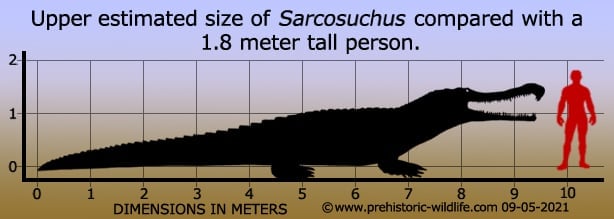
Towards the end of the twentieth century Sarcosuchus was thought to have been around eleven to twelve meters long, an estimate based upon comparison of the skull to body length proportions of crocodiles alive today. This method was also used for many other genera of prehistoric crocodiles, however it also doesn’t seem to have been entirely reliable in some cases, especially given the variance in skull shapes and sizes amongst crocodilians. Later twenty-first century studies (O’Brian et al 2019) using differing comparison methods have a yielded a slightly smaller estimate of nine to nine and a half meters for known Sarcosuchus individuals. This still makes Sarcosuchus significantly larger than the largest recorded crocodiles alive today which only rarely attain lengths of six to seven meters.
Sarcosuchus was not just bigger than today’s crocodiles it was also a lot older. Most crocodiles have an average lifespan in the wild of around twenty-five years, with some individuals reaching thirty or more. Study on the growth rings present on some of the osteoderms show that Sarcosuchus was around forty years old and yet not fully grown when it died. Whereas todays crocodiles grow large and then stop when they reach adulthood, Sarcosuchus just kept getting bigger. It could be that the only limiting factor to how big it grew was when it could no longer sustain such a massive body with the available food supply.
As such a massive predator Sarcosuchus would have had to of focused its attention on hunting animals that could provide enough sustenance to keep its body going, and the two main animal groups available to it were the dinosaurs and large lobe finned fish. While the idea of Sarcosuchus shooting out of the water to drag a hadrosaur off the shoreline is a tantalising one, you need to look at the teeth and jaws of Sarcosuchus for clues.
Deinosuchus had broad jaws and strong teeth, perfect for dealing with large and powerful prey that would have been struggling as it dragged it into the water. The jaws of Sarcosuchus however had proportionately longer and thinner jaws with relatively small teeth, more suited to a fish diet. It was not until Sarcosuchus grew bigger and older that the jaws began to widen. The tip of the upper jaw also hooked downwards, another adaption seen in other fish eating crocodiles. Predatory dinosaurs of the time and locations include Spinosaurus and Suchomimus. Both dinosaurs have long thin snouts akin to some crocodiles and their teeth are many, sharp and pointed. This has led to most palaeontologists speculating that they were fish hunters, and if true then there must have been a plentiful supply of fish of such size and sustenance to keep their numbers and massive bodies going. A large crocodile of similar size but less active lifestyle and possibly slower metabolism would have been even more suited to surviving upon a fish diet than these dinosaurs.
It may of course be that Sarcosuchus had different lifestyles and diets at different stages of its life. Fish are easy prey for small crocodiles but as they grew larger they would need more sustenance to survive and so they may have begun to incorporate dinosaurs into their diets as well. As seen in crocodiles today, they may have also left the water to scavenge the kills of the larger dinosaurs as well.
Further Reading
– Notice of some new reptilian remains from the Cretaceous of Brazil. American Journal of Sciences and Arts 47:442-444. – O. C. Marsh – 1869. – D�couverte d’un Crocodilien nouveau dans le Cr�tac� inf�rieur du Sahara [Discovery of a new crocodilian in the Lower Cretaceous of the Sahara]. – Comptes Rendus de l’Acad�mie des Sciences � Paris, S�rie D 262:2326-2329. – F. de Broin and P. Taquet – 1966. – The Giant Crocodilian Sarcosuchus in the Early Cretaceous of Brazil and Niger. – Palaeontology. 20 (1). – E. Buffetaut & P. Taquet – 1977. – The Giant Crocodyliform Sarcosuchus from the Cretaceous of Africa. – Science. 294 (5546): 1516–9. – Paul C. Sereno, Hans C. E. Larson, Christian A. Sidor & Boub� Gado – 2001. – The ‘death roll’ of giant fossil crocodyliforms (Crocodylomorpha: Neosuchia): Allometric and skull strength analysis. – Historical Biology. 27 (5): 514–524. – R. E. Blanco, W. W. Jones & J. N. Villamil – 2014. – New fossils of the giant pholidosaurid genus Sarcosuchus from the Early Cretaceous of Tunisia. – Journal of African Earth Sciences. 147: 268–280. – Jihed Dridi – 2018. – Crocodylian Head Width Allometry and Phylogenetic Prediction of Body Size in Extinct Crocodyliforms. – Integrative Organismal Biology. 1 (1). – Haley D O’Brien, Leigha M Lynch, Kent A Vliet, John Brueggen, Gregory M Erickson & Paul M Gignac – 2019. – Systematic revision of Sarcosuchus hartti (Crocodyliformes) from the Rec�ncavo Basin (Early Cretaceous) of Bahia, north-eastern Brazil. – Zoological Journal of the Linnean Society: zlz057. – Rafael G. Souza, Rodrigo G. Figueiredo, S�rgio A. K. Azevedo, Douglas Riff & Alexander W. A. Kellner – 2019.