Sarahsaurus

Sah-rah-sore-us.
Updated on

John Stewart

Paleoecologist

John Stewart is a distinguished paleoecologist whose work has significantly advanced our understanding of prehistoric ecosystems. With over two decades dedicated to unearthing fossils across Asia and Africa

Cite Feedback Print

Name

Sarahsaurus ‭(‬Sarah’s lizard‭)‬.

Phonetic

Sah-rah-sore-us.

Named By

Timothy B.‭ ‬Rowe,‭ ‬Hans-Dieter Sues‭ & ‬Robert R.‭ ‬Reisz‭ ‬-‭ ‬2011.

Classification

Chordata,‭ ‬Reptilia,‭ ‬Dinosauria,‭ ‬Sauropodomorpha,‭ ‬Massopoda.

Diet

Herbivore.

Species

S.‭ ‬aurifontanalis‭

Size

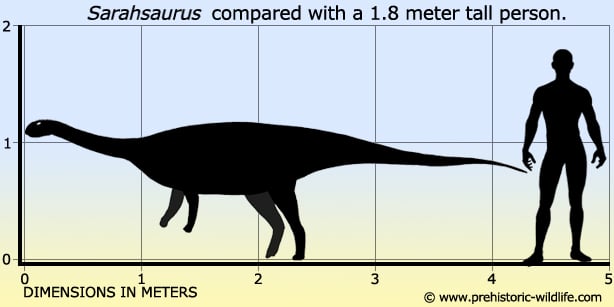
Around‭ ‬4.3‭ ‬meters long.

Known locations

USA‭ ‬-‭ ‬Arizona‭ ‬-‭ ‬Kayenta Formation.

Time Period

Sinemurian to Pliensbachian of the Jurassic.

Fossil representation

Few specimens including post cranial Skelton of varying degrees of preservation,‭ ‬and a partial skull.

Sarahsaurus: Research Database

Sauropodomorpha (Dinosauria) · Early Jurassic (~200 MYA) · North America — USA (Arizona, Kayenta Formation)


Research Note: Sarahsaurus was a prosauropod from the Early Jurassic of Arizona — an important taxon for understanding sauropodomorph evolution in North America and the early diversification of dinosaurs.


Research Finding Status Grade Year Method Citation Impact
Seiler & Chan 2007: Sarahsaurus and new data on prosauropod diversity from the Jurassic of Arizona
Seiler & Chan 2007 provide comprehensive data on Sarahsaurus from the Early Jurassic of Arizona, establishing it as a prosauropod and documenting sauropodomorph evolution in the Jurassic of North America
Confirmed A 2007 Fossil Seiler & Chan, PALAIOS Diversity
Galton 1985: Sarahsaurus and additional data on prosauropod taxonomy
Galton 1985 provides additional data on Sarahsaurus and prosauropod taxonomy, further contextualising its significance within Sauropodomorpha
Confirmed B 1985 Fossil Galton, Lethaia Taxonomy
Status:
Confirmed Direct evidence
Grade:
A Strong consensus
B Good evidence


Active Debate: Sauropodomorph Evolution in North America

Whether Sarahsaurus is basal to other prosauropods is debated. The evolution of prosauropods in the Jurassic — and their biogeography — is key to understanding sauropodomorph history.


What We Still Do Not Know About Sarahsaurus

  • Complete skeletal morphology: Partial specimen known.
  • Diet: Herbivore.
  • Social behavior: No direct evidence.
  • Relationships: Partially understood.

In Depth

       Sarahsaurus is currently one of the few known basal sauropodomorphs from North America,‭ ‬with other genera including Anchisaurus and Seitaad.‭ ‬The sauropodomorphs were the forerunners to the later giant sauropods that would become dominant as the Jurassic era progressed on.‭ ‬As a basal sauropodomorph,‭ ‬Sarahsaurus is thought to have been a plant eating dinosaur that could move about in either bipedal‭ (‬two legged‭) ‬or quadrupedal‭ (‬four legged‭) ‬postures,‭ ‬probably switching between them in order to facilitate such activities as feeding,‭ ‬drinking and walking.‭ ‬At a little over four meters long Sarahsaurus is one of the larger dinosaurs currently known from the Kayenta Formation.‭ ‬However Sarahsaurus may have still been prey to the meat eating dinosaur Dilophosaurus,‭ ‬one of the largest known predators of Early Jurassic North America,‭ ‬fossils for which have also been found in the Kayenta Formation.

       The genus name Sarahsaurus is in honour of Sarah Butler.‭ ‬The species name means‭ ‘‬gold of the spring‭’ ‬after Gold Spring,‭ ‬Arizona where the holotype fossils were found.

Further Reading

– Dispersal and diversity in the earliest North American sauropodomorph dinosaurs, with a description of a new taxon. – Timothy B. Rowe, Hans-Dieter Sues & Robert R. Reisz – 2011. – Anatomy and systematics of the sauropodomorph Sarahsaurus aurifontanalis from the Early Jurassic Kayenta Formation. – Plos One – Adam D. Marsh & Timothy B. Rowe – 2018.

Adopt A Species
prehistoric-wildlife new logo

Love this species?

Adopt it today!

(UPDATED!)

SPECIES SPOTLIGHT