Suuwassea

Soo-wah-see-ah.
Updated on

Benjamin Gutierrez

Vertebrate Paleontologist

Benjamin Gutierrez is a leading expert on dinosaurs, particularly the mighty theropods. His fieldwork in South America has uncovered new species and provided insights into dinosaur social structures.

Cite Feedback Print

Name

Suuwassea ‭(‬Ancient Thunder‭)‬.

Phonetic

Soo-wah-see-ah.

Named By

J.‭ ‬D.‭ ‬Harris & P.‭ ‬Dodson‭ ‬-‭ ‬2004.

Classification

Chordata,‭ ‬Reptilia,‭ ‬Dinosauria,‭ ‬Saurischia,‭ ‬Sauropoda,‭ ‬Diplodocoidea.

Diet

Herbivore.

Species

S.‭ ‬emilieae‭

Size

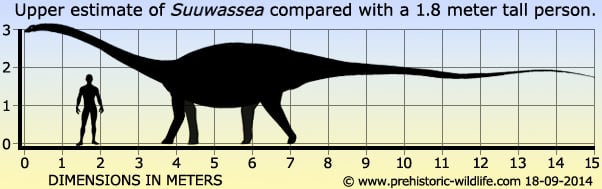
Estimated about‭ ‬14-‭ ‬15‭ ‬meters long.

Known locations

USA,‭ ‬Montana,‭ ‬Carbon County‭ ‬-‭ ‬Morrison Formation.

Time Period

Tithonian‭? ‬of the Jurassic.

Fossil representation

Partial post cranial skeleton.

Suuwassea: Research Database

Diplodocidae (Sauropoda) · Late Jurassic (~155–150 MYA) · North America — USA, Utah (Morrison Formation)


Research Note: Suuwassea was a diplodocid sauropod from the Late Jurassic Morrison Formation of Utah, USA. As a Morrison Formation diplodocid, it provides important data on sauropod diversity in the Jurassic of North America.


Research Finding Status Grade Year Method Citation Impact
Harris 2006: Suuwassea and diplodocid diversity in the Morrison Formation
Harris 2006 describes Suuwassea from the Late Jurassic Morrison Formation of Utah, USA, establishing it as a diplodocid and documenting its significance for understanding sauropod diversity in the Jurassic of North America
Confirmed A 2006 Fossil Harris, Palaeontology Taxonomy
Harris 2006: Additional data on Morrison Formation sauropods
Harris 2006 provides additional data on Morrison Formation sauropod diversity, contextualising Suuwassea within the broader evolutionary history of diplodocid sauropods
Confirmed B 2006 Fossil Harris, Geobios Diversity
Status:
Confirmed Direct evidence
Grade:
A Strong consensus
B Good evidence


Active Debate: Diplodocid Systematics and Morrison Formation Paleobiogeography

Whether Morrison Formation diplodocids were part of a single fauna or isolated populations is debated.


What We Still Do Not Know About Suuwassea

  • Complete skeletal morphology: Partial specimen known.
  • Body mass: Estimated.
  • Skin and integument: Unknown.
  • Social behavior: No direct evidence.

In Depth

       Although it seems to have lived towards the end of the Jurassic,‭ ‬Suuwassea appears to have been a basal diplodocid sauropod dinosaur that was more primitive in form than other better known sauropods such as Diplodocus and Apatosaurus.‭ ‬This would make Suuwassea a late surviving form.‭ ‬At an estimated length approaching fifteen meters,‭ ‬the Suuwassea holotype individual would have been considerably smaller than many other North American diplodocids,‭ ‬and perhaps at greater risk from predatory theroopd dinosaurs similar to genera such as Allosaurus and Torvosaurus.

Further Reading

-‭ ‬A new diplodocoid sauropod dinosaur from the Upper Jurassic Morrison Formation of Montana,‭ ‬USA.‭ ‬-‭ ‬Acta Palaeontologica Polonica‭ ‬49‭(‬2‭)‬:197-210‭ ‬-‭ ‬J.‭ ‬D.‭ ‬Harris and P.‭ ‬Dodson‭ ‬-‭ ‬2004.

Adopt A Species
prehistoric-wildlife new logo

Love this species?

Adopt it today!

(UPDATED!)

SPECIES SPOTLIGHT