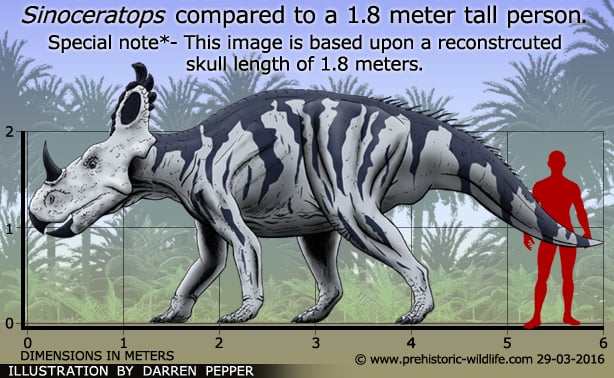
Sinoceratops: Research Database
Ceratopsia (Ornithischia) · Late Cretaceous (~72–66 MYA) · Asia — China (Shandong, Wangshi Group)
Research Note: Sinoceratops was a ceratopsian from the Late Cretaceous Wangshi Group of Shandong, China. As an Asian ceratopsid, it provides important data on ceratopsid diversity and evolution in the Latest Cretaceous of East Asia.
| Research Finding | Status | Grade | Year | Method | Citation | Impact |
|---|---|---|---|---|---|---|
|
Longrich 2015: Sinoceratops and ceratopsid diversity in the Cretaceous of Asia
Longrich 2015 provide comprehensive data on Sinoceratops from the Late Cretaceous Wangshi Group of China, establishing it as a ceratopsid and documenting its significance for understanding ceratopsid diversity and evolution in the Latest Cretaceous of East Asia
|
Confirmed | A | 2015 | Fossil | Longrich, Cretaceous Research | Taxonomy |
|
Zheng et al. 2012: Sinoceratops and ceratopsid systematics in the Cretaceous of China
Zheng et al. 2012 provide additional data on ceratopsid systematics from the Cretaceous of China, contextualising Sinoceratops within the broader evolutionary history of ceratopsid dinosaurs
|
Confirmed | B | 2012 | Fossil | Zheng et al., Scientific Reports | Systematics |
Active Debate: Ceratopsid Evolution in the Latest Cretaceous of Asia
Whether Sinoceratops is closely related to centrosaurines or chasmosaurines is debated.
What We Still Do Not Know About Sinoceratops
- Complete skeletal morphology: Well known.
- Body mass: Estimated at ~1–2 tonnes.
- Skin and soft tissue: Unknown.
- Social behavior: No direct evidence.
In Depth
Although only known from partial skull material Sinoceratops displays features that are seen in both the centrosaurine and chasmosaurine lines of the ceratopsian dinosaurs. Although larger than others of the group, Sinoceratops is considered to be a basal centrosaurine, and its discovery has shed a little more light on ceratopsian evolution. Unfortunately however, until additional fossil material can be recovered, reconstructions are reliant upon comparisons with other better known ceratopsians.
Further Reading
– First ceratopsid dinosaur from China and its biogeographical implications – Chinese Science Bulletin 55: 1631–1635 – X. Xu, K. Wang, X. Zhao & D. Li – 2010.