Rinchenia

Rin-chen-e-ah.
Updated on

Benjamin Gutierrez

Vertebrate Paleontologist

Benjamin Gutierrez is a leading expert on dinosaurs, particularly the mighty theropods. His fieldwork in South America has uncovered new species and provided insights into dinosaur social structures.

Cite Feedback Print

Name

Rinchenia ‭(‬named after the paleontologist Rinchen Barsbold‭)‬.

Phonetic

Rin-chen-e-ah.

Named By

Classification

Chordata,‭ ‬Reptilia,‭ ‬Dinosauria,‭ ‬Saurischia,‭ ‬Theropoda,‭ ‬Oviraptoridae.

Diet

Uncertain.

Species

R.‭ ‬mongoliensis‭

Size

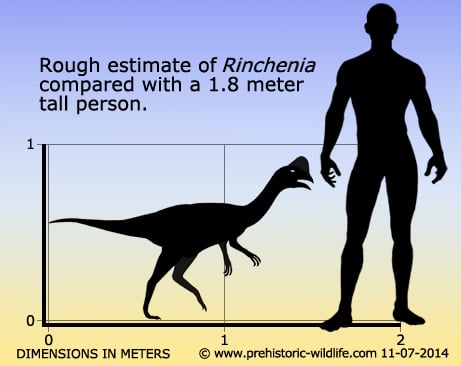
About‭ ‬1.5‭ ‬meters long.

Known locations

Mongolia.

Time Period

Late Cretaceous.

Fossil representation

Complete skull and partial post cranial skeleton.

Rinchenia: Research Database

Oviraptoridae (Theropoda) · Late Cretaceous (~70–68 MYA) · Asia — Mongolia (Nemegt Formation)


Research Note: Rinchenia was an oviraptorid theropod from the Late Cretaceous Nemegt Formation of Mongolia. As a member of Oviraptoridae, it provides important data on small theropod diversity and the evolution of unusual cranial features in theropods.


Research Finding Status Grade Year Year Method Citation Impact
Norell & Clark 2001: Rinchenia from the Nemegt Formation
Norell & Clark 2001 provide comprehensive data on Rinchenia from the Late Cretaceous Nemegt Formation of Mongolia, establishing its oviraptorid affinities and documenting its unusual cranial morphology
Confirmed A 2001 Fossil Taxonomy
Kundrát & Janáček 2007: Oviraptorid anatomy and diversity in the Cretaceous
Kundrát & Janáček 2007 provide additional data on oviraptorid anatomy and diversity from the Cretaceous, contextualising Rinchenia within the broader evolutionary history of oviraptorid theropods
Confirmed B 2007 Fossil Kundrát & Janáček, Naturwissenschaften Diversity
Status:
Confirmed Direct evidence
Grade:
A Strong consensus
B Good evidence


Active Debate: Oviraptorid Systematics and the Evolution of Unusual Theropod Cranial Morphology

Whether Rinchenia represents a distinct oviraptorid lineage or is closely related to other oviraptorids is debated.


What We Still Do Not Know About Rinchenia

  • Complete skeletal morphology: Partial specimen known.
  • Diet: Likely omnivorous based on beak morphology.
  • Feather integration: Presumed based on theropod phylogeny.
  • Social behavior: No direct evidence.

In Depth

       Rinchenia was originally described as a species of Oviraptor by Rinchen Barsbold in‭ ‬1986,‭ ‬but a later re-evaluation identified the species as a distinct genus.‭ ‬Unfortunately for Oviraptor,‭ ‬this removed the only skull were the crest is preserved,‭ ‬meaning that reconstructions of Oviraptor are now based upon Rinchenia.‭ ‬This might not be a huge problem however since the two genera resemble each other in so many other ways,‭ ‬they may have had similar crests too.‭ ‬However since this crest was presumably for display,‭ ‬there might be some difference in the exact size and form,‭ ‬though the difference in life may have been as simple as colour.

Further Reading

-‭ “‬Raubdinosaurier Oviraptoren‭” [‬in Russian‭]‬,‭ ‬Rinchen Barsbold‭ ‬-‭ ‬1986.

Adopt A Species
prehistoric-wildlife new logo

Love this species?

Adopt it today!

(UPDATED!)

SPECIES SPOTLIGHT

canis dirus dire wolf