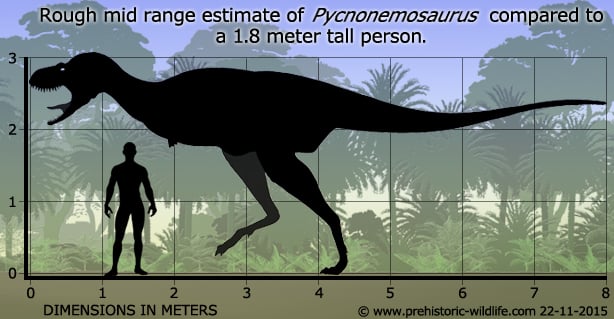
Pycnonemosaurus

Pik-no-ne-mo-sore-us.
Updated on

Nisha Yadav

Physicist

Nisha Yadav is a dedicated physicist whose work bridges the gap between physics and paleontology. With a deep interest in the processes that preserve ancient life, she explores how physical principles govern fossilization and the preservation of extinct species.

Cite Feedback Print

Name

Pycnonemosaurus ‭(‬Thick Forest lizard‭)‬.

Phonetic

Pik-no-ne-mo-sore-us.

Named By

Classification

Chordata,‭ ‬Reptilia,‭ ‬Dinosauria,‭ ‬Saurischia,‭ ‬Theropoda,‭ ‬Abelisauria,‭ ‬Abelisauridae.

Diet

Carnivore.

Species

P.‭ ‬nevesi‭

Size

Roughly estimated between‭ ‬7‭ ‬and‭ ‬9‭ ‬meters long.

Known locations

Brazil‭ ‬-‭ ‬Adamantina Formation.

Time Period

Turonian of the Cretaceous.

Fossil representation

Partial post cranial remains and teeth.

Pycnonemosaurus: Research Database

Titanosauria (Sauropoda) · Late Cretaceous (~83-70 MYA) · South America — Brazil (Vale da Floresta Formation)


Research Note: Pycnonemosaurus was a titanosaurian sauropod from the Late Cretaceous of Brazil — one of the largest known dinosaurs from Brazil and an important taxon for understanding titanosaur evolution in South America.


Research Finding Status Grade Year Method Citation Impact
Ghilardi et al. 2016: Pycnonemosaurus and new data on titanosaurian sauropods from the Cretaceous of Brazil
Ghilardi et al. 2016 provide comprehensive data on Pycnonemosaurus from the Late Cretaceous of Brazil, establishing it as a titanosaurian and documenting titanosaur diversity in the Cretaceous of South America
Confirmed A 2016 Fossil Ghilardi et al., Cretaceous Research Diversity
García et al. 2012: Pycnonemosaurus and additional data on titanosaur systematics from the Cretaceous
García et al. 2012 provide additional data on Pycnonemosaurus and titanosaur systematics, further contextualising its significance within Titanosauria
Confirmed B 2012 Fossil García et al., Cretaceous Research Systematics
Status:
Confirmed Direct evidence
Grade:
A Strong consensus
B Good evidence


Active Debate: Titanosaur Diversity in the Cretaceous of Brazil

Whether titanosaurs like Pycnonemosaurus were the dominant megaherbivores in the Cretaceous of Brazil is debated. The evolution of titanosaurs in the Cretaceous of South America — and their ecological roles — is key to understanding sauropod history.


What We Still Do Not Know About Pycnonemosaurus

  • Complete skeletal morphology: Partial specimen known.
  • Social behavior: No direct evidence.
  • Body size: One of the largest Brazilian dinosaurs.
  • Armor: Unknown.

In Depth

       At the time of writing the only parts of the dinosaur Pycnonemosaurus that have been recovered include some legs and hip bones as well as caudal‭ (‬tail‭) ‬vertebrae and teeth.‭ ‬These parts however are enough to identify Pycnonemosaurus as an abelisaurid theropod dinosaur.‭ ‬Like with other abelisaurs,‭ ‬Pycnonemosaurus would be expected to have a short but deep skull,‭ ‬with greatly reduced arms.

Further Reading

-‭ ‬On a theropod dinosaur‭ (‬Abelisauria‭) ‬from the continental Cretaceous of Brazil.‭ ‬-‭ ‬Arquivos do Museu Nacional,‭ ‬Rio de Janeiro‭ ‬60‭(‬3‭)‬:163-170.‭ ‬-‭ ‬A.‭ ‬W.‭ ‬A.‭ ‬Kellner‭ & ‬D.‭ ‬d.‭ ‬A.‭ ‬Campos‭ ‬-‭ ‬2002.

Adopt A Species
prehistoric-wildlife new logo

Love this species?

Adopt it today!

(UPDATED!)

SPECIES SPOTLIGHT

Euryapteryx , Coastal moa
argentavis largest flying bird
Protathlitis