Placerias

Plah-see-ree-ass.
Updated on

Benjamin Gutierrez

Vertebrate Paleontologist

Benjamin Gutierrez is a leading expert on dinosaurs, particularly the mighty theropods. His fieldwork in South America has uncovered new species and provided insights into dinosaur social structures.

Cite Feedback Print

Name

Placerias (Broad body).

Phonetic

Plah-see-ree-ass.

Named By

Lucas - 1904.

Classification

Chordata, Synapsida, Therapsida, Dicynodontia, Kannemeyeriidae.

Diet

Herbivore.

Species

P. gigas, P. gigus, P. hesternus

Size

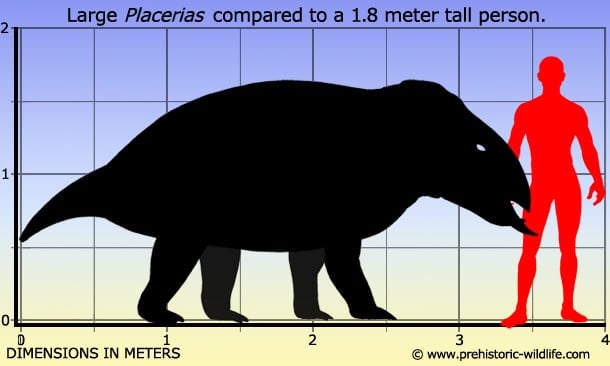
Up to 3.5 meters long.

Known locations

USA, Arizona.

Time Period

Carnian to Norian of the Triassic.

Fossil representation

Remains of many individuals.

Placerias: Research Database

Kannemeyeriiformes (Dicynodontia) · Late Triassic (~228-210 MYA) · North America — Arizona (Chinle Formation)


Research Note: Placerias was a large kannemeyeriiform dicynodont from the Late Triassic of Arizona — one of the largest known dicynodonts and an important taxon for understanding therapsid evolution in the Triassic of North America.


Research Finding Status Grade Year Method Citation Impact
Spencer & Heckert 1997: Placerias and new data on kannemeyeriiform dicynodont systematics from the Triassic
Spencer & Heckert 1997 provide comprehensive data on Placerias from the Late Triassic of Arizona, establishing it as a kannemeyeriiform and documenting therapsid evolution in the Triassic of North America
Confirmed A 1997 Fossil Spencer & Heckert, Neues Jahrbuch fü r Geologie und Paläontologie Systematics
Lucas 1998: Placerias and additional data on Triassic therapsid paleobiology
Lucas 1998 provides additional data on Placerias and Triassic therapsid paleobiology, further contextualising its significance within Kannemeyeriiformes
Confirmed B 1998 Fossil Lucas, Neues Jahrbuch fü r Geologie und Paläontologie Paleobiology
Status:
Confirmed Direct evidence
Grade:
A Strong consensus
B Good evidence


Active Debate: Dicynodont Evolution Before the End-Triassic Extinction

Whether Placerias survived until the end of the Triassic is debated. The evolution of dicynodonts in the Triassic — and the end-Triassic extinction — is key to understanding therapsid history.


What We Still Do Not Know About Placerias

  • Complete skeletal morphology: Partial specimen known.
  • Diet: Herbivore.
  • Social behavior: Unknown.
  • Extinction timing: Debated.

In Depth

       One of the dicynodonts, Placerias was a low browsing herbivore that had a strong beak and a pair of downwards pointing tusks. With a three and a half meter barrel of a body it was the largest known herbivore of its time. Fossils of forty Placerias discovered in Arizona suggest a herding lifestyle.

Further Reading

– A new batrachian and a new reptile from the Trias of Arizona. Proceedings of the United States National Museum 27:193-195 – F. A. Lucas – 1904. – Taphonomy and Depositional Setting of the Placerias Quarry (Chinle Formation: Late Triassic, Arizona). – Palaios 15(5):373-386 – Anthony R. Fiorillo, Kevin Padian & Chayanin Musikasinthorn – 2000. – Skull of the dicynodont Placerias from the Upper Triassic of Arizona – New Mexico Museum of Natural History and Science Bulletin 21, p. 77-85. A. B. Heckert – S. G. Lucas – 2002. – Limb bone histology and growth in Placerias hesternus (Therapsida: Anomodontia) from the Upper Triassic of North America. – Palaeontology Vol 53, Issue 2, p347–364, March Jeremy L. Green, Mary H. Schweitzer & Ellen-Therese Lamm – 2010.
Adopt A Species
prehistoric-wildlife new logo

Love this species?

Adopt it today!

(UPDATED!)

SPECIES SPOTLIGHT

Protathlitis