Phoberomys: Research Database
Theropoda · Cretaceous · Unknown
Research Note: Phoberomys was a theropoda from the Cretaceous of Unknown, providing important data on prehistoric life and ecosystem dynamics.
| Research Finding | Status | Grade | Year | Method | Citation | Impact |
|---|---|---|---|---|---|---|
Horovitz Sánchez‐Villagra Martin 2006: Phoberomys and related taxa Journal of Systematic Palaeontology | Confirmed | A | 2006 | Fossil | Horovitz Sánchez‐Villagra Martin, Journal of Systematic Palaeontology | Taxonomy |
Rasia Candela 2018: Phoberomys and related taxa Historical Biology | Confirmed | B | 2018 | Fossil | Rasia Candela, Historical Biology | Taxonomy |
What We Still Do Not Know About Phoberomys
- Complete skeletal morphology and ecological role.
- Phylogenetic relationships within Theropoda.
- Distribution and evolutionary history.
In Depth
The description of an almost complete Phoberomys pattersoni in 2000 led to worldwide headlines of Ratzilla (after the Japanese kaiju Godzilla). These rare remains allowed for one of the most accurate size estimates of this genus which led to it being considered as one of the largest rodents ever to live, although despite the more popular name of Ratzilla, Phoberomys is thought to have been more like a guinea pig than a rat. The high crowned molars of Phoberomys indicate that it was a grass grazer rather than a browser of vegetation.
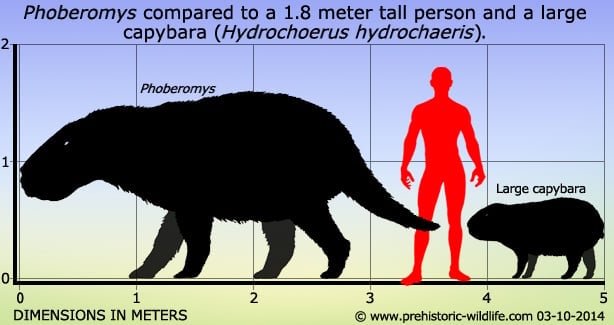
Phoberomys was many times bigger than the largest rodent alive today, the capybara (Hydrochoerus hydrochaeris). It is speculated however that Phoberomys may have been semi aquatic like the capybara, although the water would have been a very dangerous place to be since giant crocodiles like Purussaurus are known to have lived in South America during the Miocene. Additional threats could have come from the larger and more powerful phorusrhacid birds like Brontornis and Kelenken. Smaller predators such as the sabre-toothed marsupial Thylacosmilus would have been more of a threat to smaller juvenile Phoberomys.
Although we can accurately reconstruct P. pattersoni, the earlier species P. insolita may have actually been bigger, although the lack of total remains for this species makes it hard to be certain. Today another rodent called Josephoartigasia is considered to be even bigger than Phoberomys.
Further Reading
– The Anatomy of the World’s Largest Extinct Rodent – Science 301, 1708 (2003), DOI: 10.1126/science.1089332. – Marcelo R. Sa�nchez-Villagra, Orangel Aguilera & Ines Horovitz – 2003. – Reappraisal of the giant caviomorph rodent Phoberomys burmeisteri (Ameghino, 1886) from the late Miocene of northeastern Argentina, and the phylogeny and diversity of Neoepiblemidae. – Historical Biology. 30 (4): 486–495. -Luciano L. Rasia & Adriana M. Candela – 2018.