In Depth
The first sauropod dinosaur to ever be named was Cetiosaurus, which was named in 1841 by Richard Owen. Owen however did not realise that he was dealing with a dinosaur, he actually thought that he was dealing with a giant marine crocodile. The first sauropod to actually be identified as a dinosaur was actually Pelorosaurus, named in 1850 by Gideon Mantell, the man who named Iguanodon, the first plant eating dinosaur to be named, and second dinosaur overall (it was narrowly beaten by Megalosaurus).
Understanding the taxonomic history of Pelorosaurus from this point can give you a headache, but in simple facts its goes like this. After Cetiosaurus was first named Owen named many species because of differences in attributed remains, but it was later realised that some of these fossils were from different animals, and not attributable to Cetiosaurus. One species, Cetiosaurus brevis was realised to have a mix of sauropod and iguanodont bones by Alexander Melville, who subsequently took the sauropod material to create a new species of Cetiosaurus, C. conybeari, in 1849. The ‘conybeari’ part was in honour of William Conybeare, a geologist who published the first ever description of a plesiosaur, creating the genus Plesiosaurus in 1821.
Then in 1950 Gideon Mantell took the sauropod fossils of C. conybeari and realising them to be different from the others of the genus used them to establish a new genus. Adding a humerus that was confirmed to come from the original fossil site, Mantell knew that he was dealing with a big animal, and at first considered Colossosaurus, initially thinking that the Ancient Greek ‘kolossos’ meant giant, though when he checked he realised that it actually meant ‘statue’ (to be fair to Mantell, the most famous colossuses are generally very large). Mantell instead went with Pelorosaurus which means ‘monstrous lizard’ while the species name was kept as conybeari in keeping with naming guidelines concerning the naming of animals.
This would have been a simple case of naming a new genus from an established species, something that is standard fare in naming animals. However Richard Owen perceived the species and genus re-namings by Melville and Mantell as attacks upon his credibility as a naturalist. Owen after all held important positions in the fields of British natural history, and would have course wanted to protect his authority to hold those positions. Owen was also quick to try and alter the works of others, including renaming already established genera (Basilosaurus and Ornithocheirus to name but two). Some may note that Owen only sought to be scientifically clear, but less kind critics might call them deliberate attempts to stamp his name upon important discoveries.
Richard Owen’s counter to the creation of Pelorosaurus was to immediately discredit the work of Melville and Mantell. He accused Mantell of not understanding the meaning of the name ‘brevis’, as well as claiming that his original 1842 description of the name was intended as a basic description. Owen conceded that C. brevis was likely a nomen nudum, but saw to fix this by assigning further sauropod fossils. When dealing with the creation of the genus Pelorosaurus, Owen removed all fossil material with the exception of the humerus that was added by Mantell. Then later in 1859, Owen once again attributed iguanodontid vertebrae to Cetiosaurus brevis. Stating that any connection of Pelorosaurus to Cetiosaurus was a mistake, and satisfied that his Cetioasurus brevis had been preserved, this was last that anything was said about it for just over a hundred years.
While Owen was a leading figure in the early years of dinosaur palaeontology, much of his work has not stood the test of time. A 1970 study by John Ostrom and Rodney Steel applied modern reasoning to Owen’s attempts at preserving Cetiosaurus brevis. Their conclusions were that Owen had simply tried to replace the holotype of Cetiosaurus brevis, something that should not have been allowed, and certainly could not be accepted today. Criticism was also made of Melville’s decision to remove the sauropod fossils and not the iguanodont fossils, which really should have been removed instead.
The result is that even though Pelorosaurus is only represented by a few fossils, it has actually been seen as valid since the late Twentieth century, with Cetiosaurus conybeari named as a synonym to the genus. A second species of Pelorsaurus, P. becklesi which was named from partial remains and skin impressions is no longer thought to represent Pelorosaurus, but rather a different titanosaur genus. Various fossils from England and now also France have been assigned to Pelorosaurus, though often as indeterminate beyond a genus level.
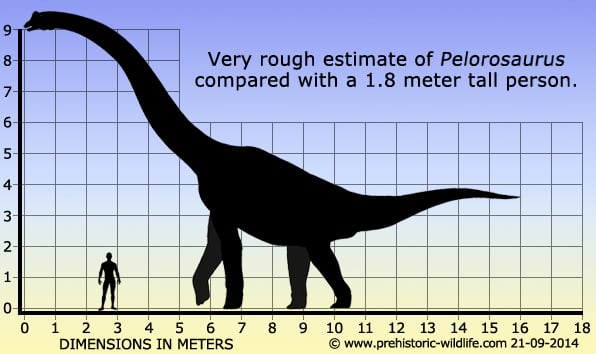
Pelorosaurus is usually considered to be ranged from the very end of the Jurassic to possibly as the end of the early Cretaceous, though most remains seem to be earlier in the early Cretaceous. The isolated nature of many Pelorosaurus fossils has led to confusion about this. Overall Pelorosaurus is perceived to have been a brachiosaurid sauropod, approximately some sixteen meters in length. Pelorosaurus may have coexisted with other sauropods such as Xenoposeidon.
Further Reading
- Report on British fossil reptiles, Part II. - Reports of the British Association for the Advancement of Science, 11: 60-204. - Richard Owen - 1842. - Notes on the vertebral column of Iguanodon. - Philosophical Transactions of the Royal Society of London, 139: 285-300. - A. G. Melville - 1849. - On the Pelorosaurus: an undescribed gigantic terrestrial reptile, whose remains are associated with those of the Iguanodon and other saurians in the strata of Tilgate Forest, in Sussex. - Philosophical Transactions of the Royal Society of London, 140: 379-390. - G. A. Mantelli - 1850. - Monograph on the fossil Reptilia of the Wealden and Purbeck formations. - Palaeontological Society, London. - R. Owen - 1853. - Monograph on the fossil Reptilia of the Wealden and Purbeck formations. Supplement no. II. Crocodilia (Streptospondylus, etc.). [Wealden.] - The Palaeontographical Society, London 1857: 20-44. - R. Owen - 1859. - Saurischia. Handbuch der Pal�oherpetologie/Encyclopedia of Paleoherpetology. - Gustav Fischer Verlag, Stuttgart 1-87. - R. Steel - 1970. - An unusual new neosauropod dinosaur from the Lower Cretaceous Hastings Beds Group of East Sussex, England. - Palaeontology, 50(6): 1547-1564. - M. P. Taylor, D. Naish - 2007. - Sauropod dinosaurs. In Batten, D. J. (ed.) English Wealden Fossils. The Palaeontological Association (London), pp. 476–525. - P. Upchurch, P. D. Mannion & P. M. Barrett - 2011.