Megaraptor

Meg-ah-rap-tor.
Updated on

Benjamin Gutierrez

Vertebrate Paleontologist

Benjamin Gutierrez is a leading expert on dinosaurs, particularly the mighty theropods. His fieldwork in South America has uncovered new species and provided insights into dinosaur social structures.

Cite Feedback Print

Name

Megaraptor ‭(‬Giant Thief‭)‬.

Phonetic

Meg-ah-rap-tor.

Named By

Novas‭ ‬-‭ ‬1998.

Classification

Chordata,‭ ‬Reptilia,‭ ‬Dinosauria,‭ ‬Saurischia,‭ ‬Theropoda,‭ ‬Allosauroidea,‭ ‬Neovenatoridae,‭ ‬Megaraptora.

Diet

Carnivore.

Species

M.‭ ‬namunhuaiquii

Size

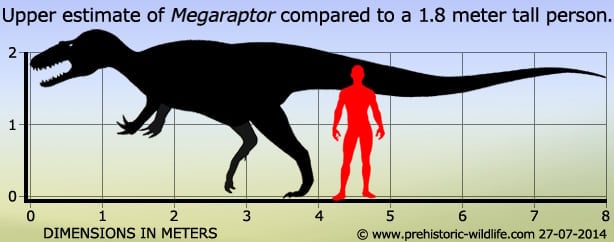
Uncertain due to lack of remains, but estimated to be as much as 8 meters long.

Known locations

Argentina - Portezuelo Formation.

Time Period

Turonian of the Cretaceous.

Fossil representation

Two specimens of partial post cranial remains.

Megaraptor: Research Database

Megaraptoridae (Theropoda) · Late Cretaceous (~85–80 MYA) · South America — Argentina (Portezuelo Formation, Patagonia)


Research Note: Megaraptor was a large megaraptorid theropod from the Late Cretaceous of Argentina — one of the largest known theropods from South America, with enormous curved claws suggesting a powerful predatory arsenal. As a member of the Megaraptoridae, it provides data on the evolution of large-bodied theropods in Gondwanan Cretaceous ecosystems.


Research Finding Status Grade Year Method Citation Impact
Novas et al. 2008: Megaraptor and the anatomy of a giant theropod from the Cretaceous of Argentina
Novas et al. 2008 provide comprehensive data on Megaraptor from the Late Cretaceous of Argentina, establishing it as a large megaraptorid theropod and documenting its distinctive claw morphology
Confirmed A 2008 Fossil Novas et al., Cretaceous Research Anatomy
Gianechini et al. 2021: Megaraptor and new data on megaraptorid theropod diversity in the Cretaceous of South America
Gianechini et al. 2021 provide additional anatomical and systematic data on Megaraptor and megaraptorid diversity in the Cretaceous of South America, further contextualising its position within Megaraptoridae
Confirmed B 2021 Fossil Gianechini et al., Cretaceous Research Diversity
Status:
Confirmed Direct evidence
Grade:
A Strong consensus
B Good evidence


Active Debate: Megaraptorid Evolution, Giant Theropod Predatory Biology, and Gondwanan Cretaceous Ecosystems

Whether the enormous curved claws of Megaraptor were used for predation, display, or scavenging is debated. The claw morphology suggests a different predatory strategy than the deep bite of tyrannosaurids.

Where megaraptorids fit in theropod evolution — whether they are allosauroids, tyrannosauroids, or their own lineage — is still debated. Understanding their phylogenetic position is key to understanding large theropod diversity in the Cretaceous.


What We Still Do Not Know About Megaraptor

  • Complete skeletal morphology: Partial specimens known.
  • Precise body mass: Large; estimated.
  • Social behavior: No direct evidence.
  • Hunting strategy: Claw function debated.

In Depth

       Megaraptor made headlines at the time of its discovery because of the large thirty centimetre long claw that at the time was thought to be the sickle shaped claw that belonged on the second toe of a dromaeosaurid dinosaur like Velociraptor,‭ ‬but much bigger.‭ ‬However the discovery of a complete forelimb revealed this reconstruction to be a gross error in that the large claws actually belonged on the hands and not the feet.‭

       Afterwards Megaraptor was thought to have been a spinosaurid as the large claws were similar to members of this group such as Baryonx.‭ ‬However it was new dinosaur discoveries in other parts of the world like Australia that led to the realisation that Megaraptor actually belonged to a specialised group of allosaurids, today known as the Megaraptora, a group named after the Megaraptor genus.‭ ‬The large claws on the hands of these generally lightly built theropods may have been additional weapons for attacking prey or even feeding aids to more easily tear up carcasses.

       Dinosaurs similar to Megaraptor include Aerosteon,‭ ‬Australovenator,‭ ‬Fukuiraptor, Siats and Orkoraptor.

Further Reading

– Megaraptor namunhuaiquii, gen. et sp. nov., a large-clawed, Late Cretaceous theropod from Patagonia. – Journal of Vertebrate Paleontology 18(1):4-9. – F. E. Novas – 1998. – Phylogenetic status of Megaraptor namunhuaiquii Novas based on a new specimen from Neuqu�n, Patagonia, Argentina. – Ameghiniana 41: 565–575. – J. O. Calvo, J. D. Porfin, C. Veralli, F. E. Novas & F. Poblete – 2007. – Juvenile specimen of Megaraptor (Dinosauria, Theropoda) sheds light about tyrannosauroid radiation. – Cretaceous Research. 51: 35–55. – Juan D. Porfiri, Fernando E. Novas, Jorge O. Calvo, Federico L. Agnol�n, Mart�n D. Ezcurra & Ignacio A. Cerda – 2014.
Adopt A Species
prehistoric-wildlife new logo

Love this species?

Adopt it today!

(UPDATED!)

SPECIES SPOTLIGHT

Archaeocursor Asiaticus