In Depth
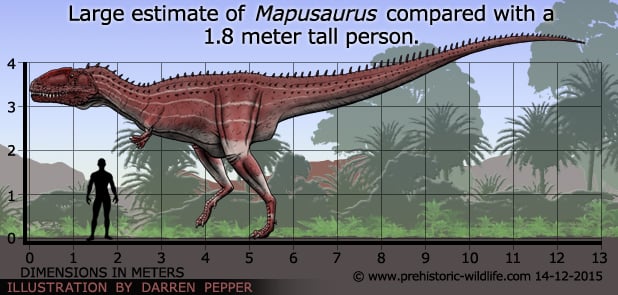
Closely related to the massive predator Giganotosaurus, the discovery of seven Mapusaurus individuals in the same bone bed would question the notion that predatory dinosaurs were always solitary creatures. When the bone bed was excavated between 1997 and 2001, only the remains of Mapusaurus where found, and these individuals were all of different ages. These are two of the hallmarks that have led to this bone bed to be hailed as strong evidence to support the pack hunting predator hypothesis. Further, while it is not known what Mapusaurus targeted as a prey, it does hail from the same part of the world as the huge titanosaur Argentinosaurus. A full grown individual of this dinosaur would have been unassailable to just one of the known predators of the time, but a pack targeting the weaker perhaps not fully grown individuals would have had a chance of defeating it by attrition alone. This is of course just conjecture, and without further fossil finds, this is how this scenario will remain.
Analysis of the site however could cast doubt on potential gregarious behaviour as the area has been interpreted as a depositional area. This means that the bone bed may have been formed when a stream or river had swollen with flood water, and carried the Mapusaurus individuals down-stream and deposited them in a group arrangement. If true then this would be a great fluke of nature considering that only Mapusaurus and no other dinosaurs species were washed there.
What is known about Mapusaurus is that it is a member of the Carcharadontosauridae, a group known for its large members that can rival and even exceed the more famous Tyrannosaurus rex in size. The teeth on Mapusaurus where very much like those of its relative Giganotosaurus in that they were flat and curved with a serrated edge, perfect for slicing through flesh. This is in contrast to the teeth which are found in Tyrannosaurus which are conical and smooth, an adaption better suited to biting through bone.
Study of the teeth has led to further strengthening of the hypothesis that Mapusaurus could have preyed upon dinosaurs like Argentinosaurus that had bones that were simply too big to bite through. If the pack hunting theory is true then Mapusaurus may have worn down an Argentinosaurus with multiple bites. These wounds would that lead to blood loss and infection which would then bring the huge dinosaurs down.
Mapusaurus is a combination of the Mapuche word for earth, and the Greek word for lizard. The species name M. roseae has dual meaning, references both Rose Letwin, the dig sponsor, and the colour of the rocks that Mapusaurus was recovered from.
Further Reading
– A new carcharodontosaurid (Dinosauria, Theropoda) from the Upper Cretaceous of Argentina – Geodiversitas 28(1):71-118 – R. A. Coria & P. J. Currie – 2006. – New Information on the Cranial Anatomy of Acrocanthosaurus atokensis and Its Implications for the Phylogeny of Allosauroidea (Dinosauria: Theropoda). – PLoS ONE 6(3): e17932. – Drew R. Eddy & Julia A. Clarke – 2011. – Palaeopathological survey of a population of Mapusaurus (Theropoda: Carcharodontosauridae) from the Late Cretaceous Huincul Formation, Argentina – PLoS ONE 8(5):e63409:1-6 – P. R. Bell & R. A. Coria – 2013. – Cranial ontogenetic variation in Mapusaurus rosae (Dinosauria: Theropoda) and the probable role of heterocrony in carcharodontosaurid evolution. Palaeontol Z doi: 10.1007/s12542-014-0251-3. – J. L. Canale, F. E. Novas, L. Salgado & R. A. Coria – 2014.