In Depth
Lycaenops acquired its name from the striking similarity between it and modern wolves. Although Lycaenops itself was what is loosely termed a mammal like reptile, its similarity to wolves is most likely a case of convergent evolution. Some sources about prehistoric animals also go one further and claim that Lycaenops also hunted in packs like wolves do. However this is pure speculation based upon the translation of the name, and no fossil evidence exists to corroborate this claim.
Although often noted for having a pair of large canine teeth which required the skull to be deeper in order to accommodate the large roots, the key features of study for Lycaenops are actually the legs. Many of the therapsids had legs that sprawled out to the sides or a combination of forelegs to the side and hind legs underneath. In Lycaenops however all four legs supported the body from underneath. Aside from more efficient weight bearing, muscles that had been used to support the body from the side could now be used just for movement. This more specialised muscle development combined with the stride of its long legs granted Lycaenops the ability to run faster and longer than other therapsids that still had the old sprawling body design.
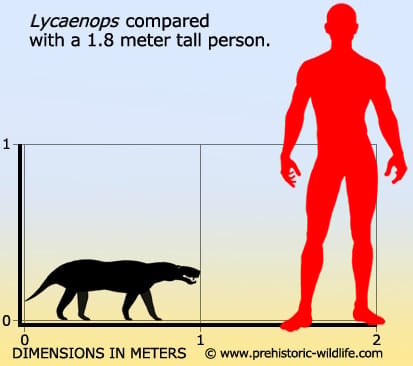
With a body of length of one meter Lycaenops was very small when compared to both other carnivores and herbivores. Given its smaller size Lycaenops probably hunted for smaller prey which it could catch more easily with little risk of injury. Once prey was caught the enlarged pair of upper canines could be brought down for a quick kill.
Further Reading
– The mammal-like reptile Lycaenops. – Bulletin of the AMNH ; v. 89, article 6. – Colbert, Edwin Harris, 1905-; Broom, Robert, 1866-1951. – Studies on new specimens of the Gorgonopsia. – Palaeontologia Africana 1:1-28. – A. S. Brink & J. W. Kitching – 1953. – New data on the cranial anatomy of Lycaenops (Synapsida, Gorgonopsidae), and reflections on the possible presence of streptostyly in gorgonopsians. – Journal of Vertebrate Paleontology, Vol. 18, No. 4 (Dec. 28, 1998), pp. 765-776. – Michael laurin – 1998. – Phylogeny and evolution of the Gorgonopsia with a special reference to the skull and skeleton of GPIT/RE/7113 (‘Aelurognathus?’ parringtoni). – T�bingen: Eberhard-Karls Universit�t T�bingen. pp. 1–316. – E. V. I. Gebauer – 2007.