Keichousaurus

kay-chow-sore-us.
Updated on

Nisha Yadav

Physicist

Nisha Yadav is a dedicated physicist whose work bridges the gap between physics and paleontology. With a deep interest in the processes that preserve ancient life, she explores how physical principles govern fossilization and the preservation of extinct species.

Cite Feedback Print

Name

Keichousaurus‭ (keichow‭ ‬lizard‭)‬.

Phonetic

kay-chow-sore-us.

Named By

Young‭ ‬-‭ ‬1958.

Classification

Chordata,‭ ‬Reptilia,‭ ‬Sauropterygia,‭ ‬Nothosauroidea,‭ ‬Pachypleurosauria

Diet

Piscivore.

Species

‬K.‭ ‬hui,‭ ‬K.‭ ‬yuananensis

Size

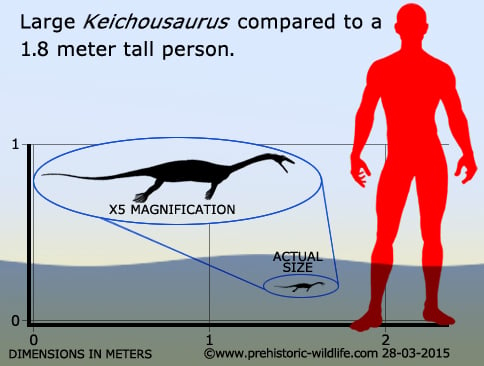
Most known individuals range between 15‭-‬30‭ ‬centimetres long.

Known locations

China.

Time Period

Anisian through to the Norian of the Triassic.

Fossil representation

Specimens are so numerous it is hard to estimate.

Keichousaurus: Research Database

Temnospondyli (Amphibia) · Middle Triassic (~240 MYA) · Asia — China (Guizhou Province)


Research Note: Keichousaurus was a capitosaurid temnospondyl from the Middle Triassic of China — an important taxon for understanding temnospondyl evolution in the Triassic of Asia and the recovery after the Permian-Triassic extinction.


Research Finding Status Grade Year Method Citation Impact
Barycka 2007: Keichousaurus and new data on capitosaurid diversity from the Triassic of China
Barycka 2007 provides comprehensive data on Keichousaurus from the Middle Triassic of China, establishing it as a capitosaurid temnospondyl and documenting temnospondyl diversity in the Triassic of Asia
Confirmed A 2007 Fossil Barycka, Neues Jahrbuch für Geologie und Paläontologie Diversity
Schoch 1997: Temnospondyl phylogeny and the evolution of Keichousaurus
Schoch 1997 provides phylogenetic data on Keichousaurus and related temnospondyls, clarifying the evolutionary relationships within Capitosauria
Confirmed A 1997 Fossil Schoch, Neues Jahrbuch für Geologie und Paläontologie, Abhandlungen Phylogeny
Status:
Confirmed Direct evidence
Grade:
A Strong consensus
B Good evidence


Active Debate: Triassic Temnospondyl Biogeography

Whether Keichousaurus is related to other Asian capitosaurids or represents an independent lineage is debated. The biogeography of Triassic temnospondyls in Asia — and their relationships to European forms — is key to understanding Triassic ecosystem recovery after the Permian-Triassic extinction.


What We Still Do Not Know About Keichousaurus

  • Complete skeletal morphology: Partial specimen known.
  • Growth patterns: Unknown.
  • Social behavior: No direct evidence.
  • Precise relationships: Still debated.

In Depth

       Keichousaurus looks like a miniature plesiosaur,‭ ‬and indeed many have looked into the possibility that it may either be a direct ancestor,‭ ‬or representative of an ancestral form that led to the evolution of the giant plesiosaurs.

       As well as resembling the later plesiosaurs,‭ ‬Keichousaurus may have moved like them too,‭ ‬using their flattened fore limbs to push themselves along.‭ ‬Study of the caudal vertebrae also suggests strong muscle attachment,‭ ‬implying that the tail could have also provided some form of propulsion,‭ ‬perhaps as a throwback to its earlier terrestrial ancestors.

       Because of these specialised limbs,‭ ‬it is thought by many that Keichousaurus would have spent most of its time in the water.‭ ‬However,‭ ‬there are some specimens that show a differently developed ulna that could have supported limited movement on the land.‭ ‬Study of Keichousaurus individuals of different ages has also shown aliometric growth,‭ ‬meaning that different body parts grew at different rates to other parts.

       Some fossils of Keichousaurus have been recovered with what appear to be young Keichousaurus inside of the main specimen.‭ ‬Their position and completion inside of the main fossil suggest that they are not in the stomach,‭ ‬but are actually young waiting to be born.‭ ‬This implies that Keichousaurus was viviparous and gave birth to live young as opposed to laying eggs.‭ ‬This further reinforces the view that Keichousaurus was a primarily marine creature.

       Because Keichousaurus skeletons are often so well preserved,‭ ‬they make popular collectors pieces.‭ ‬However,‭ ‬care should be taken as some fossils that are sold as genuine,‭ ‬are actually reproductions of original fossils.‭ ‬The reproductions still make nice collectors pieces,‭ ‬but do not warrant the price tags of the originals.‭ ‬As with anything,‭ ‬try to find a reputable dealer.

Further Reading

– On the new Pachypleurosauroidea from Keichow, south-west China. – Vertebrata PalAsiatica 2(2-3):72-81 – C. -C. Young – 1958. – On the new nothosaurs from Hupeh and Kweichou, China. – Vertebrata PalAsiatica 9(4):337-356. – C. -C. Young – 1965. – New information on sexual dimorphism and allometric growth in Keichousaurus hui, a pachypleurosaur from the Middle Triassic of Guizhou, South China. – Acta Palaeontologica Polonica 60 (3): 681–687. – Yifan Xue, Dayong Jiang, Ryosuke Motani, Olivier Rieppel, Yuanlin Sun, Zuoyu Sun, Cheng Ji & Pengfei Yang – 2013.
Adopt A Species
prehistoric-wildlife new logo

Love this species?

Adopt it today!

(UPDATED!)

SPECIES SPOTLIGHT

Velociraptor