In Depth
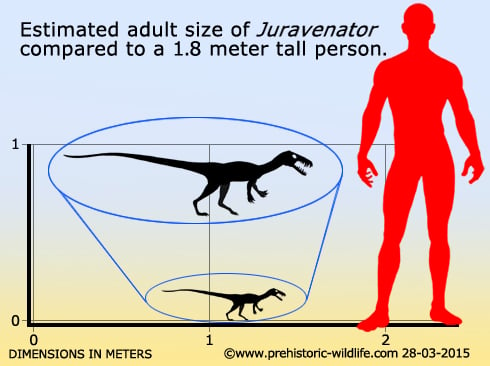
Juravenator was a small predatory dinosaur active in the late Jurassic of Europe. It appears to have been a fleet footed hunter that specialised in either invertebrates or small vertebrates like lizards. The scleral rings of Juravenator show similarities with nocturnal birds strongly suggesting that Juravenator was most active at night.
The holotype specimen of Juravenator was assumed to have a covering of primitive protofeathers, something that gave rise to the nickname Borsti (after bristle haired dogs). However when skin impressions belonging to Juravenator were initially described they were found to have no clear indication of protofeathers just scales. This is markedly different from other members of the Compsognathidae such as Sinosauropteryx which are known to have had them. Other longer known members of the group such as Compsognathus neither confirm or deny the presence of feathers, but Compsognathus itself is morphologically similar to the ‘dino-bird’ Archaeopteryx in its skeletal make up. This means that the Compsognathidae group may either end up being re-shuffled into feathered and non-feathered, or it should be accepted that small dinosaurs being feathered is not a hard and fast rule that can be applied to all genera.
Of course further fossil discoveries may yet reveal a completely different realisation, and a follow up study in 2010 by Xu Xing reported that when viewed under Ultraviolet light a light covering of protofeathers are visible. It’s possible that as a juvenile its covering of feathers was not fully developed. However it is also possible that Juravenator had protofeathers upon hatching which then disappeared when it grew older. Alternatively the type specimen may have been in a moult when it died resulting in the appearance of reduced feathers for the living animal.
Further Reading
– A new carnivorous dinosaur from the Late Jurassic Solnhofen archipelago. – Nature 440:329-332. – U. B. G�hlich & L. M. Chiappe – 2006. – Juravenator starki (Reptilia, Theropoda) ein neuer Raubdinosaurier aus dem Oberjura der Suedlichen Frankenalb (Sueddeutschland): Skelettanatomie und Weichteilbefunde. – Archaeopteryx 24: 1–26. – U. B. Goehlich, H. Tischlinger & L. M. Chiappe – 2006. – Anatomy of Juravenator starki (Theropoda: Coelurosauria) from the Late Jurassic of Germany. – Neues Jahrbuch f�r Geologie und Pal�ontologie – Abhandlungen 258 (3): 257–296. – L. M. Chiappe & U. B. G�hlich – 2010. – Re-evaluating Moodie’s Opisthotonic-Posture Hypothesis in fossil vertebrates. Part I: Reptiles – The taphonomy of the bipedal dinosaurs Compsognathus longipes and Juravenator starki from the Solnhofen Archipelago (Jurassic, Germany). – Palaeobiodiversity and Palaeoenvironments 92 (1): 119–168. – A. G. Reisdorf & M. Wuttke – 2012. – Two of a feather: a comparison of the preserved integument in the juvenile theropod dinosaurs Sciurumimus and Juravenator from the Kimmeridgian Torleite Formation of southern Germany. – Christian Foth, Carolin Haug, Joachim T. Haug, Helmut Tischlinger & Oliver W. M. Rauhut – 2020.