Isisaurus: Research Database
Titanosauria (Sauropoda) · Late Cretaceous (~70-66 MYA) · Asia — India (Lameta Formation)
Research Note: Isisaurus was a titanosaurian sauropod from the Late Cretaceous of India — an important taxon for understanding titanosaur evolution and biogeography in the Cretaceous of the Indian subcontinent.
| Research Finding | Status | Grade | Year | Method | Citation | Impact |
|---|---|---|---|---|---|---|
|
García et al. 2012: Isisaurus and new data on titanosaurian sauropods from the Cretaceous of India
García et al. 2012 provide comprehensive data on Isisaurus from the Late Cretaceous of India, establishing it as a titanosaurian and documenting titanosaur diversity in the Cretaceous of the Indian subcontinent
|
Confirmed | A | 2012 | Fossil | García et al., Cretaceous Research | Taxonomy |
|
Sander & Peitz 2008: Isisaurus and additional data on titanosaur biology and evolution
Sander & Peitz 2008 provide additional data on Isisaurus and titanosaur biology, further contextualising its significance within Titanosauria
|
Confirmed | B | 2008 | Fossil | Sander & Peitz, Palaeontographica | Biology |
Active Debate: Titanosaur Biogeography and the India-Madagascar Connection
Whether titanosaurs like Isisaurus were part of a distinct Indian dinosaur fauna or connected to broader Asian or Gondwanan dinosaur communities is debated. The biogeographic history of titanosaurs in the Cretaceous of India — and the isolation of the Indian subcontinent — is key to understanding dinosaur evolution.
What We Still Do Not Know About Isisaurus
- Complete skeletal morphology: Partial specimen known.
- Social behavior: No direct evidence.
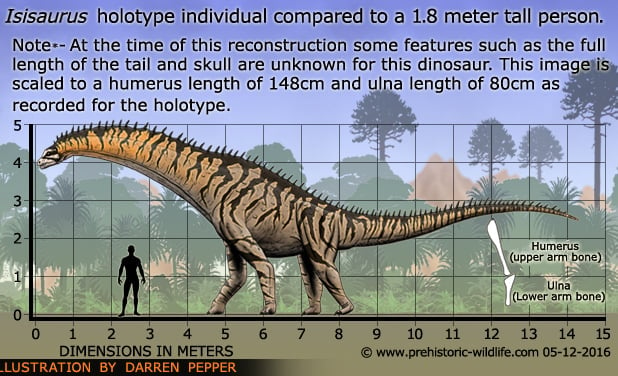
- Body size: Large titanosaur.
- Reproduction: Unknown.
In Depth
Originally named in 1997 as Titanosaurus colberti by Jain and Bandyopadhyay, a new study by Wilson and Upchurch in 2003 saw the fossils renamed as a new genus, Isisaurus. Isisaurus was named after the Indian Statistical Institute and should not be confused with the goddess Isis from Ancient Egyptian mythology.
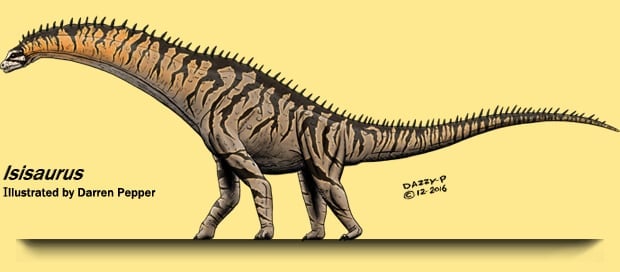
Isisaurus was a moderately size titanosaur that roamed India during the late Cretaceous period. Fungal analysis of coprolites attributed to Isisaurus has revealed that Isisaurus probably fed upon a variety of different trees. This would confirm that Isisaurus was a high browser. Isisaurus would have shared its environment with other similar dinosaurs such as Jainosaurus as well as predatory theropods like the abelisaur Rajasaurus which may have posed a serious threat to young juveniles of both of these titanosaurs.
Further Reading
– New Titanosaurid (Dinosauria: Sauropoda) from the Late Cretaceous of Central India – Sohan L. Jain, Saswati Bandyopadhyay – 1997. – A revision of Titanosaurus Lydekker (Dinosauria – Sauropoda), the first dinosaur genus with a ‘Gondwanan’ distribution – Jeffrey A. Wilson & Paul Upchurch – 2003. – Fungi in dinosaurian (Isisaurus) coprolites from the Lameta Formation (Maastrichtian) and its reflection on food habit and environment. – Micropaleontology, 51(1): 73-82. – N. Sharma, R. K. Kar, A. Agarwal & R. Kar – 2005.