In Depth
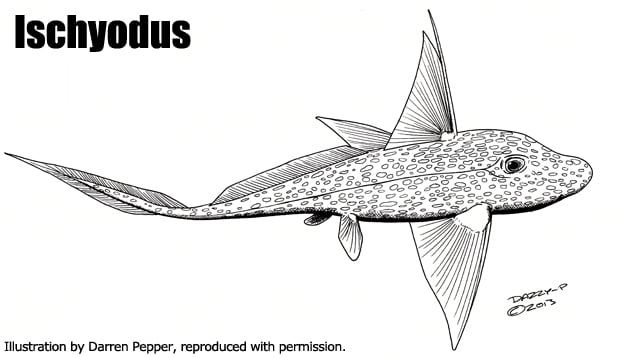
Nine times out of ten Ischyodus in simply referred to as a prehistoric Chimaera. In this instance it is meant as being similar to Chimaera monstrosa, also known as the rat fish and the rabbit fish, due to its physical similarity. Both Ischyodus and Chimaera monstrosa are members of the Chondrichthyes, which means that they are relatives of the sharks and rays. Assuming that Ischyodus lived like Chimaera do today, they would have been deep water fish often inhabiting the depths beyond where sunlight from the surface could penetrate.
The tail of Ischyodus would have been very thin and underdeveloped in relation to its body, just like in the living Chimaera (hence another nickname of ‘rat tail’). This meant that Ischyodus could not swim fast to chase after prey and instead hunted for slow swimming or sick and dying fish, or scavenged the carcasses of other marine animals as they sank down to the bottom of the ocean.
Another feature that Ischyodus shares with the Chimaera is a single large spine that rises up just in front of the dorsal fin. In Chimaera this spine connects to a venom sac, which makes it poisonous to predators that try to eat it. It’s probable, but not known for certain, that the spine of Ischyodus functioned in the same way.
Ischyodus fossils from Europe are usually Jurassic in age and attributed to such species as I. egertoni and I. emarginatus, while those of North America are late Cretaceous (as I. bifurcatus) to the Palaeocene. More interesting though is that fossils from Australia and Antarctica are Eocene to Pliocene in age, and usually attributed to I. dolloi.
Given the broad temporal range, it would be interesting to see if Ischyodus is really extinct and is not just lurking somewhere in the depths of the ocean just like coelacanths were when the wider scientific community insisted that they were extinct.
Further Reading
- A new species of Ischyodus (Chondrichthyes: Holocephali: Callorhynchidae) from Upper Maastrichtian shallow marine facies of the Fox Hills and Hell Creek formations, Williston Basin, North Dakota, USA. Palaeontology 48: 709-721., J. W. Hoganson & J. M. Erickson - 2005. - A review of the Tertiary fossil Cetacea (Mammalia) localities in Australia. Memoirs of the Museum of Victoria 61(2):183-208, E. M. G. Fitzgerald - 2004.