In Depth
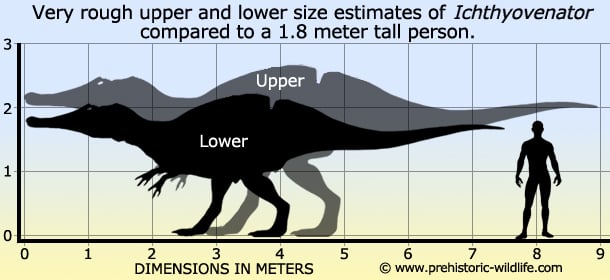
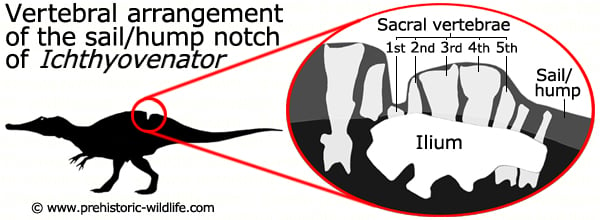
Although still only known from a few bones, Ichthyovenator remains a very exciting discovery as at the time of its discovery it was still the most complete spinosaurid dinosaur known from Asia, and still more complete than other spinosaurid genera such as the South American Oxalaia. Ichthyovenator is also the first known spinosaurid of its kind since it appears to not only have one but two sails on its back, the first on its back before coming to an abrupt stop with a rectangular corner when it reaches the first sacral vertebrae. The second sail rises up steeply from the second sacral vertebrae where it seems to reach maximum height over the third and fourth vertebrae before gradually reducing over the fifth. Alltogether this would at least give the impression of a chunk being taken out of the sail so that it was divided into two sections rather than a single continuous growth. This feature may yet lend significant support to the theory that the sails on spinosaurid dinosaurs served a primary purpose of display, allowing them to recognise others of their species. After Siamosaurus, Ichthyovenator is the second genus of spinosaurid dinosaur to be named from Asia. However Siamosaurus is only named after teeth which is why it is often sometimes treated as a dubious genus of dinosaur since further skeletal remains are going to be very difficult to attribute to it. The few current remains of Ichthyovenator do actually indicate that it belongs in the Baryonychinae, a sub group of the Spinosauridae. This means that Ichthyovenator is currently considered to be related to Baryonyx from England and also Suchomimus from North Africa, although there is speculation that Suchomimus may actually be a more grown up Baryonyx.
The genus name means ‘fish hunter’, while the type species name laosensis means ‘from Laos’. Together, the full species name of Ichthyovenator laosensis means ‘fish hunter from Laos’. The name ‘fish hunter’ is a reference to the fact that all known spinosaurids seem to have been specialists in hunting fish rather than other dinosaurs. This is because the long jaws and teeth of spinosaurids are more suited to catching prey like fish and would be only marginally effective in killing a larger dinosaur. Additionally the snouts of spinosaurids which have been preserved with them seem to be developed to house pressure sensitive receptors that would have allowed them to sense fish swimming in water. Although these parts of Ichthyovenator are unknown at the time of its description, it’s reasonable to assume that it would have had a very similar appearance and lifestyle to other better known spinosaurids.
Further Reading
– The first definitive Asian spinosaurid (Dinosauria: Theropoda) from the early cretaceous of Laos. – Naturwissenschaften 99:369-377. – R. Allain, T. Xaisanavong, P. Richir & B. Khentavong – 2012. – New material of the theropod Ichthyovenator from Ban Kalum type locality (Laos): Implications for the synonymy of Spinosaurus and Sigilmassasaurus and the phylogeny of Spinosauridae. – Journal of Vertebrate Paleontology Programs and Abstracts. – Ronan Allain – 2014.