In Depth
Isanosaurus is recognised as being one of the first sauropods to appear on the planet, replacing the previous earliest sauropod title holder Vulcanodon. It should be mentioned here that at the time Vulcanodon was thought to have lived in the early Hettangian stage of the Jurassic, just after the Triassic/Jurassic boundary, though a 2004 study by Adam Yates covering the Vulcanodon holotype fossil location led to the realisation that Vulcanodon lived much later in the Jurassic during the Toarcian stage.
Back to Isanosaurus, the genus is noted to have been one of the first to adapt to an exclusive quadrupedal form of locomotion. Evidence for a quadrupedal posture comes from the femur which in Isanosaurus is straight, while in known sauropodomorph genera which were at least partially bipedal, the femur is always curved. Isanosaurus is also noted for having vertebrae that had high neural spines, whereas the neural spines on the vertebrae of sauoropodomorphs usually have low neural spines.
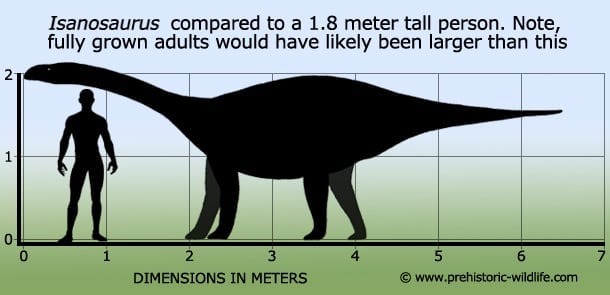
Because the neural arches were not fused to the centra (the circular central part) of the vertebrae, it’s a fairly safe bet that the holotype remains of Isanosaurus are those of a juvenile, or at the very oldest a subadult. Whichever, it is fairly certain that Isanosaurus could grow quite a bit larger than the six and a half meters that the holotype individual is estimated to have been.
Isanosaurus means ‘Isan lizard’, and Isan is the name used to refer to Northeast Thailand. The type species name, I. Attavipach, is in honour of P. Attavipach, a prominent supporter of palaeontological research in Thailand. Thailand has been kind of late coming to the party in terms of fossil discoveries, and those that are found are often very fragmentary. However with known fossil locations ranging from the Triassic to Cretaceous, and remains of pterosaurs, spinosaurs, ornithopods, ceratopsians and sauropods already being discovered, Thailand is will likely be one of the key locations to be keeping an eye on in the near future.
Further Reading
- The earliest known sauropod dinosaur. – Nature. 407 (6800): 72–74. - E. Buffetaut, V. Suteethorn, G. Cuny, H. Tong, J. Le Loeuff, S. Khansubha, & Jongautchariyakul - 2000. - Eric Buffetaut, Varavudh Suteethorn, Jean Le Loeuff, Gilles Cuny, Haiyan Tong & Sasidhorn Khansubha - 2002. -The earliest known sauropod dinosaur and the first steps towards sauropod locomotion. Proceedings of the Royal Society of London B: Biological Sciences 270: 1753-1758. - A. M. Yates & J. W. Kitching - 2003.