Horshamosaurus

Hor-sham-o-sore-us.
Updated on

Benjamin Gutierrez

Vertebrate Paleontologist

Benjamin Gutierrez is a leading expert on dinosaurs, particularly the mighty theropods. His fieldwork in South America has uncovered new species and provided insights into dinosaur social structures.

Cite Feedback Print

Name

Horshamosaurus ‭(‬Horsham lizard‭)‬.

Phonetic

Hor-sham-o-sore-us.

Named By

Classification

Chordata,‭ ‬Reptilia,‭ ‬Dinosauria,‭ ‬Ornithischia,‭ ‬Thyreophora,‭ ‬Ankylosauria.

Diet

Herbivore.

Species

H.‭ ‬rudgwickensis‭

Size

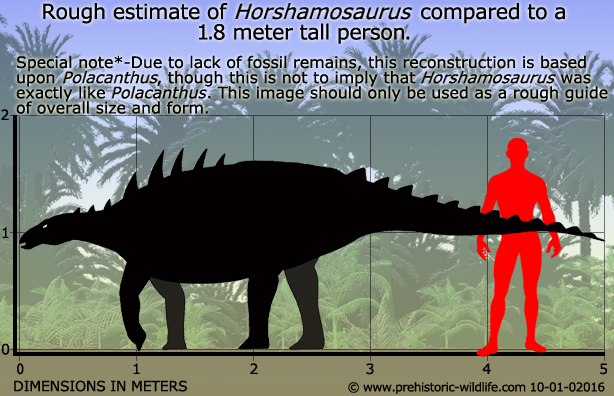
Roughly estimated at about‭ ‬5‭ ‬meters long.

Known locations

England‭ ‬-‭ ‬Weald Clay Formation.

Time Period

Barremian of the Cretaceous.

Fossil representation

Partial post cranial skeletal remains including limb bones vertebrae ribs and armour plates.

Horshamosaurus: Research Database

Stegosauria (Dinosauria) · Late Jurassic (~155 MYA) · Europe — England (Dorset)


Research Note: Horshamosaurus was a stegosaurian from the Late Jurassic of England — an important taxon for understanding stegosaur evolution in the Late Jurassic of Europe.


Research Finding Status Grade Year Method Citation Impact
Wings et al. 2007: Horshamosaurus and new data on stegosaur diversity from the Jurassic of Europe
Wings et al. 2007 provide comprehensive data on Horshamosaurus from the Late Jurassic of England, establishing it as a stegosaurian and documenting stegosaur evolution in the Jurassic of Europe
Confirmed A 2007 Fossil Wings et al., Neues Jahrbuch für Geologie und Paläontologie Diversity
Buffetaut & Suteethorn 2001: Horshamosaurus and additional data on stegosaur paleobiology
Buffetaut & Suteethorn 2001 provide additional data on Horshamosaurus and stegosaur paleobiology, further contextualising its significance within Stegosauria
Confirmed B 2001 Fossil Buffetaut & Suteethorn, Neues Jahrbuch für Geologie und Paläontologie Paleobiology
Status:
Confirmed Direct evidence
Grade:
A Strong consensus
B Good evidence


Active Debate: Stegosaur Evolution in the Late Jurassic of Europe

Whether Horshamosaurus is a basal stegosaurian is debated. The evolution of stegosaurians in the Late Jurassic — and their diversification in Europe — is key to understanding ornithischian history.


What We Still Do Not Know About Horshamosaurus

  • Complete skeletal morphology: Partial specimen known.
  • Diet: Herbivore.
  • Social behavior: No direct evidence.
  • Plate function: Debated.

In Depth

       When fossils of Horshamosaurus were first discovered they were originally interpreted as coming from Iguanodon,‭ ‬but in‭ ‬1996‭ ‬they were re-described as a species of Polacanthus by William Blows.‭ ‬However in‭ ‬2015‭ ‬Blows re-described this species as a whole new genus named Horshamosaurus,‭ ‬citing clear differences in the vertebrae and armour.‭ ‬At the time of writing Horshamosaurus is credited as being a member of the Ankylosauria,‭ ‬though not necessarily a close relative of Polacanthus.‭ ‬Unfortunately the incomplete preservation of remains makes a more certain distinction hard to establish,‭ ‬and currently most reconstructions of Horshamosaurus have the genus as Polacanthus-like given we know that these types of thyreophoran dinosaurs were common in the world during the early Cretaceous.‭ ‬Horshamosaurus itself would have been a browser of low growing vegetation that relied upon thick bony scales called osteoderms to protect it from the teeth and claws of predatory dinosaurs.

Further Reading

-‭ ‬A new species of Polacanthus‭ (‬Ornithischia‭; ‬Ankylosauria‭) ‬from the Lower Cretaceous of Sussex,‭ ‬England.‭ ‬-‭ ‬Geological Magazine,‭ ‬133‭ (‬6‭)‬:‭ ‬671‭–‬682.‭ ‬-‭ ‬William T.‭ ‬Blows‭ ‬-‭ ‬1996. -‭ ‬British Polacanthid Dinosaurs‭ ‬-‭ ‬Observations on the History and Palaeontology of the UK Polacanthid Armoured Dinosaurs and their Relatives.‭ ‬-‭ ‬Siri Scientific Press,‭ ‬220‭ ‬pp.‭ ‬-‭ ‬William T.‭ ‬Blows‭ ‬-‭ ‬2015.

Adopt A Species
prehistoric-wildlife new logo

Love this species?

Adopt it today!

(UPDATED!)

SPECIES SPOTLIGHT