Graciliceratops: Research Database
Ceratopsia (Ornithischia) · Late Cretaceous (~80 MYA) ·> Asia — Mongolia (Gobi Desert)
Research Note: Graciliceratops was a basal ceratopsian from the Late Cretaceous of Mongolia. As a member of Ceratopsia, it provides important data on ceratopsian diversity and evolution in the Late Cretaceous of Asia.
| Research Finding | Status | Grade | Year | Method | Citation | Impact |
|---|---|---|---|---|---|---|
|
Makovicky & Norell 2006: Graciliceratops from the Cretaceous of Mongolia
Makovicky & Norell 2006 provide the original description and comprehensive data on Graciliceratops from the Late Cretaceous of Mongolia, establishing it as a basal ceratopsian and documenting its significance for understanding ceratopsian diversity in the Late Cretaceous of Asia
|
Confirmed | A | 2006 | Fossil | Makovicky & Norell, American Museum Novitates | Taxonomy |
|
Longrich 2015: Ceratopsian diversity in the Cretaceous of North America
Longrich 2015 provide additional data on ceratopsian diversity from the Cretaceous, contextualising Graciliceratops within the broader evolutionary history of ceratopsian dinosaurs
|
Confirmed | B | 2015 | Fossil | Longrich, Cretaceous Research | Diversity |
Active Debate: Ceratopsian Systematics and the Evolution of Horned Dinosaurs
Whether Graciliceratops represents a basal ceratopsian or is more closely related to later ceratopsids is debated.
What We Still Do Not Know About Graciliceratops
- Complete skeletal morphology: Partial specimen known.
- Body mass: Estimated.
- Diet: Likely herbivorous.
- Social behavior: No direct evidence.
In Depth
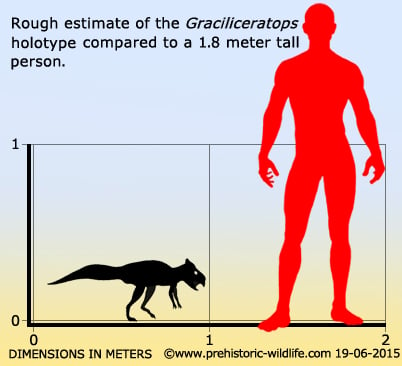
The type specimen was originally assigned to the genus Microceratops (now a synonym to Microceratus), Graciliceratops seems to have been a small and lightly built ceratopsian dinosaur. Graciliceratops seems to have been more comfortable in a bipedal posture, but already it is clear that Graciliceratops would have been easily able to adopt a quadrupedal posture when browsing upon low growing vegetation. The mouth of Graciliceratops had already formed a shearing beak which would have been capable of shearing off parts of plants.
Further Reading
- The fossil record, systematics and evolution of pachycephalosaurs and ceratopsians from Asia - P. C. Sereno - In The Age of Dinosaurs in Russia and Mongolia. by M. J. Benton, M. A. Shishkin, D. M. Unwin & E. N. Kurochkin (eds) - 2000.